

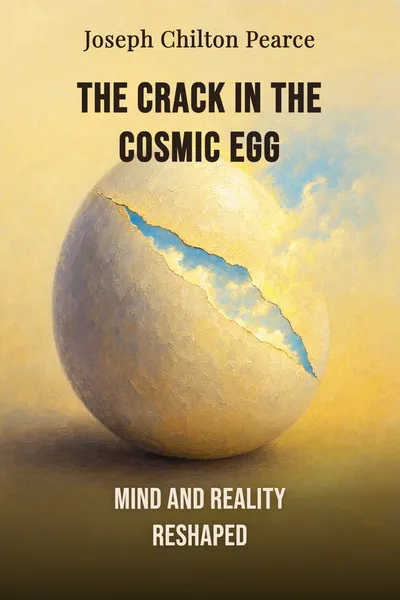
The Crack in the Cosmic Egg
Mind and reality reshaped
Description
In 1971, a college teacher of humanities named Joseph Chilton Pearce published a slim, strange book with a title that sounded like it belonged on a poster in a dorm room. The Crack in the Cosmic Egg arrived without academic credentials attached, without a laboratory behind it, and without much interest in staying inside the lines of any single discipline. Pearce was not a neuroscientist or a physicist. He was a reader — of William Blake, of Carlos Castaneda, of anthropology and myth and reports of impossible things — and he had spent years turning over a single unfashionable question. What if the mind does not simply perceive the world, but helps assemble it?
The book found its people fast. It circulated through the counterculture, got passed hand to hand, and became one of those titles a certain kind of curious reader keeps mentioning decades later. Its appeal was not that it proved anything in the way a lab proves things. Its appeal was that it took seriously a suspicion many people already carried privately: that reality feels less fixed than the textbooks insist, that belief seems to bend outcomes, that the line between what is inside our heads and what is out there in the world is drawn in pencil, not ink.
Pearce built his argument from an image. He imagined our shared picture of reality as an egg — a whole, sealed structure of assumptions we are born into and rarely notice, because it is the very thing we see through. His question was what happens when that shell cracks, when a person steps outside the agreed-upon picture and the world, improbably, goes along with them. That is the territory the book stakes out, and it does so with more nerve than caution.
The question we’re asking : If the mind takes part in assembling reality, where exactly does the boundary between the two lie?What we’ll see : How Pearce turns an old metaphysical hunch into a working picture of mind, belief, and a world that sometimes answers back.
Table of contents
01Chapter 1 — A book that reads the mind as a builder
The starting move of the book is quiet but total. Most of us assume a clean division of labor: the world exists out there, complete and indifferent, and the mind sits inside, taking pictures of it. Perception, on this view, is a kind of passive reception, like a camera pointed at a landscape that would look the same whether or not anyone was looking. Pearce refuses this. He argues that the mind is not a camera but a participant — that what we call reality is partly a construction the mind takes part in building, moment by moment, out of expectation, culture, and belief.
He borrows from anywhere that helps him. Developmental observation about how children learn to see, anthropology about cultures that experience the world on terms alien to ours, the poetry of Blake with its insistence that imagination is a form of perception rather than an escape from it. Pearce is not fussy about where an idea comes from; what interests him is whether it points toward the same conclusion. And again and again, his sources point toward a mind that is doing more work than we credit it with.

02Chapter 2 — The cosmic egg and its crack
The book's governing image is the cosmic egg. Picture the entire structure of what a culture holds to be real — its facts, its physical laws as commonly understood, its sense of what can and cannot happen — as a single vast shell surrounding us. We live inside it from birth. We do not experience it as a shell, because we have never been outside; it is simply what we call the world. The egg is not a lie, exactly. It is a shared, largely functional agreement about reality, and most of the time it holds up well enough that questioning it never occurs to anyone.
The crack is what happens when someone slips through. Pearce is interested in the individuals and moments that break the seal: mystics, certain children, people under extreme conviction, cultures whose egg is shaped so differently that its members walk on fire or heal wounds that our egg says cannot heal that way. A crack, in his telling, is not a hole in a wall behind which the real real waits. It is a point where one construction of reality gives way and another becomes briefly available — and where the world, startlingly, cooperates with the new construction.
03Chapter 3 — Fire-walkers, healers, and the outer edge of belief
To make the abstract argument bite, Pearce reaches for cases at the edge of the believable. Fire-walking is a favorite: the documented practice, across several cultures, of people passing barefoot over beds of glowing coals without the burns that ordinary physics would predict. He is drawn to reports of religious healing, of anesthesia achieved through conviction alone, of individuals who seem to reorganize their own bodies through a state of belief so complete it leaves no room for the doubt that would ordinarily intrude. These are exactly the phenomena a careful skeptic files under trickery or exaggeration, and Pearce knows it.
His interest, though, is not in proving each case airtight. It is in what the cases have in common when you set them side by side. In each, an outcome the standard egg rules out actually occurs, and in each, the person achieving it appears to be operating from a whole, unified certainty rather than from hope or effort. The healer does not try to believe. The fire-walker is not gritting through fear. There is, in Pearce's reading, an absence of internal argument — the mind is not divided against itself, and in that undivided state the boundary with the physical world seems to soften.
04Chapter 4 — When the world answers back
Step back from the fire-walkers and the sorcerers, and Pearce's real claim comes into focus, larger and more disturbing than any single anecdote. The book is not fundamentally about miracles. It is about a boundary — the one between self and world — that modern culture treats as a hard wall and that Pearce treats as a membrane. His deepest suggestion is that reality, at least the reality we live in, is relational: it is not simply given to us, nor simply invented by us, but negotiated in the space where mind meets world. What we call the objective world is, on this reading, a conversation whose terms we help set.
This is why the book landed the way it did on a generation. It gave language to a feeling that the tidy separation of observer and observed did not quite match lived experience — that expectation shapes outcome, that despair and conviction seem to reach past the skull and touch events, that two people can stand in the same room and inhabit measurably different worlds. Pearce was not offering a technique for bending spoons. He was offering a reframe of the whole situation, one that made the mind a stakeholder in reality rather than a spectator of it.
05Conclusion
Pearce began with an egg and a crack, and he ends more or less where he started — with the shell intact but no longer opaque. He never claims to have shattered it, never hands over a method for walking through walls. What he does is stranger and more durable: he shows the shell to be a shell, a shared construction we mistake for the fixed edge of the possible. The reports of impossible things are not the point in themselves. They are the pressure that reveals the material, the moments when the world briefly answers to a mind that has stopped enforcing the usual limits.