
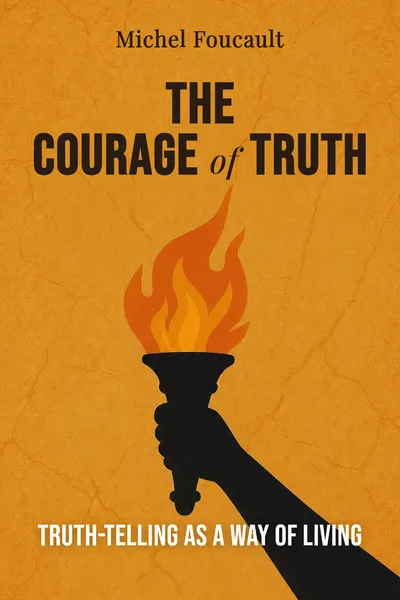
The Courage of Truth
Truth-telling as a way of living
Description
In the early months of 1984, a visibly ill Michel Foucault climbed the steps of the Collège de France to deliver what would be his final lectures. He was in the last stretch of a long inquiry into how we became creatures who tell the truth about ourselves, and the room was packed the way it always was — recorders held up, students on the floor. He would die that June. These sessions, gathered afterward under the title The Courage of Truth, read now like a thinker circling one idea he couldn't quite let go of before the end.
That idea has an old Greek name: parrhesia. It means something like frank speech, or truth-telling, but neither phrase catches it. Parrhesia isn't about stating a correct fact. It's about saying a dangerous thing to someone who has the power to punish you for it — the courtier telling the tyrant he is wrong, the philosopher telling the assembly what it doesn't want to hear. The truth here is measured not by whether it's accurate but by what the speaker is willing to risk in saying it.
Foucault spends these lectures tracing that risk across ancient thought, and then lands somewhere unexpected: on the Cynics, the barefoot provocateurs who didn't argue for the truth so much as live it out loud, scandalously, with their own bodies. What he finds there reorganizes the whole picture of where philosophy came from — and quietly asks what we gave up when we decided truth was something you demonstrate rather than something you dare.
The question we’re asking : What did the ancients mean by parrhesia, and why did Foucault, at the end of his life, treat truth-telling as a matter of courage rather than correctness?What we’ll see : How a single Greek word led Foucault back to a forgotten idea — that the truest thing about a truth might be what it costs the person who says it.
Table of contents
01 Chapter 1 — The last course, and a word that wouldn't translate
Foucault had been running the same seam for years. His late work turned away from the machinery of power and prisons that had made him famous, toward something quieter: the ways people are taught to work on themselves, to shape a self worth having. By 1984 that inquiry had a keyword, parrhesia, which he had already picked at the previous year. The final lectures pick it up again and refuse to put it down.
The word is stubborn. Translators reach for frankness, free speech, saying-everything, but each version leaks. Parrhesia isn't a right you exercise; it's a scene you enter. There's someone speaking, someone with power to lose from what's said, and a gap between them that the truth has to cross at the speaker's expense. Foucault keeps insisting on this asymmetry. The parrhesiast is always the one with less standing, telling the one with more that something is wrong.

02 Chapter 2 — Speaking truth when it costs something
To feel the weight of parrhesia, Foucault keeps returning to concrete scenes rather than definitions. The model case is the philosopher who tells a ruler the truth to his face. Plato traveling to Sicily to advise the tyrant Dionysius, knowing the trip could end badly, is the kind of episode that fascinates him. The philosopher does not flatter, does not calculate the safe thing to say. He speaks, and accepts whatever comes of it. The truth is proven, in a sense, by his willingness to stand behind it in a room where it is unwelcome.
There is a structure here that Foucault names carefully. Parrhesia requires a bond between speaker and listener — the speaker cares enough about the other, or about the shared world, to take the risk. It is not aggression. The frank speaker isn't insulting the powerful for sport; he's staking himself on the belief that this person can still hear something true and be changed by it. The risk and the care travel together. Remove the care and it's provocation; remove the risk and it's counsel from a safe distance.
03 Chapter 3 — Diogenes, and truth turned into a life
This is where Foucault makes his most surprising move. He turns to the Cynics, and to Diogenes above all — the philosopher who lived in a large ceramic jar, owned almost nothing, urinated and masturbated in public, and told Alexander the Great, when the conqueror offered him anything he wished, to step aside because he was blocking the sun. The stories are usually filed under eccentricity. Foucault reads them as the sharpest form parrhesia ever took.
The Cynics didn't argue for their doctrines the way other schools did. They enacted them. Where a Stoic might write a treatise on living according to nature, Diogenes simply stripped his life down until nothing artificial remained, and let the spectacle of that life do the arguing. His body became the proof. This is truth not as a proposition to be defended but as a mode of existence to be displayed — what Foucault calls the true life, la vraie vie, lived so bluntly that it exposes everyone else's compromises.
04 Chapter 4 — The two families of the true
Step back from the parade of philosophers and a larger claim comes into focus, the one these final lectures were quietly building toward. Foucault is proposing that Western thought carries two different relationships to truth, braided together and often confused. One is the truth of the proposition — the statement that can be verified, demonstrated, proven correct independent of who utters it. The other is the truth of the truth-teller — the truth that requires a certain kind of person, living a certain kind of life, to be spoken at all. Parrhesia belongs entirely to the second family.
His suggestion is that we inherited mostly the first and largely forgot the second. Somewhere along the way, the question who has earned the right to say this? got absorbed into the question is this statement true? — and once truth became something a proposition could hold on its own, the speaker dropped out. It no longer mattered morally who said a true thing, or what it cost them, or whether their life contradicted their words. Truth became detachable from character. That detachment is enormously powerful — it's the basis of science, of law, of any claim that must hold regardless of who makes it — but Foucault wants us to notice it was a choice, and that something went quiet when we made it.
05 Conclusion
Foucault gave the final lecture of The Courage of Truth in late March 1984 and died a few months later, on June 25, at fifty-seven. The course was never revised into a book by his own hand; it reached us from the recordings and the notes, transcribed by others — which gives it, fittingly, the texture of speech rather than doctrine, a voice caught in the act of thinking. He ended not on a system but on a set of figures who had made their lives into arguments, and on a word that still refuses to sit still in translation.
Related books











