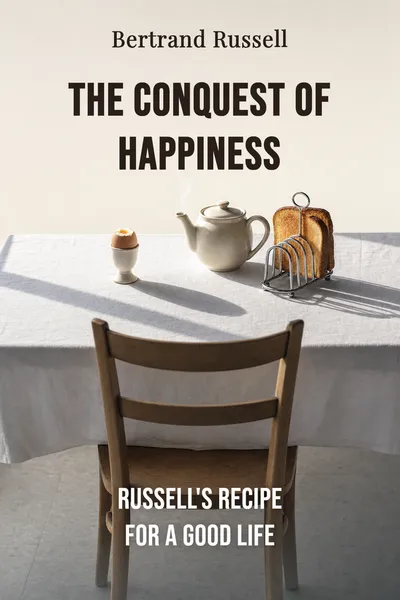
The Conquest of Happiness
Russell's recipe for a good life
Description
In 1930, a fifty-eight-year-old British philosopher who had already been jailed for pacifism, divorced twice, and stripped of a Cambridge lectureship sat down to write a book about being happy. Bertrand Russell was not, on paper, the obvious author. He had spent decades on the coldest questions in logic and mathematics, and he had watched a war swallow a generation of the men he taught. Yet the book he produced, The Conquest of Happiness, is warm, practical, and almost startlingly direct — less a treatise than the counsel of someone who has looked hard at his own misery and worked out, more or less, how to get around it.
The puzzle he set himself was the one that still nags at us. By 1930, large parts of the West were safer and richer than any society in history. Famine had receded, medicine had advanced, comfort was spreading. And still people were unhappy — not the unhappiness of hunger or war, but a duller, harder-to-name discontent that seemed to arrive precisely when the external reasons for suffering fell away. Russell wanted to know why a well-fed, well-housed, healthy person could wake up each morning with a sense that nothing was quite worth doing.
His answer refuses the usual comforts. He offers no religion, no cosmic reassurance, no five-step morning routine. He treats unhappiness the way an engineer treats a stalled machine: as something with causes that can be found and, often, removed. Nearly a century on, philosopher Daniel Dennett has reintroduced the book to new readers, and the strange thing is how little of it has dated.
The question we’re asking : Why do people in safe, prosperous societies stay unhappy — and what, if anything, can a person actually do about it?What we’ll see : How Russell diagnoses the modern malaise, why he distrusts the pleasures we reach for, and the outward-looking life he prescribes in their place.
Table of contents
01 Chapter 1 — The malaise that survived the good life
Russell opens not with theory but with a confession. As a child, he tells us, he hated life so much that he was on the verge of suicide, held back mainly by a wish to learn more mathematics. As an adult he grew steadily happier — and he insists this was not luck but the result of things he learned to do and stopped doing. The book is built on that claim: that happiness, for most people, is not handed out by fate but assembled, deliberately, over time. It is a conquest, not a gift.
The unhappiness he wants to explain is a specific kind. He is not writing about the person crushed by poverty, illness, or grief, where the cause is plain and the cure external. He is writing about the person who has, by any reasonable measure, enough — food, safety, work, company — and who is nonetheless flattened by a discontent they cannot quite locate. This, he argues, is the characteristic suffering of a prosperous society, and it is more common precisely because the older, cruder sources of misery have been reduced.

02 Chapter 2 — Turning inward, and getting stuck there
The heart of Russell's diagnosis is the self-absorbed person, and he sketches three versions with a novelist's eye. First the sinner: the one haunted by guilt, convinced of their own wickedness, forever measuring themselves against an ideal instilled in childhood by a stern mother or nurse. Their misery is not caused by anything they have done but by a running commentary of self-reproach that no achievement can silence. Second the narcissist, who craves admiration and organizes life around being seen to be impressive — and who, because they are interested chiefly in themselves, ends up dull, since a person interested only in their own qualities has very little to be interested in.
Third the megalomaniac, driven by the wish for power rather than charm, who can never have enough because the appetite grows with feeding. All three, Russell notes, are turned so far inward that the world outside barely reaches them. The sinner cannot enjoy a meal for thinking of their unworthiness; the narcissist cannot enjoy a friendship except as a mirror; the power-seeker cannot enjoy a success except as a step toward the next one.
03 Chapter 3 — Zest, affection, and the work that holds
Having spent the first half of the book on what makes us unhappy, Russell turns to what makes us happy — and his central word is zest. The happy person, he argues, is the one with a genuine appetite for the world: for food, for people, for facts, for whatever crosses their path. He compares people to diners at a buffet. One eats greedily and enjoys everything; another picks joylessly, suspicious that pleasure is somehow unearned. The difference is not in the food but in the appetite brought to it, and appetite, he insists, is something that outward interests keep alive.
This is his key distinction: the happy life is one turned outward. The more things a person cares about beyond themselves — a hobby, a science, a cause, the fortunes of a football club, the growth of a garden — the more footholds they have when any one of them gives way. A person whose happiness rests entirely on their career is ruined by a bad year; a person who also loves geology or birdsong or their children has somewhere else for their attention to rest. Interests outside the self are not decoration, in Russell's account. They are the structure that keeps a life standing.
04 Chapter 4 — A morality without guilt
Step back from the individual remedies and Russell is making one large claim: that happiness is not a moral reward but a skill, and that the traditional morality of guilt actively gets in the way. For centuries, Western culture treated happiness with suspicion — as frivolous, as selfish, as something to be earned through suffering or deferred to an afterlife. Russell, a lifelong atheist writing in the shadow of that inheritance, wants to dismantle it. He argues that the sense of sin, far from making people good, mostly makes them miserable and self-obsessed, and that a person freed from it is not more selfish but less, because they finally have attention to spare for others.
This is why the book reads less like self-help than like applied philosophy. Russell approaches happiness with the same rationalist temper he brought to logic: identify the causes, test them against experience, discard what does not work. He does not ask you to believe anything or to feel guilty for failing. He asks you to notice, honestly, where your attention goes and what it costs you. The prescription — cultivate interests outside yourself, resist passive pleasure, love generously, work at something real — follows from the diagnosis the way a treatment follows from a correct account of a disease.
05 Conclusion
The book ends where the man began: with someone who once wanted to die learning, over a long life, how to want to live. Russell's happy person is not the one who has been spared trouble, but the one whose interests reach so far beyond their own ego that no single wound can take everything down. They eat at the buffet with appetite. They love without keeping score. They work at something that outlasts the day. Their happiness is not a mood that visits them but a structure they have built, plank by plank, out of attention aimed outward.
Related books