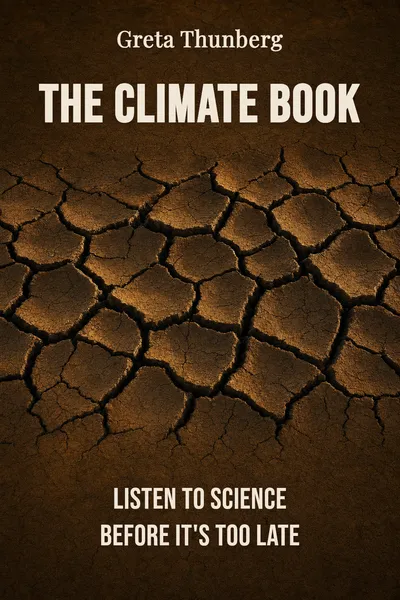
The Climate Book
Listen to science before it's too late
Description
In 2022, Greta Thunberg did something unusual for someone who had spent four years being treated as a single, amplified voice: she stepped aside. The Climate Book, which she assembled and edited, hands the microphone to more than a hundred people — climate scientists, geophysicists, oceanographers, economists, historians, Indigenous leaders, doctors, and writers. Her own contributions are stitched between theirs, short and pointed, less lecture than connective tissue. The result is a strange kind of book, closer to an anthology than a manifesto, built on a bet that no one person can hold the whole picture, and that the picture is exactly what has gone missing.
The bet matters because the climate story most of us carry is a story of fragments. A heatwave here, a flooded town there, a target announced at a summit that few of us can name. Each piece arrives on its own, gets absorbed, and fades. What The Climate Book tries to do is put the fragments back into one continuous line — from how the carbon cycle actually works to why the pledges keep missing, from melting permafrost to the wildly uneven way the damage falls across the planet. Assembled in one place, the line reads differently than the pieces did apart.
The subtitle of Thunberg's project is unglamorous and deliberate: listen to the science before it's too late. It sounds like something we already agree with, which is part of why the book keeps returning to a harder question — what would it mean to actually do it, at a scale and speed the modern world has never attempted, and why, decades in, we still mostly haven't.
The question we’re asking : What does it change to read the climate crisis as one continuous story, told by the people who study it, rather than as scattered headlines?What we’ll see : How the book is built, what its assembled facts add up to, why the emergency became background noise, and what taking the science seriously would actually demand.
Table of contents
01 Chapter 1 — A book that refuses to be one voice
The most telling decision in The Climate Book is structural. Thunberg had every incentive to write a solo book — she was, by 2022, one of the most recognizable people on the planet, and a single-author memoir would have sold on her name alone. Instead she built an anthology of more than a hundred contributions, organized into five parts that move from how the climate works, to how the planet is changing, to how it affects us, to what we've done about it, to what we must do now. Her own texts run through the collection as brief interventions, and they read less like a thesis than like a person insisting the specialists be heard in their own words.
The reasoning behind the choice is itself an argument. Thunberg has said repeatedly that she is not a scientist and has no wish to be treated as an oracle; her role, as she frames it, is to point at the people who do the work. So the book gives space to figures like the geophysicist working on ice sheets, the economist tracking the true cost of fossil fuels, the historian tracing how the crisis was known and buried, the physician describing what heat does to a body. The point of assembling them is that the crisis is genuinely too large for any single discipline to see whole.

02 Chapter 2 — The numbers the summaries leave out
Read in sequence, the science section of the book is designed to correct a specific distortion. Most of us have absorbed climate change as a matter of a single number — a degree and a half, two degrees — treated almost as a speed limit we might edge past without much happening. The contributors dismantle that reassurance. Warming is not linear in its consequences, and the difference between 1.5 and 2 degrees is not a small step but, for many regions and species, the difference between difficulty and collapse. The book insists on the physics that the round targets tend to hide.
It also insists on the parts of the system that don't wait for us. Several contributors dwell on feedback loops and tipping points — melting Arctic permafrost releasing methane, ice loss reducing the planet's reflectivity, forests shifting from absorbing carbon to emitting it. These are processes that, once triggered, continue regardless of what we do afterward. The framing matters because it undercuts the comforting idea that we can always course-correct later. Some doors, the science says, close behind us.
03 Chapter 3 — Why the crisis was allowed to become normal
If the science has been clear for decades, the obvious question is why so little has changed, and the book's fourth part is largely an attempt to answer it. The short version its contributors offer is that the failure was not one of knowledge but of will, and that the gap between the two was actively engineered. The basic facts of warming were understood by scientists and, crucially, by fossil fuel companies well before the public debate began. What followed was not confusion but the manufacture of doubt.
The historians and journalists in the collection trace how that doubt was produced: industry-funded campaigns that borrowed tactics from the tobacco fight, think tanks that reframed a settled question as an open controversy, and a media habit of staging false balance between the overwhelming evidence and a paid minority. The effect was to convert an emergency into a debate, and a debate into background noise. Every year the story stayed contested was a year nothing had to be done.
04 Chapter 4 — What listening to science actually asks of us
Step back from the individual chapters and the book's shape becomes its argument. By refusing to be a single voice, by binding physics to fairness and history to policy, The Climate Book is making a case that the climate crisis cannot be understood or solved as a narrowly technical problem. It is a crisis of honesty — about what we know and when we knew it — and a crisis of equity, about who pays and who profits. The instruction to listen to the science turns out to be far more demanding than swapping one energy source for another.
This is where the book's insistence on the whole picture pays off. If the harms fall hardest on those least responsible, then any response that ignores justice is not merely incomplete but a continuation of the same imbalance. If the delay was manufactured, then trusting the next round of comfortable pledges is a mistake we have already made. Listening to science, in the book's framing, means acting on the full implications of the evidence, including the uncomfortable political and economic ones, rather than accepting the parts that require nothing of us.
05 Conclusion
By stepping aside and handing the book to the people who study the planet, Thunberg made her point without having to argue it: the story was never hers to tell alone, and it was never as fragmented as the headlines made it feel. Read straight through, the carbon budget, the tipping points, the manufactured doubt, and the uneven harm stop being separate topics and become one continuous account of a crisis we understand and keep deferring. The book's quiet achievement is simply to hold all of it in view at once.
Related books