The Cheese and the Worms
One miller's cosmology on trial
Description
Sometime in 1583, in the hill town of Montereale in the Friuli region of northeastern Italy, a miller named Domenico Scandella — everyone called him Menocchio — was denounced to the Inquisition for saying strange things. He was roughly fifty-two, could read and write, had held minor village offices, and had a habit of arguing about God with anyone who would listen. The things he said were, by the standards of the time, spectacular. God, he claimed, was not the beginning of everything. In the beginning there was chaos, and out of that chaos the world formed the way a cheese forms out of milk — and from that cheese, worms appeared, and those worms were the angels.
The inquisitors were baffled and then alarmed. Here was an unremarkable man from a small village who had somehow assembled an entire cosmology, one that borrowed the vocabulary of the Church while emptying it of everything the Church meant. He talked freely, almost eagerly, correcting the judges, insisting on his readings, naming the books he had gotten his hands on. Two trials, fourteen years apart, generated a thick file of interrogations. In 1599, on orders that came from Rome, Menocchio was burned at the stake.
Four centuries later the Italian historian Carlo Ginzburg pulled that file from the archive and did something unusual with it. Instead of treating Menocchio as a curiosity or a madman, he took the miller's words seriously as evidence — evidence of a whole layer of belief that rarely leaves a written trace, the mental world of people who did not write books and were not supposed to have ideas of their own.
The question we’re asking : What can the words of one obscure miller, recorded by the men who condemned him, tell us about the beliefs of people history almost never lets speak?What we’ll see : How Ginzburg reconstructs a peasant cosmology from a hostile trial record, and what he wagers on a single life.
Table of contents
01 Chapter 1 — A miller who wouldn't stop talking
Menocchio was not a hermit or a crank hiding in the woods. He was woven into village life: he milled grain, he had a family, he had served as mayor of his little community and administered a local church. People knew him, and many of them had heard him hold forth. That was the problem. In a world where dangerous opinions were meant to be whispered, Menocchio said his out loud, in the square, at the tavern, to the priest, to travelers passing through. When the denunciation finally reached the Holy Office, half the town seemed to have a story about something he had said.
What strikes anyone reading the trial is how much he wanted to talk. Most defendants before the Inquisition retreated into silence, denial, or the minimum necessary confession. Menocchio did the opposite. He lectured his judges. He wanted them to understand his system, to follow his reasoning, to grant that he had thought it all through. He seems to have believed, with a kind of stubborn confidence, that if he could just explain himself properly, they would see he was right — or at least that he was sincere.

02 Chapter 2 — The cheese, the worms, the angels
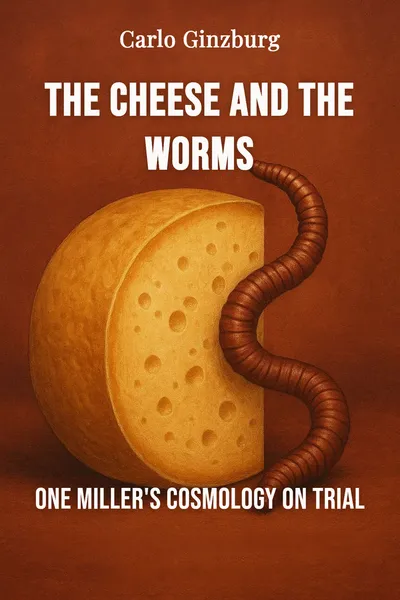
At the center of the file sits the image that gives Ginzburg his title. Asked about the creation of the world, Menocchio explained that everything had once been chaos — earth, air, water, and fire all mixed together. This mass gradually thickened and took shape, he said, just as cheese is made out of milk. And as worms appear in aging cheese, so out of this coagulating mass appeared living creatures, which were the angels. Among them, by the will of God, was one who became God himself. God, in other words, was not before the world; he emerged from it.
The consequences ripple outward. If God was produced along with the angels out of primordial matter, then he is not the sovereign creator of Christian doctrine. The whole hierarchy tilts. Menocchio pushed further: he doubted that Christ was divine, questioned the virgin birth, dismissed much of scripture as human invention, and denounced the Church as a machine that fed off the poor. Sacraments he regarded as inventions of priests, useful for keeping people in line and taking their money.
03 Chapter 3 — Where a peasant found such ideas
The obvious question is where a village miller got any of this. Menocchio was literate, and he named his sources: a handful of books he had read or had read to him. There was a vernacular Bible, a collection of saints' lives, an Italian version of the travels attributed to Sir John Mandeville, a chronicle of world history, a book of legends, and, very likely, an Italian rendering of the Qur'an. These were not radical texts. They were the ordinary reading matter that had begun to circulate more widely with the printing press.
This is the heart of Ginzburg's argument. Menocchio did not simply absorb these books; he ran them through a filter that was already in his head before he opened them. He read the way you would expect a man to read who arrived at the page carrying an entire oral tradition — a peasant common sense about matter, generation, decay, and fairness. When a printed line brushed against that inherited framework, it lit up; when it did not, he ignored or twisted it. The cheese and the worms are not in any of his books. They come from somewhere older, from a lived, agrarian intuition that the world grows and rots and breeds like everything a farmer watches.
04 Chapter 4 — Reading the archive against the grain
Here the case opens onto a larger problem that runs underneath the whole book: how do we know anything about people who left no writings of their own? The beliefs of peasants, artisans, the vast unlettered majority, survive almost only in documents produced by their superiors — tax rolls, sermons, and above all trial records, in which the powerful describe the powerless in order to correct or punish them. The voice we hear is filtered twice: through the questions the inquisitors chose to ask, and through the notary who wrote it down. Menocchio speaks to us across four centuries, but he speaks in a room controlled by the men who will kill him.
Ginzburg's response is to read the record against the grain. The inquisitors wanted confessions that fit their categories — Lutheran heresy, learned unbelief. When Menocchio's answers refuse to fit, when they surprise or confuse the judges, that friction is precisely where something authentic leaks through. The distortions of the source become, paradoxically, its most valuable feature: where the trial fails to reduce the miller to a known type, we glimpse the actual shape of his mind.
05 Conclusion
Menocchio was burned around 1599, after a second trial and an order that came from the highest levels of the Church. By then he was an old man who had spent years in prison, been released, and gone back to saying the same things. His stubbornness reads, at this distance, less like defiance than like a man who genuinely could not see why his picture of the world should be forbidden. The file that condemned him is the only reason we know he existed at all.
Related books