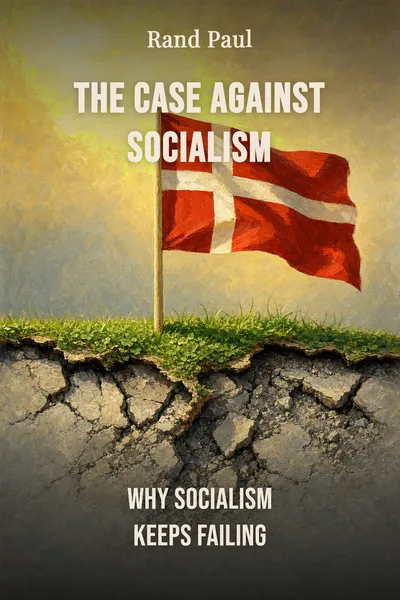
The Case Against Socialism
Why socialism keeps failing
Description
In 2018, a Gallup poll landed on a desk in Washington that Rand Paul would return to again and again. For the first time in the survey's history, a majority of Americans between eighteen and twenty-nine held a more favorable view of socialism than of capitalism. Not a fringe. A majority. Around the same time, self-described socialists were winning primaries, Bernie Sanders was filling arenas, and "democratic socialism" had migrated from seminar rooms to campaign slogans. To a libertarian senator from Kentucky, this looked less like a policy debate and more like a warning light.
Paul's response was a book, published in 2019, with a title that leaves no ambiguity about where he stands: The Case Against Socialism. Its argument is built on a single insistence — that socialism is not an untested good idea waiting for the right people to run it, but a tested one, and the results are on the record. Stalin's gulags, Mao's famines, the collapsing hospitals of Caracas: for Paul, these are not deviations from socialism but its recurring destinations. The book reads history as a prosecutor reads a rap sheet.
What makes the book more than a list of atrocities is the second half of its worry. Paul is convinced the ideology is staging a comeback not despite its record but because the record has been forgotten — repackaged on college campuses as compassion, and sold as the ordinary decency of Scandinavia. The book sets out to break both stories at once.
The question we’re asking : On what grounds does Rand Paul argue that socialism is not merely inefficient but dangerous — and that its American revival rests on a misreading of both history and present-day Europe?What we’ll see : A prosecutor's tour through what socialism has actually produced, why the Scandinavian counter-example doesn't hold, and where Paul locates the real engine of its return.
Table of contents
01Chapter 1 — The body count nobody wants to claim
Paul opens where the defenders of socialism prefer not to linger: the twentieth century. His method is blunt and deliberate. He wants the reader to sit with numbers that are usually kept at a polite distance from the word socialism. The Soviet gulag system, into which millions were fed under Stalin. The Ukrainian famine of the early 1930s, the Holodomor, which killed something in the range of several million people while grain was exported. Mao's Great Leap Forward, whose famine of 1958 to 1962 is estimated by historians to have cost tens of millions of lives. Cambodia under the Khmer Rouge, where roughly a quarter of the population died. Paul stacks these not as isolated tragedies but as a pattern.
The point he presses is about causation, not coincidence. The standard rebuttal — that these were dictatorships, not real socialism — is precisely the argument Paul refuses to grant. His claim is that the machinery of a fully planned economy requires a machinery of coercion to match it. If the state is to abolish private property, decide what gets produced, and distribute the results, someone has to enforce those decisions against everyone who would rather choose differently. The gun, in Paul's telling, is not a corruption of the system. It is the system's precondition.

02Chapter 2 — The Scandinavia that isn't socialist
The most common answer to Paul's rap sheet is a change of subject. Nobody wants Venezuela, the reply goes; we want Denmark, Sweden, Norway — prosperous, humane, unmistakably not gulag states. Paul devotes a substantial part of the book to arguing that this defense rests on a category error, and he leans on an unexpected witness to make it. In 2015, Denmark's prime minister Lars Løkke Rasmussen stood at Harvard and asked, in effect, to be left out of the American argument: Denmark, he said, is a market economy, not a planned or socialist one.
Paul builds the point out from there. The Scandinavian countries have private property, open markets, free trade, and some of the least regulated business environments in the world. What they also have is high taxation funding generous welfare — but that, Paul insists, is a different thing from socialism as historically defined. Socialism means state ownership of the means of production. A country where private firms compete freely and are then taxed heavily to fund public services is a large welfare state sitting on top of a capitalist engine. Confusing the two, he argues, is how the word gets laundered.
03Chapter 3 — The professor problem
Having argued that socialism fails wherever it is tried, Paul turns to a puzzle of his own making: if the record is this clear, why is the idea more popular among young Americans than at any point in living memory? His answer locates the engine on the college campus. The revival, in his reading, is not economic but cultural — manufactured in classrooms where socialism is taught as an ideal and its history is quietly left off the syllabus.
Paul's charge is that the academy presents socialism in its abstract, aspirational form — equality, fairness, solidarity — while treating the twentieth century as a series of unfortunate accidents unconnected to the theory. Marx is assigned; the Holodomor is optional. A generation graduates fluent in the vocabulary of redistribution and largely innocent of what redistribution required when it was actually attempted. He sees this as an ideological monoculture, a campus climate where the case against is rarely made and rarely heard, so that the young inherit the promise without the price tag.
04Chapter 4 — The argument underneath the argument
Read to the end, The Case Against Socialism is only nominally a book about economics. Its deeper subject is power — who holds it, how much of life it reaches, and what happens when a single authority is handed the job of arranging everyone else's affairs. This is where Paul writes most clearly as a libertarian rather than merely a conservative. For him, the decisive question about any system is not whether its intentions are kind but how much coercion it requires to function, and socialism fails that test by design.
The through-line of the whole book is that concentrated economic control and concentrated political control cannot be separated. Once a government owns the farms, the factories, and the shops, it owns the livelihoods of everyone who works them, and dissent becomes not just risky but materially impossible — you cannot quit a boss who is also the state. Paul's reading of the gulag and the famine is that they were not betrayals of a good plan but the plan's enforcement arm. Total control of the economy, he argues, is total control, full stop.
05Conclusion
The book ends where it began, with that Gallup number and the young Americans behind it. Paul's wager is that they are not malicious but uninformed — that they have been offered socialism's promise with none of its receipts. His response is to lay the receipts on the table: the gulags and famines as the system's logic rather than its accidents, Venezuela as the argument playing out in the present tense, and Scandinavia removed from the defense as a capitalist welfare state that was never socialist at all.
Related books