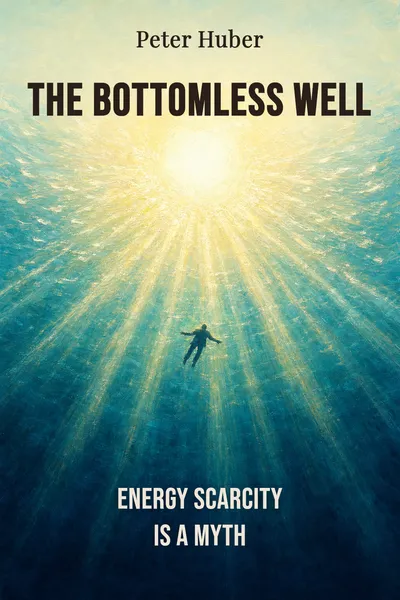
The Bottomless Well
Energy scarcity is a myth
Description
In 2005, a lawyer-turned-engineer named Peter Huber and the physicist Mark Mills published a book with a title that sounded like a taunt: The Bottomless Well. The subtitle promised to explain "the surprising origins of energy, why we never run out of it, and why we should never worry about its supply." This was, and still is, close to heresy. We have spent decades being told the opposite — that oil is running out, that we consume too much, that efficiency is how we save ourselves. Huber and Mills took every line of that catechism and turned it over to look at the underside.
Their claim is bracing in its simplicity. Energy, they argue, is not scarce and never has been. The Earth is drenched in it; the sun alone delivers more in an hour than humanity uses in a year. What is scarce is our ability to order raw energy into useful forms — into light, motion, refrigeration, computation. And that ability has done nothing but grow. Every worry about "running out" mistakes a temporary limit of engineering for a limit of nature. The two, in Huber's telling, are almost never the same thing.
The book is a contrarian's tour through coal, oil, electricity, the engine, and the microchip, written by two men who clearly enjoy poking the received wisdom of their moment. Some of it has aged sharply; some of it has aged well. Either way it forces a question most of us have never actually stopped to ask, because the answer felt too obvious to check.
The question we’re asking : If the Earth is soaked in energy, why do we keep insisting we are about to run out of it?What we’ll see : How Huber and Mills rebuild the idea of energy from the ground up, and land on a conclusion that still divides the room.
Table of contents
01 Chapter 1 — The seven things everyone gets wrong about energy
Huber opens by lining up the conventional wisdom and knocking it down, one belief at a time. The book's spine is a set of what the authors call the great energy myths — the intuitions almost everyone shares and almost no one examines. We run out of energy. Efficiency lowers consumption. Cheaper energy means we burn less. Renewable is the same thing as clean. The order of these claims matters, because Huber wants to show they lean on each other, and that pulling one out topples the rest.
Take the first and most emotional one: scarcity. We picture energy as a tank that drains. Huber's counter is that we have never actually measured the world's energy and found a floor. What we measure is the cost and difficulty of extracting a particular fuel with a particular technology at a particular moment. When oil looked scarce in the 1970s, the shortage was political and technical, not geological. New tools kept finding new reserves, or made old ones usable, or made entirely different sources cheap enough to matter. The tank kept refilling because it was never really a tank.

02 Chapter 2 — Why we burn fuel to make waste — and why that's the point
The most counterintuitive idea in the book is that most of the energy we consume is, by design, thrown away — and that this waste is not a failure but the whole mechanism of progress. Huber and Mills reframe energy history as a long climb up a ladder of quality. What matters, they insist, is not how much raw energy we have but how ordered it is: how tightly concentrated, how precisely controllable, how easily converted into the exact form a task requires.
The engine of a power plant burns enormous quantities of coal or gas and dumps most of that heat straight into the sky. On paper, that looks like grotesque inefficiency. But the plant is not trying to conserve heat. It is trying to manufacture a small stream of something far more valuable: high-grade, on-demand electricity. We spend abundant low-quality energy to purchase scarce high-quality energy, and the trade is spectacularly worth it. The waste heat is the price of refinement, the way sawdust is the price of a finished plank.
03 Chapter 3 — The engines got smaller, cleaner, and hungrier all at once
If waste is the mechanism, then technology is the story of getting more order out of each unit of that waste. Huber and Mills track how the machines that convert fuel into work have become steadily smaller, cleaner, and — crucially — hungrier, all at the same time. Each new engine used its fuel more finely, and precisely because it used it so well, we built far more of them and asked far more of each.
Electricity is their favorite case. Roughly a fifth of the fuel a nation burns goes to making electric power, and the share keeps rising. Huber reads this not as a warning but as a trend line pointing up the quality ladder: we are converting cruder fuels into the cleanest, most versatile carrier we have. An electrified economy, in this view, is not the enemy of fossil fuels but their highest expression — coal and gas transmuted into something a computer or a train can actually use. The pollution debate, they argue, is largely a debate about the messy bottom of the process, which technology keeps cleaning up as it climbs.
04 Chapter 4 — What a bottomless well actually implies
Step back from the specific fights — nuclear versus solar, efficiency versus consumption — and a single move underlies all of them. Huber redefines what the word energy points to. In ordinary speech, energy means the stuff in the ground: the barrel, the seam, the reservoir. In Huber's book, energy means the order we manage to impose on that stuff. The oil is just matter. Energy is what we do with it. Once you accept that swap, the well cannot run dry, because the thing being drawn from it is not a substance but a capacity — and capacity compounds.
This is why the title is a provocation rather than a survey of oil fields. The bottomless well is not underground. It is the widening gap between the raw energy the universe hands us for free and the useful, ordered energy we know how to make from it. That gap has never stopped growing, because human ingenuity — the finding, refining, converting, controlling — is the actual resource. Fuels are interchangeable and replaceable; the ability to organize them is the thing that accumulates and never depletes.
05 Conclusion
Huber and Mills set out to overturn the most settled intuition we have about energy — that it is a finite thing we are steadily spending down — and replaced it with a picture in which the only real limit is our own inventiveness. Scarcity, in their account, is never geological; it is a temporary report on the state of our tools. Waste is not a leak but the price of refinement. Efficiency does not shrink demand; it feeds it. And the fuels we argue over are less important than the widening human ability to convert any of them into ordered, useful power.
Related books