

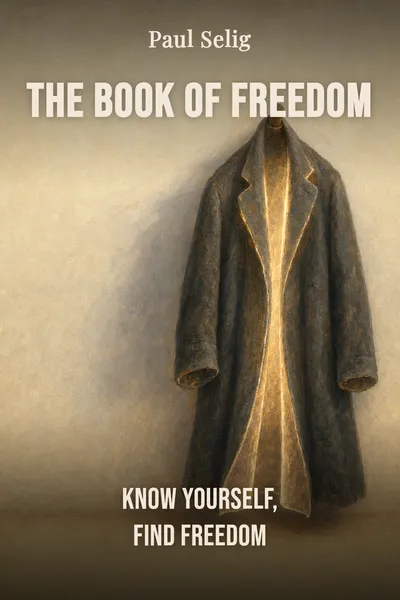
The Book of Freedom
Know yourself, find freedom
Description
Paul Selig writes his books with his eyes closed. A former journalist and academic who ran the graduate theater program at Goddard College, he describes himself as a channeler: he sits, enters a light meditative state, and dictates aloud the words of what he calls his Guides, while a transcriber or a recording captures them. The text arrives more or less as spoken, lightly edited. The Book of Freedom, published in 2015, is the third volume of what became known as the Mastery Trilogy, following I Am the Word and The Book of Mastery. It reads less like an argument than like a series of dictated teachings, addressed directly to whoever is holding it.
That is an unusual object to sit with, and it asks something unusual of a reader. There are no case studies, no five-step programs, no footnotes to lean on. Instead there is a single, insistent claim, turned over from many angles across three hundred pages: that freedom is not something we build or earn, but something we are, hidden under the layers of who we think we are. The Guides call the true self the Divine Self, and most of the book is spent describing what stands between us and the plain recognition of it.
It would be easy to file this under spiritual self-help and move on. But Selig's version resists the genre's usual promises. Nothing gets fixed here, nothing gets optimized, and the reader is not flattered. The book keeps insisting that the very self trying to get free is the one thing in the way. That knot — the seeker as the obstacle — is where the whole thing lives.
The question we’re asking : How can a book claim that knowing yourself is the same act as becoming free?What we’ll see : How a channeled text turns freedom into a matter of recognition, and why the self we work so hard to protect is the thing it asks us to see through.
Table of contents
01Chapter 1 — The channeled book, and what that even means
Before the ideas, there is the delivery, because with Selig the two can't quite be separated. He does not claim to be the author in the ordinary sense. He says the words come through him from a group of Guides, and he speaks them aloud, often to a live audience or into a recorder, entering what he describes as an altered but lucid state. The transcription becomes the book with minimal reshaping. This is why the prose repeats itself, circles back, and addresses the reader in the second person — it was spoken, not composed. The Guides frequently interrupt to comment on their own difficulty finding words, or to note that a passage is being received imperfectly.
For a skeptical reader this is the first hurdle, and the book more or less knows it. It doesn't argue for the reality of channeling; it simply proceeds as if the teaching matters more than its packaging. Selig himself, in interviews and in his introductions, tends to shrug at the metaphysics. He was, by his own account, as surprised as anyone when this started happening to him in the late 1980s, and he spent years unsure what to do with it before the books arrived.

02Chapter 2 — Freedom as recognition, not achievement
The central move of the book is to redefine freedom so completely that the usual questions fall away. We tend to think of freedom as the absence of constraint — money, options, no one telling us what to do. Selig's Guides mean something else entirely. Freedom, in their telling, is the state of knowing yourself as you actually are, beneath the personality and its history. It is not acquired. It is uncovered. You are already free; you simply don't know it, and the not-knowing functions exactly like a cage.
This is why the book leans so hard on the word know. The Guides distinguish sharply between believing something and knowing it. We can believe we are worthy, believe we are safe, believe we are divine, and remain completely unchanged, because belief sits on the surface. Knowing, in their sense, is a shift in identity — you stop reciting a claim about yourself and start operating as the thing itself. The book returns again and again to a phrase like "I know who I am," not as an affirmation to repeat but as a state to fall into.
03Chapter 3 — The problem with the self we defend
If freedom is recognition, then the great obstacle is the false self, and this is where the book does its hardest work. Selig's Guides describe a self built out of fear and defense — the accumulated identity of who we've decided we are, stitched together from wounds, comparisons, and the need to be safe. They sometimes call it the self that was made in fear. It is not evil, and the book is careful not to demonize it. It is simply a construction that mistook itself for the whole person, and now runs the show.
The trouble is that this defended self experiences any real freedom as a threat. It has organized a life around being right, being protected, being better or worse than others, and freedom dissolves all of that. So it resists, and it resists cleverly — often by adopting the language of growth itself. The Guides warn repeatedly against the seeker who turns liberation into another achievement, another way to be superior, another identity to defend. The spiritual ego, in other words, is just the old defended self wearing new clothes.
04Chapter 4 — When the world reflects what we know
Step back from the mechanics of the self and a larger wager comes into view, one that runs through Selig's whole trilogy. The Guides do not treat the world as a fixed stage on which we simply feel better or worse. They claim that reality itself responds to the level of knowing we operate from — that as we come to know ourselves differently, we begin to encounter a different world. This is the book's boldest and most contestable claim, and The Book of Freedom stakes itself on it rather than hiding it.
This is not framed as manifestation in the pop-spiritual sense, the ordering of a car or a promotion from the universe. The Guides are almost dismissive of that. What they describe is closer to a shift in perception so deep that it changes what is perceived: we meet others as who they truly are rather than as our defended self needs them to be, and in doing so we call something forward in them. Freedom, in this reading, is not private. Knowing who you are changes the field you move through, because you stop projecting the fearful self onto everything you see.
05Conclusion
The Book of Freedom ends where it began, with a voice speaking directly to whoever is listening, insisting that the freedom being described is not somewhere ahead but already present, waiting to be known. Selig closes his eyes, the Guides speak, and the teaching arrives as it always does — not as a conclusion reached but as a recognition offered. The book never resolves into a method you can carry away, because a method would belong to the very self it asks you to see through. What it leaves instead is a shift in where the question sits: not what must I do to be free, but who am I when I stop defending the one who isn't.