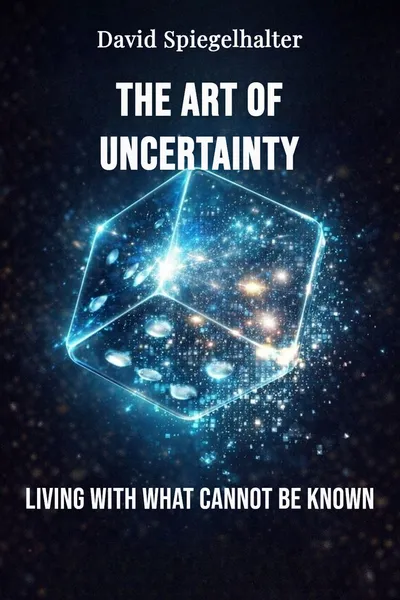
The Art of Uncertainty
Living with what cannot be known
Description
In March 2020, as the pandemic spread, a British statistician named David Spiegelhalter found himself on television more or less constantly, being asked the one question nobody could answer honestly: how many people would die? He had spent a career at Cambridge turning risk into something ordinary people could hold in their heads, and here was the ultimate test. The honest reply was some version of "we don't know yet, and here's the range, and here's why the range is wide." On air, that answer sounds like a dodge. In fact it was the most rigorous thing anyone could say.
That tension sits at the center of his book The Art of Uncertainty. Spiegelhalter is not a doom-monger and not a cheerleader for false precision. He is interested in a quieter, harder thing: how we live, decide and govern when the future genuinely cannot be known, and when even the numbers we cite about it are constructed, contestable, and shaped by whoever built them. A weather forecaster saying "70 percent chance of rain" is doing something surprisingly sophisticated — and most of us misread it.
His wager is that uncertainty is not a gap in knowledge waiting to be filled but a permanent feature of the world we can learn to handle with skill. Probability is less a fact about coins and dice than a tool for reasoning under ignorance — one we can wield well or badly. The stakes are not academic. They surface every time a doctor quotes a survival rate, a government models a crisis, or a headline turns a fragile estimate into a hard promise.
The question we’re asking : How do we reason, decide and speak honestly about a future that genuinely cannot be known?What we’ll see : How probability actually works, where its numbers come from, how they get twisted in the telling, and why owning uncertainty turns out to be a matter of trust.
Table of contents
01 Chapter 1 — The weather forecast that means nothing and everything
Start with the humble forecast. When an app says there's a 70 percent chance of rain tomorrow, what does that even mean? Tomorrow will either rain or it won't — there is no 70-percent-wet middle state. Spiegelhalter uses this everyday puzzle to open his central idea: probability is not a property of the event, it's a statement about our knowledge of the event. The 70 percent lives in the forecaster's head, not in the clouds. It's a considered degree of belief, calibrated against how often similar forecasts have come true.
That last part is what makes it more than a hunch. A good forecaster is one whose 70 percents rain about seventy times out of a hundred over the long run. This is "calibration," and it's a genuinely testable standard. We can grade a weather service without ever asking whether any single forecast was "right," because a single forecast was never a promise. It was an honest expression of confidence, and confidence can be measured for accuracy across many cases even when each case is a one-off.
02 Chapter 2 — Numbers don't fall from the sky
If the first move is understanding what a probability is, the second is asking where it came from — because the numbers we argue over are manufactured, not found. Spiegelhalter spends a good part of the book pulling back the curtain on how statistics get made, and it is less tidy than the confident figures on a slide suggest. Every risk estimate, every survival rate, every "1 in 10,000" rests on choices: what counted as a case, who got measured, which model was fitted, what got left out.
Take something as apparently solid as a death toll. During a crisis, do you count deaths where the disease was the main cause, or any death within a set window of a positive test, or the excess deaths above what a normal year would bring? Each definition gives a different number, and none is simply the truth. Spiegelhalter's instinct is not to throw up his hands — the numbers are still worth having — but to insist we remember they are constructed. A figure with no acknowledgment of how it was built is a figure pretending to be more certain than it is.
03 Chapter 3 — How to lie without lying, and how not to
Once you accept that a fact can be framed to frighten or to reassure, you're in the territory Spiegelhalter has spent much of his career defending: the ethics of communicating uncertainty. You can mislead people with entirely accurate numbers — by choosing relative over absolute risk, by picking a scary timeframe, by omitting the base rate, by showing the one chart that flatters your case. None of it is technically a lie. All of it corrodes trust once the audience catches on.
His counter-model is what he calls trustworthy communication, and it borrows from the philosopher Onora O'Neill's idea that the goal is not to be trusted but to be worthy of trust. The difference matters. An organization chasing trust will spin, simplify and project confidence to win us over. An organization aiming to be trustworthy does the opposite: it shows its workings, states its uncertainty plainly, admits what it doesn't know, and lets us decide. Counter-intuitively, the second approach tends to earn more durable belief precisely because it isn't trying to.
04 Chapter 4 — The confidence trap
Step back and Spiegelhalter's real subject comes into focus. It is not probability as a branch of mathematics but honesty as a public posture — the willingness of experts, institutions and governments to say "we don't know for sure" and survive saying it. His worry is structural. We reward confidence and punish doubt. The pundit who states things flatly gets booked again; the one who honestly hedges sounds weak. Over time this filters our public voices toward exactly the people least equipped to reason under uncertainty: the ones who never feel it.
This is the confidence trap, and it runs deeper than any single crisis. A politician who admits a policy might not work looks unfit to govern, so policies arrive wrapped in false certainty and then curdle when reality declines to cooperate. A scientist who states a finding with all its caveats gets out-competed in the headline by one who overclaims. The system quietly selects against the very intellectual honesty that good decisions require. Spiegelhalter's book is, in part, a plea to change what we reward — to treat a well-owned "it depends" as a sign of competence rather than evasion.
05 Conclusion
Back on that television set in early 2020, the honest answer looked like weakness and was in fact the opposite. Spiegelhalter kept giving ranges instead of numbers, kept saying which figures were fragile and why, kept refusing the false comfort of a single prediction. Some viewers found it maddening. But it was the same discipline that runs through the whole book — the forecaster's calibrated 70 percent, the constructed death toll, the risk stated as one in a hundred people rather than a bare percent. Each is a small refusal to pretend we know more than we do.
Related books