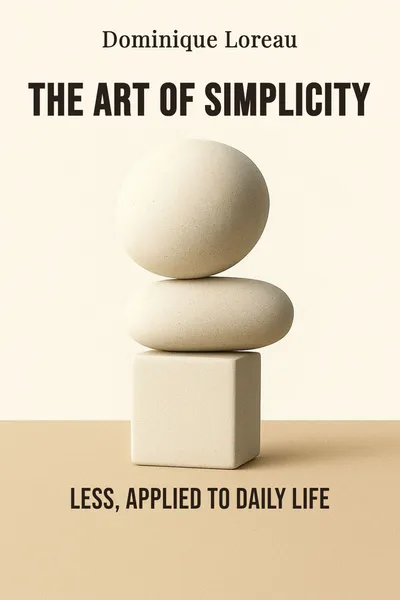
The Art of Simplicity
Less, applied to daily life
Description
Sometime in the 1970s, a young French teacher named Dominique Loreau moved to Japan to teach, and never really left. She expected a working stint abroad. What she found was a way of living that ran against everything her French upbringing had taught her about comfort, accumulation and the good life. In the small apartments of her new country, in tea rooms built around a single flower, in meals served on tiny plates, she kept meeting the same quiet idea: that having less could feel like more, and that emptiness was not a lack but a kind of luxury. The encounter reorganized her, slowly, over decades.
Years later she wrote it down. "The Art of Simplicity" — L'art de la simplicité in the original French — became an unlikely bestseller, first in France and then well beyond it, carried by readers who sensed they owned too much and felt oddly heavier for it. The book is not a philosophy treatise and does not pretend to be. It is closer to a notebook kept by someone who tried things: emptying closets, shrinking wardrobes, eating less, writing lists, letting go of furniture, friendships and habits that no longer earned their place. The through-line is a single verb that most of our lives are built to resist — to subtract.
What makes the book worth sitting with is that it treats simplicity as a craft rather than a mood. Not a weekend purge, not a hashtag, but a daily practice drawn largely from Japanese aesthetics and Buddhist habit, applied to the very ordinary textures of a Western life: the apartment, the body, the bank account, the diary. It asks less what we should believe and more what we might let go of, starting this afternoon.
The question we’re asking : What does it actually mean to apply "less" to the texture of an ordinary day?What we’ll see : A French woman's Japanese apprenticeship in subtraction, carried into the home, the body and the plate, and the quiet demand it finally makes of us.
Table of contents
01Chapter 1 — A French woman who learned to subtract in Japan
Loreau's starting point is personal, and she never hides it. She grew up in a culture where abundance read as success and a full house as a life well furnished. Japan undid that assumption almost by accident. She noticed that the rooms she admired most were the emptiest — a tatami floor, a scroll, a single branch in a vase — and that this emptiness was not poverty but a choice, maintained at some cost. The Japanese word she keeps returning to is a sensibility rather than a rule: beauty found in restraint, in the uncluttered, in what has been deliberately left out.
Behind the aesthetic sits a longer tradition. The tea ceremony, Zen temples, the practice of keeping only what is used and loved — these were not invented to be minimalist in the modern branded sense. They came out of centuries in which space, materials and attention were treated as finite and therefore precious. Loreau borrows from this without pretending to have become Japanese. She is clear that she remains a Western woman with a Western appetite for things, and that subtraction, for her, is a muscle she has to keep working against her own grain.

02Chapter 2 — The home as a place that breathes
The home is where Loreau applies the idea most concretely, because the home is where accumulation hides in plain sight. We keep things, she observes, not because we use them but because getting rid of them feels like a small loss — a gift we never liked, clothes we might fit again, papers we might one day need. The result is an apartment that slowly fills with objects that serve mainly to be stored. Her remedy is blunt: a thing earns its place only if it is useful or genuinely loved, and almost nothing qualifies on both counts.
She recommends going through possessions category by category and being honest about the function each object actually performs. Much of what we own, she argues, is kept out of guilt, nostalgia or a vague fear of future need — emotions that have attached themselves to objects and now demand rent in the form of space. Letting go, in her telling, is less about the object than about the feeling glued to it. The closet is really an inventory of unresolved attachments.
03Chapter 3 — The body kept light, the plate kept small
Loreau extends the same logic inward, to the body and the plate, and this is where the book is most demanding. Just as we overfurnish our rooms, she argues, we overload our bodies — too much food, too many products, too much of everything marketed as care. Her counter-ideal is lightness: eating less and better, owning a small number of good things rather than a drawer of mediocre ones, treating the body as something to keep clear rather than to indulge and then correct.
Food gets particular attention. Drawing on what she observed of Japanese eating — smaller portions, simple preparation, attention paid to each bite rather than to volume — she makes the case for quality and restraint over quantity. The point is not deprivation but a shift in pleasure: a little, savored, satisfies more than a lot, barely tasted. She describes stopping before fullness, choosing a few ingredients well, and noticing how quickly the body recalibrates to a smaller, steadier intake.
04Chapter 4 — What we actually give up when we simplify
Step back from the closets and the small plates and Loreau's practice reveals what it truly asks, which is harder than tidying. Subtraction is not a single purge but a standing decision, renewed daily, about what deserves space in a life. Every object kept, every meal, every commitment on the calendar is a small vote, and the discipline she describes is simply the refusal to cast those votes on autopilot. That refusal is quiet, but it is relentless, and it never finishes.
The difficulty is that most of what fills a life also protects us from something. A crowded home, a full diary, a wardrobe of options are not only burdens; they are also places to hide — from boredom, from choice, from the plainer question of what we actually want. Loreau's version of simplicity removes those hiding places one by one. The empty room is restful, but it also leaves us alone with ourselves, with fewer things to arrange and rearrange in place of deciding how to live.
05Conclusion
Dominique Loreau never quite stopped being the French woman who moved to Japan and found herself undone by an empty room. The book she eventually wrote keeps that double perspective: an outsider's gratitude for a tradition of restraint, and an insider's honesty about how hard that restraint is to sustain in a Western life built on more. Its appeal was never a trend. Readers reached for it because they recognized the weight she named — the slow accumulation of things, meals, obligations that were supposed to make life fuller and somehow made it heavier.
Related books