The Art of Not Being Governed
Highland peoples who evaded the state
Description
For a long time, the standard story about hill peoples in Southeast Asia went roughly like this: down in the valleys you found rice paddies, kings, temples, taxes, writing — civilization, in other words — and up in the mountains you found the leftovers. Scattered tribes, shifting agriculture, no script, no state, people who had simply been passed over by progress and were waiting, more or less patiently, to be absorbed. The higher and more remote a group lived, the more "primitive" it was assumed to be. James C. Scott, an anthropologist and political scientist at Yale, spent years looking at that map and came away convinced the arrow was pointing the wrong way.
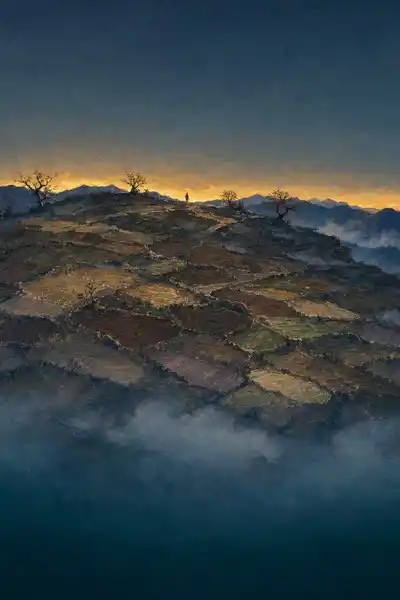
His argument, laid out in The Art of Not Being Governed, published in 2009, is that the vast upland stretch running from the central highlands of Vietnam through Laos, Thailand, Myanmar and into southwestern China — a zone a Dutch historian nicknamed Zomia — is not a reservoir of people history forgot. It is a refuge. For roughly two thousand years, Scott says, the hills filled up with people who were running from the valley states: from their taxes, their forced labor, their conscription, their epidemics, their wars. The mountains were not where civilization hadn't yet arrived. They were where people went to escape it.
That reframing turns a lot of familiar assumptions inside out. If the highlanders weren't left behind but had actively pulled away, then their supposed backwardness starts to look like something else entirely — a set of choices. And once we start reading their way of life as a response to the state rather than an absence of it, almost every detail changes meaning.
The question we’re asking : What if the peoples we call primitive weren't left behind by civilization but were fleeing it on purpose?What we’ll see : How a scholar reread two millennia of Southeast Asian hill life as one long, deliberate act of escape.
Table of contents
01Chapter 1 — The mountains as a place people chose
The first move Scott makes is to stop treating the valley and the hills as two separate worlds that happened to sit next to each other. He treats them as a single system, locked together by a relationship of pressure and flight. The lowland states of Southeast Asia — the padi states, built on wet-rice farming — needed one thing above all: people. Concentrated, settled, countable people who could be taxed, drafted into armies, and put to work on canals and temples. Land was plentiful; labor was scarce. So these states spent enormous energy trying to hold populations in place, and populations spent a matching energy slipping away.
Where did they slip to? Up. The hills were the one direction the state's reach ran out. A rice kingdom could project power across flat, wet plains, but its soldiers, its tax collectors and its cavalry lost their grip the moment the terrain tilted and the roads gave out. Altitude, distance and rough ground did the work that a border wall might do elsewhere. Scott calls this "friction of terrain," and it explains why the same peoples who looked helpless on paper were, in practice, almost impossible for the state to grab.

02Chapter 2 — Everything a state can read, and everything the hills refused
To see why the mountains worked, it helps to think about what a state actually needs in order to govern. Scott's earlier work had already given him the key word: legibility. A state can only tax, conscript and control what it can see and measure. It needs standardized names, fixed addresses, mapped fields, permanent settlements, written records — the whole apparatus that turns a messy human population into rows it can read at a glance. Everything the valley states built, from land surveys to census counts, was in service of making people legible.
The hill peoples, in Scott's reading, organized their entire existence around not being readable. Not by accident, but as a working strategy. If the danger is being counted and captured, then the smart response is to make yourself hard to count and easy to scatter. This is where his argument becomes genuinely provocative: he asks us to see practices long dismissed as signs of underdevelopment as active defenses against the state.
03Chapter 3 — Crops, kinship, and the tools of staying invisible
The evasion, Scott argues, went all the way down to what people planted. Wet rice, the foundation of the valley states, is almost perfectly designed for taxation: it grows in fixed, visible paddies, ripens on a predictable schedule, and sits in the field waiting to be assessed and seized. It is, in effect, a state's dream crop. So it should not surprise us that peoples trying to stay out of a state's reach often turned to the opposite kind of agriculture.
The hills favored root crops and shifting cultivation — tubers and maize and mountain rice grown by clearing a plot, using it, and letting it go. Root crops in particular have a lovely defensive quality: they can be left in the ground and dug up only when needed, which means there is no ripe, concentrated harvest sitting out in the open for an army to carry off. Scott coins the phrase "escape agriculture" for this. The menu of what to grow was, among other things, a menu of how visible to be.
04Chapter 4 — When a people has no history because it decided not to
Here is where Scott asks his reader to take the real step back, and it lands on the touchiest artifact of all: writing. The absence of literacy among hill peoples has always been treated as the clearest proof of their backwardness — the missing rung on the ladder to civilization. Scott turns even this over. Some Zomian groups, he notes, seem to have had writing and lost it, and their own legends often tell the story that way: a script written on skins or leaves that was eaten, or lost in a flood, or swapped away. He reads these tales not as quaint excuses but as a culture making sense of a genuine retreat from literacy.
Why would anyone give up writing? Because writing, in the world Scott describes, is the state's technology before it is anyone else's. It fixes obligations, records who owes what, freezes genealogies into hierarchies, and hands elites a permanent claim on the past. An oral culture, by contrast, can quietly revise its own story — reshuffle a genealogy, forget an old debt, reinvent an identity — every time it needs to. Illiteracy, from this angle, buys a kind of freedom: the freedom to keep no fixed record that a state could ever use against you.
05Conclusion
Return, for a moment, to that old map with its arrow of progress running from the wild hills up toward the civilized plains. Scott's book asks us to flip it — to see the people in the mountains not as those who never arrived, but as those who deliberately left. Zomia, in this reading, is less a region than a two-thousand-year-long verb: the act of not being governed, practiced by ordinary people who found taxes, conscription and forced labor a worse deal than a hard life in the highlands.
Related books