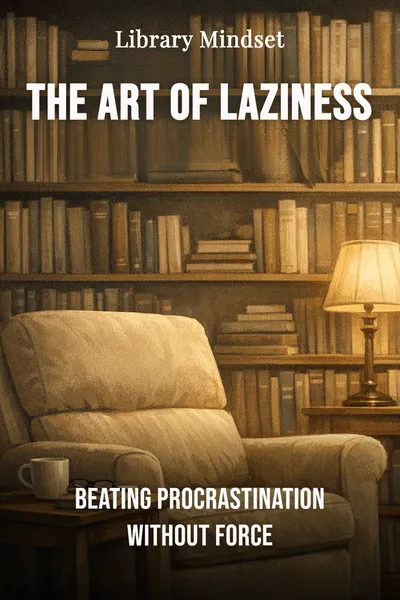
The Art of Laziness
Beating procrastination without force
Description
There's a peculiar moment most of us know well. The task is right there, small and clear, and yet we find ourselves refilling the water glass, checking a phone that has nothing new on it, deciding the desk needs tidying before any real work can begin. Nothing dramatic happens. We just don't start. This is the everyday texture of procrastination — not a spectacular failure of character, but a quiet, repeated slipping-away from the thing we said we'd do. Library Mindset, the account behind the short book The Art of Laziness, builds its whole argument on that ordinary experience rather than on some grand theory of motivation.
The book's premise runs against the usual advice. Most productivity writing treats procrastination as an enemy to be crushed with discipline, willpower, and more effort — grind harder, wake earlier, want it more. The Art of Laziness takes a gentler and, in a way, sneakier position: forcing yourself rarely works for long, because force is expensive and we run out of it. What lasts is not more pressure but less resistance. Make the good thing easy and the hard thing slightly harder, and behavior shifts without the constant internal shouting match.
That reframing is worth sitting with, because it changes what the problem even is. If procrastination is a willpower deficit, the fix is moral: try harder, feel guiltier. If it's something else — a matter of how our days and our self-image are arranged — then the fix is practical, and oddly kinder. The book leans hard into that second reading, and it's the thread we'll follow.
The question we’re asking : Why does forcing ourselves to work so reliably fail, and what actually gets us moving instead?What we’ll see : How a small, deliberate start beats brute willpower — and why the fix looks less like discipline than like design.
Table of contents
01Chapter 1 — The two-minute head start
The most repeated idea in the book is almost embarrassingly simple: the hardest part of any task is starting it. Not finishing, not sustaining — beginning. The gap between not-doing and doing is where procrastination lives, and it's wider than it looks. Once we're two minutes into writing, the sentences keep coming; once we've laced up the shoes and stepped outside, the run mostly happens on its own. The friction is almost entirely at the threshold. So the book's advice is to make the threshold tiny.
This is where the borrowed rule of thumb comes in. If something takes less than a couple of minutes, do it now rather than filing it away for a later that rarely arrives. And for the bigger jobs that can't be done in two minutes, shrink the entry point until it can: don't sit down to write the report, sit down to open the document and type one line. The trick isn't that one line is enough. It's that one line dissolves the resistance, and the rest tends to follow.

02Chapter 2 — Friction is the real enemy
If starting is the battle, then the book's next move is to notice what makes starting hard in the first place. Its answer is friction — the small obstacles, distractions, and default temptations sitting between us and the thing we want to do. We usually blame ourselves when we get pulled off course, but the phone on the desk, the open browser tab, the notification badge are not neutral bystanders. They are engineered to win, and against a well-designed distraction, raw willpower is a poor defense.
So the book reframes the problem as a matter of arrangement rather than resolve. Instead of promising to resist the phone, put it in another room. Instead of trusting yourself to skip social media, log out, delete the app, add the friction back where it belongs — on the wrong action rather than the right one. This is the mirror image of the two-minute rule. There, we lowered the friction on good behavior. Here, we raise it on the bad. The environment does the work that willpower kept failing to do.
03Chapter 3 — Rest that isn't procrastination
A book called The Art of Laziness has to answer an obvious objection: isn't it just permission to slack off? Its response is to draw a line most productivity writing blurs — the difference between rest and avoidance. Both look like not-working, but they feel entirely different from the inside. Rest is chosen, bounded, and restorative; we step away, recover, and come back with something. Avoidance is the low-grade anxiety of scrolling while a deadline hums in the background, never quite resting because we never quite stopped worrying.
The distinction matters because burnout is procrastination's quieter cousin. Push relentlessly, skip recovery, treat every idle minute as a moral failure, and the system eventually stalls — and a stalled system procrastinates by default. The book argues that deliberate rest is not the opposite of getting things done; it's part of the machinery. The nap, the walk, the genuine day off are inputs, not indulgences. What corrodes us is the guilty half-rest, where we neither work nor recover.
04Chapter 4 — When effort stops being the point
Stack the book's advice together and a single shape appears. The two-minute start, the phone in another room, the bounded rest — none of them ask us to want the work more or grit our teeth harder. Each one quietly redesigns the situation so that the right action becomes the easy one. That's the deeper claim hiding under a modest self-help title: procrastination is less a flaw in our character than a flaw in our setup, and setups can be changed without a personality transplant.
This is why the book keeps drifting from behavior toward identity. Doing one small task is a tactic; becoming the kind of person who starts is something else. The book's version of habit rests on repetition until an action stops requiring a decision — until we run, or write, or tidy not because we've willed it but because it's simply what we do. At that point effort drops out almost entirely. The behavior has moved from the willpower budget to the autopilot, and autopilot is cheap. That, more than any single trick, is what the book is quietly building toward.
05Conclusion
Come back to that opening moment — the task in front of us, the glass of water, the phone with nothing new on it. The Art of Laziness doesn't answer it with a pep talk or a demand for more discipline. It answers it with a smaller move: open the document, type one line, let the beginning be almost nothing. The dread was always bigger than the task, and a deliberate, unambitious start is the cheapest way to prove it. Everything else in the book — the friction, the rest, the slow shift toward identity — radiates out from that single, unglamorous idea about starting.
Related books