The Art of Happiness
Epicurus was never wrong
Description
Around 306 BC, in Athens, a man in his mid-thirties bought a plot of land just outside the city walls and started growing vegetables on it. His name was Epicurus, he had grown up on the island of Samos, and the plot became known simply as the Garden. It was a school, but it did not look like one. Plato's Academy and Aristotle's Lyceum trained young men of standing for public life; the Garden let in women, and it let in at least one enslaved man, Mys, as a full participant. People came, ate simply, talked, and tried to work out a single practical question: how does a person actually live well?
The answer Epicurus reached has been misunderstood almost from the moment he gave it. His name now survives in the word "epicurean," which we attach to expensive tasting menus and refined indulgence. That is close to the opposite of what he taught. The man behind the word ate bread and water, treated a pot of cheese as a feast for special occasions, and argued that the surest route to happiness was to want less, not to consume more. For centuries after his death he was slandered as a preacher of gluttony, and his writings were largely destroyed. Most of what we have survives in three letters and a handful of collected sayings.
And yet the outline held. What Epicurus put down about death, about the gods, about fear, and about pleasure kept resurfacing — in Roman poetry, in Enlightenment politics, in the reading habits of people who built the modern world. A philosophy grown in a vegetable patch turned out to be unusually durable.
The question we’re asking : What did Epicurus actually teach about how to be happy — and why has a philosophy of modest pleasure been so consistently mistaken for its opposite?What we’ll see : We follow the argument from a garden outside Athens to a way of living, and then to the strange afterlife of a man history kept trying to bury.
Table of contents
01 Chapter 1 — A garden outside the walls
Epicurus was born in 341 BC and came to philosophy young, reportedly frustrated with a teacher who could not explain to him what the primordial "chaos" of the old poems was made of. He wanted answers that held together. After years of teaching in the Greek cities of Asia Minor, he settled in Athens and set up the Garden, which he ran until his death in 270 BC. The setting mattered. This was not a lecture hall but a household, and the philosophy that came out of it was domestic in the best sense — concerned with the texture of an ordinary day rather than the abstractions of the marketplace or the assembly.
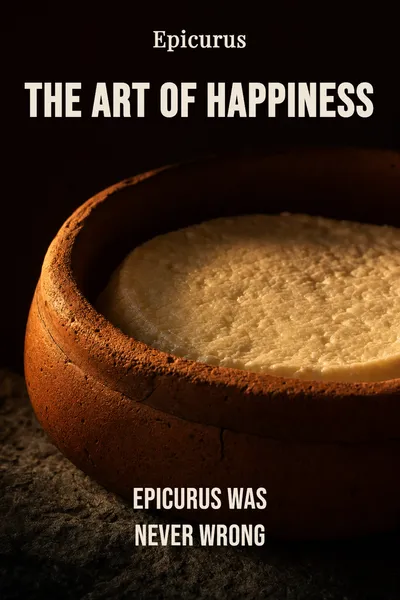
The community lived on very little, and did so on purpose. Epicurus is famous for a line in a letter where he asks a friend to send a pot of cheese so that he can have a feast when he wants one. The joke is doing serious work. If a small luxury can turn plain food into a banquet, then the source of pleasure is not the luxury; it is the appetite that meets it. Learn to arrive at the table hungry and grateful, and bread becomes enough. Learn to expect the banquet, and no banquet ever satisfies.

02 Chapter 2 — Nothing to fear, nothing to want
Epicurus diagnosed unhappiness as, above all, a problem of fear. Two fears in particular ruined people: fear of the gods and fear of death. Remove those two, he argued, and most of the anxiety that clouds a life simply lifts. The bulk of his physics and theology is aimed at exactly this therapeutic goal — not knowledge for its own sake, but relief.
On the gods, his move was quietly radical. He did not deny that gods existed. He denied that they cared. Blissful and untroubled beings, he reasoned, would not spend eternity monitoring human behavior, rewarding the pious and punishing the impious with storms and plagues. A god who fretted over sacrifices would not be blissful at all. So the vast apparatus of appeasement — the dread that a bad harvest or an illness was divine retribution — rested on a confusion. The gods were real and serenely indifferent, which meant there was no cosmic judge to placate and no supernatural punishment to dread.
03 Chapter 3 — The math of desire
With the fears removed, Epicurus stated his conclusion bluntly: pleasure is the beginning and end of the happy life. This is the sentence that earned him his reputation as a hedonist, and it is the sentence most often ripped from its context. Because the pleasure he meant was not sensation piled on sensation. It was a specific state — freedom from bodily pain and freedom from mental disturbance, a Greek word he made central, ataraxia, meaning something like untroubledness. The goal was not the peak of enjoyment but the steady baseline of a life without gnawing want.
To get there, he sorted desires into a kind of practical taxonomy. Some desires are natural and necessary: food, shelter, safety, the company of friends. Some are natural but not necessary: fine wine, a bigger house, richer food. And some are neither natural nor necessary: fame, power, unlimited wealth — desires manufactured by society and, crucially, impossible to satisfy, because they have no ceiling. The whole art of happiness, on this view, is learning to meet the first category reliably and to hold the other two loosely.
04 Chapter 4 — The thinker they kept trying to bury
It is worth asking why a philosophy this modest attracted such ferocious hostility. Part of the answer is that Epicurus threatened the machinery of fear that religion and ambition both run on. If the gods do not punish, priests lose leverage; if status is a trap, the whole competitive order looks foolish. His denial of an afterlife made him an easy target for later moralists, and by the early Christian centuries "Epicurean" had hardened into a term of abuse for the godless glutton. Much of his writing was left to rot, and we know the system mainly through the Roman poet Lucretius, who versified it in the first century BC, and through fragments preserved almost by accident.
So the word survived while the meaning inverted. This is the strange fate of Epicurus: the name became a byword for exactly the excess he spent his life arguing against. "Epicurean" tastes of foie gras and vintage claret, when the man himself was thrilling at a pot of cheese. The distortion is almost total, and it tells us something about how easily a subtle idea gets flattened into its cartoon.
05 Conclusion
The Garden did not survive as an institution; the Academy and the Lyceum have longer afterlives in the textbooks. But the practical core of what Epicurus taught there has proven oddly hard to kill. He set out to answer one question — how does a person actually live well — and his answer was that you subtract before you add. Clear away the fear of death and the fear of the gods, sort your desires honestly, meet the necessary ones simply, and hold the rest lightly. What remains is a kind of contentment that costs almost nothing and depends on almost no one.
Related books