
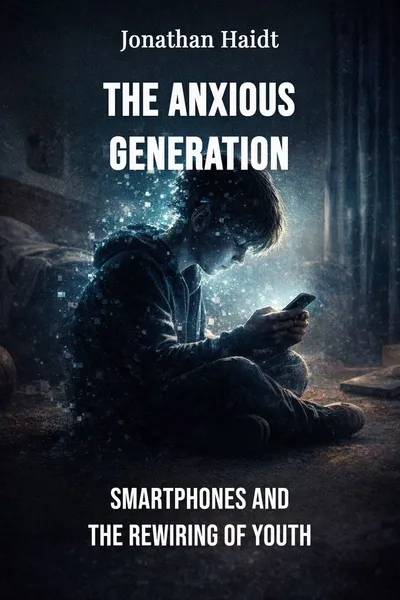
The Anxious Generation
Smartphones and the rewiring of youth
Description
Around 2012, something shifts in the data. Jonathan Haidt, a social psychologist at NYU's Stern School of Business, spent years staring at charts of adolescent mental health across the United States, the United Kingdom, Canada, Australia, and beyond — and kept finding the same bend in the line. Rates of depression, anxiety, self-harm, and suicide among teenagers, especially girls, had been roughly stable for decades. Then, in the early 2010s, they climbed sharply and didn't come back down. American emergency-room visits for adolescent self-harm rose steeply over the following years. The pattern was too synchronized across countries to be a coincidence of local politics or economics.
Haidt's book, The Anxious Generation, published in 2024, tries to explain that bend. His answer is disarmingly specific: between about 2010 and 2015, childhood was rebuilt around the smartphone. The front-facing camera arrived, Instagram went mainstream, unlimited data plans spread, and the phone stopped being a device teenagers occasionally used and became the place they lived. A generation that had already been losing unsupervised outdoor play traded it for a screen — and the timing lines up almost exactly with the mental-health decline.
It is a strong claim, and Haidt knows critics will push on the difference between correlation and cause. Much of the book is spent building the case that this is not just two lines happening to move together, and drawing out what a phone-based childhood does to a developing mind. He also refuses to leave it at diagnosis. The book ends with a set of concrete demands — for parents, schools, tech companies, and governments — meant to give kids their childhood back.
The question we’re asking : Did smartphones and social media actually rewire adolescence, or did two curves simply happen to bend at the same moment?What we’ll see : How a generation's childhood was rebuilt around a screen, what that did to developing minds, and what Haidt thinks we should do about it.
Table of contents
01 Chapter 1 — The graph that starts around 2012
The heart of Haidt's argument is a cluster of graphs that all bend in the same place. Take rates of major depression among US teens: fairly flat through the 2000s, then rising sharply from roughly 2012 onward, with the steepest climb among girls. Anxiety follows. So do emergency-room visits for self-harm, which for younger adolescent girls rose to levels that alarmed the clinicians tracking them. Suicide rates for young teens, having fallen for years, turned back up in the same window.
What makes Haidt confident this isn't noise is how widely the pattern repeats. He points to similar reversals in the United Kingdom, Canada, Australia, New Zealand, and the Nordic countries — places with very different economies, school systems, and politics. When a symptom appears at the same time across the English-speaking and Scandinavian world, the usual local explanations start to look thin. A 2008 financial crisis or a specific national curriculum can't be everywhere at once with the same timing.

02 Chapter 2 — How play became scrolling
Before Haidt gets to phones, he tells a longer story about what childhood had already lost. Across the 1980s and 1990s, in the US and elsewhere, kids were granted steadily less freedom to roam. Parents, spooked by rare but vivid dangers, kept children indoors and supervised. Haidt calls the result the decline of the play-based childhood — the unstructured, risky, adult-free time that he argues is how young mammals learn to handle fear, conflict, and independence. This was a slow erosion, well underway before the first iPhone.
Into that hollowed-out childhood came the phone. Haidt dates the crucial transition to roughly 2010 through 2015. The smartphone became affordable and ubiquitous, the front-facing camera turned everyone into a subject, Instagram and later Snapchat and the endless-scroll feeds became the default social world, and 'likes' turned peer approval into a quantified, public, around-the-clock scoreboard. The old world of the mall and the backyard was replaced by a feed.
03 Chapter 3 — Four harms and a rewired brain
Haidt organizes the damage into four foundational harms of the phone-based childhood. The first is social deprivation: hours that once went to face-to-face contact now go to screens, and time spent with friends in person fell markedly for teens over the 2010s. The second is sleep deprivation. The phone comes to bed, notifications interrupt the night, and adolescents — who need a lot of sleep during a period of intense brain development — get measurably less of it, with knock-on effects for mood and learning.
The third harm is attention fragmentation. A feed engineered to interrupt, with buzzes and pulls arriving hundreds of times a day, trains a young mind against the sustained focus that deep thought and real relationships require. The fourth is addiction, in a fairly literal sense: the apps are built on variable-ratio reinforcement, the same intermittent-reward schedule that makes slot machines compulsive, deliberately tuned to keep users pulling the lever.
04 Chapter 4 — Coordinating a way out
Having built the case, Haidt turns to what should change — and the most useful thing he adds here is a diagnosis of why the problem is so sticky. It is a collective-action trap. Any single parent who takes the phone away hands their child a real social cost: the friends are all online, the group chats and plans happen there, and the unequipped kid gets left out. Rational individual choices, made by everyone at once, produce a bad outcome nobody wanted. No family can solve this alone, which is why blaming parents misses the point.
So his four reforms are built to break the trap by moving the default for everyone together. First: no smartphones before high school — give younger kids basic phones for calls and texts, not internet-connected pocket computers. Second: no social media before sixteen, the age at which he argues the sensitive window has done its most vulnerable work. Third: phone-free schools, with devices locked away for the whole day so attention and face-to-face life can return to the classroom. Fourth: far more independence, free play, and real responsibility in the physical world, to rebuild the play-based childhood the phone displaced.
05 Conclusion
The book returns, in the end, to the bend in the graph it opened with. Something happened to adolescence in the early 2010s, and Haidt's wager is that we already know enough about what — the great rewiring, as he calls it, of childhood around a screen — to act before the science is fully settled. His four reforms are less a program of restriction than an attempt to give a generation back the thing it quietly lost: an unsupervised, embodied, occasionally risky childhood in the real world.
Related books