The Analects
How to live with virtue
Description
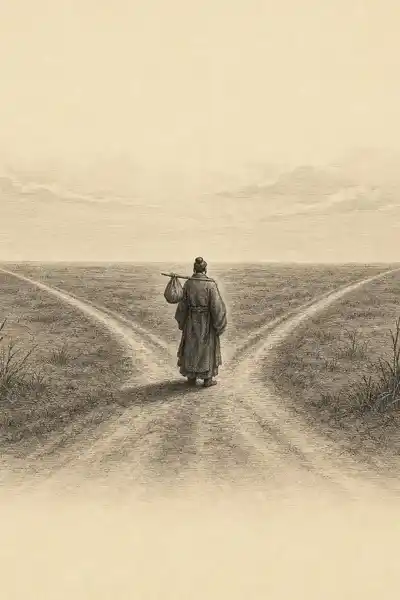
Sometime around 500 BCE, in the small state of Lu in what is now Shandong province, a man in his fifties kept looking for work. His name was Kong Qiu, and later generations would Latinize it to Confucius. He wanted a ruler to hire him and let him put his ideas about good government into practice. Mostly, rulers didn't. He traveled from court to court for years, was turned away, went hungry at least once, and eventually came home to teach. He left no book of his own. What we have instead is a collection his students, and their students, assembled after his death: short remarks, half-scenes, answers to questions, a few flashes of temper and humor. We call it the Analects.
It is a strange classic. There is no system in it, no numbered set of commandments, no grand argument that builds to a conclusion. Open it anywhere and you get a fragment: someone asks Confucius what filial piety is, or how to govern, or whether he ever regrets a thing, and he answers in a sentence or two, often by turning the question back. And yet from these scraps a whole way of thinking about how to live took shape, one that would organize education, family life, and statecraft across East Asia for more than two thousand years.
What makes the Analects worth reading now is not its antiquity but its stubborn practicality. Confucius is not interested in the afterlife, in metaphysics, or in what happens to the soul. He is interested in the person you are becoming, day by day, in how you treat your parents and your neighbors and the people who work for you. He treats being good as something you practice, badly at first, the way you'd practice an instrument.
The question we’re asking : What does it actually mean to live well, according to a teacher who left behind only fragments?What we’ll see : The man behind the book, the virtue at its center, the role of ritual in ordinary life, and why a text this old still reads like advice.
Table of contents
01 Chapter 1 — A teacher and a book he never wrote
Confucius was born around 551 BCE into a family that had once been minor nobility and had come down in the world. His father died when he was young; he grew up without much. By his own account he was not a prodigy of virtue but a prodigy of effort — "I am not one who was born with knowledge," he says in the Analects, "but one who loves the past and is diligent in seeking it." He held a few modest official posts in Lu, rose briefly to something like a ministerial role, then lost his footing in court politics and spent roughly a decade wandering between states, offering his services and being politely declined.
The Analects records almost none of this as biography. It arrives in pieces. A disciple asks a question, Confucius replies, occasionally another student pushes back. The book is organized into twenty short chapters, but the arrangement is loose, and scholars have long argued that the layers were written down over more than a century after his death, around 479 BCE. Some passages feel like eyewitness memory; others read like later students defending the school. Reading it, we are eavesdropping on a classroom that kept meeting long after the teacher had gone.

02 Chapter 2 — Ren, or the long work of becoming decent
At the center of the Analects sits a word Confucius returns to constantly and never quite pins down: ren. It gets translated as benevolence, humaneness, goodness, or simply humanity — the quality that makes a human being fully human toward others. When students ask him to define it, he almost never gives the same answer twice. To one he says ren is to love others. To another, that it is to conquer yourself and return to propriety. To a third, who is impatient and brash, he says only that the person of ren is careful in speech. He tailors the answer to the questioner, because for him virtue is not an abstraction but a fit between a person and their particular life.
One formulation comes close to a general principle, and it is the one most often quoted. A disciple asks whether there is a single word to guide a life. Confucius offers shu — reciprocity, or considerateness — and glosses it: "Do not impose on others what you yourself do not desire." It is the golden rule in its negative form, humbler than the positive version, less about grand generosity and more about restraint, about not doing harm you wouldn't want done to you.
03 Chapter 3 — Ritual, and why manners are not trivial
Alongside ren runs a second great theme that can look, to modern eyes, almost quaint: li, usually rendered as ritual, ceremony, or propriety. Confucius cared enormously about how things were done — how you mourned, how you greeted a superior, how you sat, how you sacrificed to ancestors, when you spoke and when you stayed quiet. He describes his own conduct in obsessive detail: how he adjusted his expression on entering the ruler's gate, how he would not sit on a mat that was crooked. It is tempting to read this as fussiness, a preoccupation with etiquette.
But li in the Analects is doing serious work. Ritual, for Confucius, is the outward form that gives inner feeling somewhere to live. Grief without the forms of mourning dissipates; respect without the gestures of respect stays private and untested. The forms train the feeling and steady it. He is scathing about ceremony performed hollowly — "a man without ren, what has he to do with ritual?" — but equally clear that raw sincerity with no form is crude and unreliable. Character shows itself in conduct, and conduct is largely a matter of practiced forms done with real attention.
04 Chapter 4 — A mirror for anyone who wants to be better
Step back from the fragments and a shape appears. The Analects is not a revelation handed down from a god, and it is not a code of rules to be obeyed. It is closer to a portrait of a craft — the craft of becoming a better person — sketched by someone who took that craft as seriously as anything can be taken. What Confucius offers is not a shortcut but a stance: pay attention to your conduct, learn from those better than you, correct what is wrong, and keep at it for as long as you live. He describes his own life this way, as a slow progression — at fifteen he set his heart on learning, and only at seventy could he follow what his heart desired without overstepping. It took him a lifetime.
That framing is why the text has traveled so far and lasted so long. It became the backbone of Chinese education and the imperial examination system for centuries, and it shaped moral and political thought across Korea, Japan, and Vietnam. But its reach is not really explained by institutions. It is explained by the fact that the questions the students ask are the questions people still ask. How should I treat my parents now that they are old? What do I owe a friend? How do I keep my temper, my word, my sense of proportion when everything pushes the other way?
05 Conclusion
Confucius died around 479 BCE thinking himself, by the standard he cared about, a failure. No ruler had adopted his ideas; his political career had come to little. What he had was a room full of students who remembered how he spoke. Out of that memory came a book he never wrote, and out of that book came one of the most durable pictures of the good life the world has produced — not because it dazzles, but because it stays close to the ground of ordinary conduct.
Related books