The Age of Extremes
The short twentieth century
Description
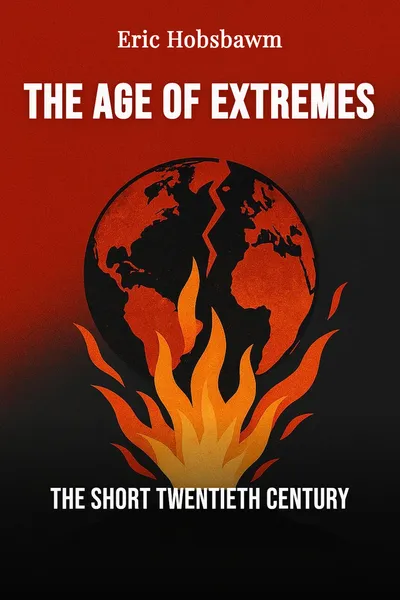
In 1994, an eighty-year-old British historian named Eric Hobsbawm published the fourth and final volume of a project he had been building for decades. The first three books had traced the long nineteenth century, from the French Revolution to the outbreak of the First World War. This one covered what he called the short twentieth century — a span he dated with unusual precision, from 1914 to 1991. It ran, in other words, from the guns of August to the dissolution of the Soviet Union, and Hobsbawm argued that these were not two arbitrary bookends. They were the birth and death of a single coherent era.
The claim was strange on its face. Most of us think of a century as a round number, a hundred years marked off by a calendar. Hobsbawm was saying the calendar had it wrong. The nineteenth century, for him, had run long, past its own turn, and only truly ended when the world it built tore itself apart in the trenches. The twentieth, by contrast, had run short — it began late and it ended early, and it had a shape you could see once you stood far enough back. That shape was not a straight line of progress. It was a plunge, then a rise, then another plunge.
What makes the book more than a chronicle is that Hobsbawm lived it. Born in Alexandria in 1917, raised in Vienna and Berlin as the old order collapsed, a communist for most of his adult life, he was writing about a world that had formed him and then, in his last years, come apart entirely. The Age of Extremes is a history written by someone standing in the rubble of his own convictions, trying to make sense of how the century had moved.
The question we’re asking : If the twentieth century really was short — 1914 to 1991 — what gave it its shape, and why did Hobsbawm see it as a single arc rather than a hundred loose years?What we’ll see : How a historian who had lived through the whole span carved it into three movements and read the end as something larger than one empire falling.
Table of contents
01Chapter 1 — 1914, and the century that started late
Hobsbawm's whole architecture rests on the idea that eras have edges, and that the edges rarely line up with the numbers on a calendar. He had already argued, across three earlier volumes, that the nineteenth century was a long one — a bourgeois, liberal, expanding world that began with the double revolution of 1789 and industrial Britain, and kept going, confident and roughly stable, well past 1900. What ended it was not a date but an event. In the summer of 1914, the great powers of Europe marched into a war they expected to win by Christmas, and the world that had believed in progress, free trade, and its own permanence did not survive it.
So the short twentieth century, in this reading, is defined by loss before it is defined by anything else. It opens with the shattering of a set of assumptions — that civilization moved forward, that the great European states knew what they were doing, that violence on a continental scale belonged to the past. The years before 1914 had felt, to the people living in them, like the settled middle of things. Afterward, nothing looked settled again.

02Chapter 2 — The catastrophe that ate three decades
The first movement Hobsbawm calls the Age of Catastrophe, and he runs it roughly from 1914 to the end of the Second World War in 1945. What holds these three decades together is that the disasters did not arrive one at a time. They compounded. The First World War killed on an industrial scale nobody had imagined possible and settled almost nothing, leaving a peace that felt like an intermission. The Russian Revolution of 1917 split the world into rival systems. Then came the economic collapse.
The Great Depression, beginning in 1929, is central to his account because it did more than impoverish people. It discredited the liberal capitalist order that had seemed, before 1914, like the natural shape of the modern world. Millions were thrown out of work across the industrial economies, and the market's failure to right itself convinced large numbers of people that the whole system had exhausted itself. Into that vacuum came the alternatives — Soviet communism on one side, fascism on the other — each promising to master the chaos that liberalism could not.
03Chapter 3 — Thirty years nobody saw coming
The second movement is the one that surprises Hobsbawm the most, and he lets that surprise show. He calls it the Golden Age, running from roughly 1947 to the oil shock of 1973, and it is the stretch when the world economy grew at a rate without precedent in recorded history. Standards of living in the developed countries rose faster and further than they ever had. Full employment, welfare states, mass consumption, the spread of cars and refrigerators and televisions into ordinary homes — the whole texture of what we still think of as modern comfort was laid down in these few decades.
What makes his account persuasive is that he does not treat this boom as inevitable or as the natural reward of capitalism. He treats it as a puzzle. The same economic system that had failed so catastrophically in the 1930s now delivered a quarter-century of near-continuous growth, and Hobsbawm is honest that economists have never fully explained why. Part of the answer, in his telling, is that capitalism had learned from the catastrophe — governments now managed demand, cushioned downturns, and struck a truce between labor and capital that would have been unthinkable a generation earlier.
04Chapter 4 — The ground gives way
The third movement Hobsbawm calls the Landslide, and it covers the last two decades of his century, from the mid-1970s to 1991. The word is chosen carefully. A landslide is not a single dramatic event like a war or a revolution; it is a slow, accelerating loss of solid ground, a sense that the terrain everyone was standing on has begun to move. What slid, in his account, was less any particular institution than the confidence that the world could be understood and steered at all.
The economic certainties went first. The tools that had produced the Golden Age stopped working, unemployment returned to the rich countries, and the postwar consensus that governments could manage prosperity dissolved. But Hobsbawm reaches for something wider than economics. He describes a crumbling of the shared structures that had organized modern life — political ideologies, class solidarities, the authority of the nation-state, even the family and the ordinary moral certainties that had held communities together. The Soviet collapse of 1989 to 1991, which closes his century, was in this reading the most spectacular symptom rather than the cause.
05Conclusion
Hobsbawm ends the book on a note that is unusual for a historian of his stature: uncertainty, and something close to unease. He had lived the whole arc he described — born as the catastrophe was beginning, formed in its worst years, an adult through the Golden Age, and old enough to watch the Landslide carry away the convictions of his youth. Writing in 1994, he could see the three movements clearly precisely because the era they belonged to had just ended, closed off and available to be read as a whole.
Related books