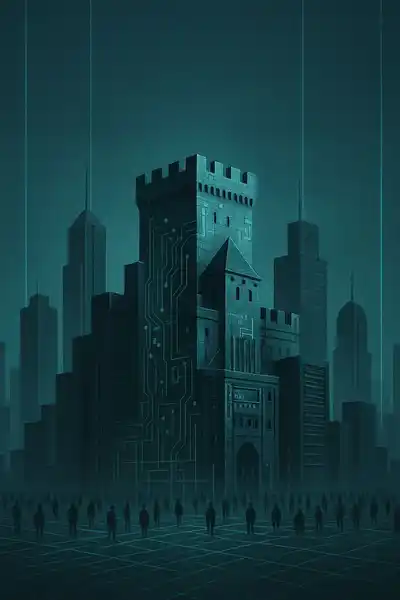
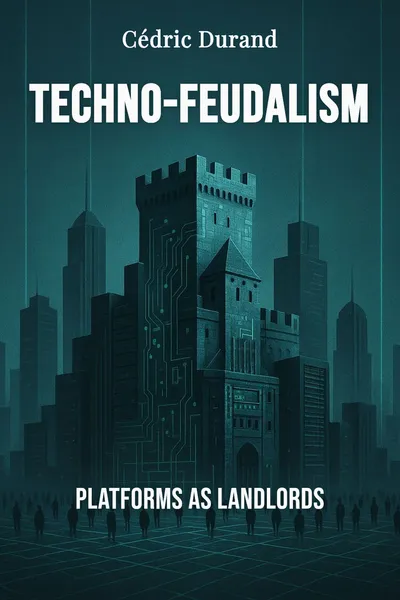
Techno-Feudalism
Platforms as landlords
Description
Open any app on a phone and a strange arrangement is already in motion. We type a search, and the result is sorted by a company that also sells the slots. We order dinner, and a platform takes a cut from the restaurant, a cut from the courier, and a fee from us. We post a photo, and the value of that post flows to a firm we do not work for and cannot leave without cutting ourselves off from everyone we know. None of this feels like buying and selling in the ordinary sense. It feels more like paying for access to ground we do not own.
That intuition is the starting point of the economist Cédric Durand, whose 2020 book Techno-Féodalisme argues that the digital giants are not just very large capitalist firms. They are something older wearing new clothes. Durand teaches at the Sorbonne and belongs to a French tradition of heterodox political economy, and his claim is deliberately provocative: the engine of the digital economy is no longer profit extracted from production, but rent extracted from control. Amazon, Google and their peers, in this reading, behave less like factory owners and more like landlords — collecting tolls on territory everyone else is forced to cross.
The provocation only works if the word "feudalism" is doing real analytic work and not just reaching for drama. Durand knows this, and much of the book is an attempt to show that the comparison is structural, not rhetorical. Something in the way value is captured has changed, and the vocabulary of startups and disruption actively hides it. The task is to decode what the analogy sees that the cheerful language of innovation does not.
The question we’re asking : If the great digital firms no longer live mainly on profit, what exactly are they living on — and why does calling it "feudal" clarify rather than confuse?What we’ll see : How a landlord's logic took hold inside the devices we use every day, and what it reveals about where capitalism is heading.
Table of contents
01 Chapter 1 — The rent beneath the app
Economists have a precise word for income earned not by making something but by controlling access to it: rent. A landlord produces no wheat, yet collects a share of every harvest because he owns the field. Durand's first move is to argue that the dominant digital firms increasingly resemble this figure. Their revenue does not come, in the main, from manufacturing goods at a margin. It comes from sitting between parties and charging for the connection — for the search, the listing, the transaction, the attention.
Consider the structure rather than the branding. Amazon's marketplace hosts millions of independent sellers; the company competes with them, sees their sales data, and charges them fees to reach buyers who have nowhere comparable to go. Google's search page organizes the open web while selling the best positions on it. The App Store takes its percentage from software it did not write. In each case the firm owns the terrain, and everyone productive must pass through and pay. The classic capitalist earns profit by improving production. The platform, Durand argues, earns rent by owning the gate.

02 Chapter 2 — When data becomes a fief
If platforms are landlords, their land is data. Durand draws on the analysis of what others have called surveillance capitalism, but pushes it toward the question of ownership. Every interaction leaves a trace — what we searched, lingered on, bought, abandoned. Collected at scale, these traces become an asset that only the platform holds and only the platform can refine. The user generates the raw material and surrenders it as the price of entry, much as a serf worked land whose yield belonged to the lord.
The comparison sharpens once we notice that the value flows one way. We produce the data through our ordinary activity, yet we receive no share of what it earns; we receive the service, and the service is the bait. Durand insists this is not an unfortunate side effect but the core mechanism. The platform's power rests on an informational enclosure: it fences off a resource that was, in principle, collectively produced, and turns exclusive access into a source of permanent advantage no rival can match without the same hoard.
03 Chapter 3 — Why the free lunch was never free
The strongest objection to all this is obvious: most of these services cost nothing. Search is free, the map is free, the social feed is free. How can a landlord be extracting rent from tenants who pay no rent? Durand's answer reframes what payment means, and it is one of the book's sharpest passages.
The transaction is not absent; it is displaced. We pay in data and attention, both of which the platform resells at a premium to advertisers and to anyone building on its infrastructure. More importantly, the firms that do pay directly are the businesses forced to operate through the platform — the seller who must advertise to be seen, the restaurant handing over thirty percent to a delivery app, the developer surrendering a cut to the store. The rent is real. It is simply collected one step away from the person enjoying the free service, which is precisely what makes it feel benign.
04 Chapter 4 — The word for what we are living in
Step back from the particular firms and the deeper point comes into view. Durand's wager is that the language we use to describe the digital economy — innovation, disruption, platforms, tech — flatters it and hides its actual mechanism. Calling the giants "tech companies" suggests the old story of inventors competing to build better things. The feudal analogy insists on a different story: that the center of gravity has shifted from making to owning, from profit to rent, and that this shift is not a glitch but a direction.
The value of the word "feudal" is that it names a regime, not an incident. Feudalism was a whole order in which wealth flowed through fixed hierarchies of ownership and obligation, where access to the means of life ran through a lord. Durand's claim is that the digital layer reintroduces that structure inside capitalism rather than after it — a hybrid in which market competition persists at the surface while, underneath, a handful of actors hold the enclosed ground everyone else must rent. That is why he reaches for an old word for a new thing: the mechanism is older than the hardware.
05 Conclusion
Return to the phone in the hand. The search, the order, the post — each now reads differently once the landlord's logic is visible. We are not only buyers in a marketplace; we are occupants of enclosed digital ground, generating the data that becomes someone else's asset and paying a toll that is usually collected a step out of sight. Durand's argument is that this is not a distortion of the digital economy but its shape: rent has moved to the center where profit used to sit, and dependence has taken the place competition was meant to hold.
Related books