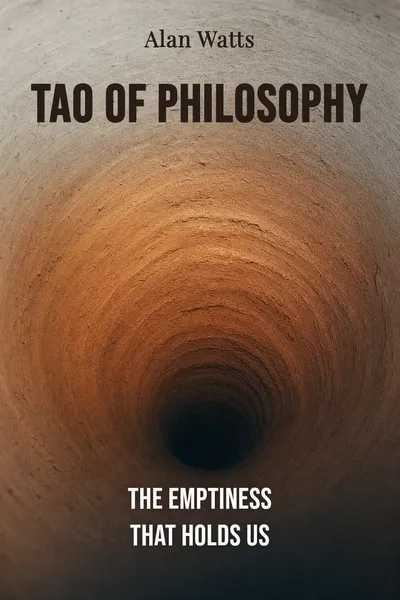
Tao of Philosophy
The emptiness that holds us
Description
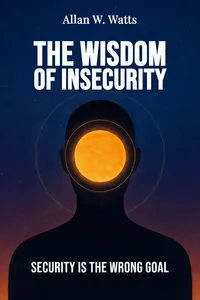
In a lecture recorded sometime in the early 1970s, a British-born man with an unmistakable radio voice asks his audience to consider a clay bowl. What makes it useful, he says, is not the clay. It is the hollow inside — the part that isn't there. The observation is old; it comes from the Tao Te Ching, a Chinese text traditionally attributed to Laozi and probably older than any single author. But the man reciting it, Alan Watts, has a gift for making a twenty-five-century-old idea sound like something you half-knew this morning and forgot. He was, by then, one of the most listened-to voices in America explaining Eastern thought to Western ears.
Watts died in 1973, and much of what survives him is spoken rather than written — talks taped in seminars, on ferryboats, in a cabin on Mount Tamalpais. Tao of Philosophy gathers several of these pieces, edited by his son Mark, together with a written essay from 1953. The collection is not a treatise. It circles a handful of stubborn questions — what am I, where do I stop and the world begin, why is there anything at all — and answers them from a Taoist angle, where the goal is less to solve a problem than to notice you invented it.
His credentials were unusual for a man who spent his life telling people to relax. Watts had been an Episcopal priest, a graduate-school dean, a research fellow at Harvard. He left the institutions behind and kept the learning, and what he did with it was closer to performance than to scholarship. The wager of these essays is that some of the deepest things about being alive are not hard to understand — they are only hard to feel, because we are looking straight past the empty space that holds everything together.
The question we’re asking : What does a Taoist see when they look at a clay bowl, a human body, or a universe — and why does it change the way any of them feels?What we’ll see : How Watts turned an ancient Chinese intuition into a way of loosening the knots we tie ourselves in without noticing.
Table of contents
01 Chapter 1 — The bowl is useful because it is empty
Watts liked to begin with objects you could hold. The bowl is his favorite, and it comes almost verbatim from the eleventh chapter of the Tao Te Ching: thirty spokes share a wheel's hub, but it is the hole at the center that makes the wheel turn; we shape clay into a pot, but the emptiness inside is what we actually use; we cut doors and windows for a room, and it is the empty space that makes it livable. The lesson, stated plainly, sounds almost like a riddle. What we call useful is the presence of the material. What is actually useful is the absence it surrounds.
For Watts this was not a decorative paradox but a correction to a habit of attention. We are trained, he argued, to notice things — the figure, not the ground; the object, not the space; the noise, not the silence that lets us hear it. The West had built an extraordinary civilization on this habit, on the conviction that reality is made of stuff and that the gaps between the stuff are simply nothing, uninteresting, waiting to be filled. Taoism reverses the emphasis. The nothing is not a failure of somethingness. It is the condition that makes something usable at all.

02 Chapter 2 — We are not born into the world — we grow out of it
The line Watts returns to most often is deceptively simple: we do not come into this world, we come out of it. The ordinary story has us arriving — a self dropped into a foreign environment, an ego parachuted into a body, a stranger in a strange land who must then fight to survive against everything that is not him. Watts thought this picture was not only gloomy but mistaken, in the way a bad map is mistaken. It draws a hard line where there is only a gradient.
His preferred image was the apple tree. A tree apples; that is what it does, the way the Earth peoples. A human being is not an accident marooned on a rock in space. A human being is something the universe is doing, an activity of the whole, the way a wave is an activity of the ocean rather than a thing riding on top of it. Ask where the wave stops and the sea begins and the question dissolves. Ask where you stop and the world begins and, Watts insisted, the same thing happens if you look honestly — your breath is the air, your warmth is the sun, and the skin you took for a wall is closer to a bridge.
03 Chapter 3 — The pointless universe, and why that is a relief
Watts had a habit of saying, with evident delight, that the universe has no purpose — and then watching people brace as though he had announced a catastrophe. The West, shaped by centuries of Christian and industrial thinking, had tied meaning to purpose, and purpose to work: everything must be for something, headed somewhere, justified by a result down the line. A life, on this model, is a project, and the point of it is always further ahead. Watts thought this was a peculiar way to be miserable.
He drew the contrast with music, and it is one of his sharpest strokes. Nobody listens to a symphony in order to reach the final chord. If the point were the ending, the best conductors would play fastest and the finest performance would be the one that finished soonest. We do not treat music this way because we understand, at least while listening, that the meaning is in the playing, spread across the whole of it, not banked at the end. Then we walk out of the concert hall and live the rest of our lives as if the goal were to get to the finish as efficiently as possible. We treat existence as a journey to a destination, when it is far more like a dance, or a song.
04 Chapter 4 — The philosopher who wanted to be misunderstood
Read enough of these talks and a question surfaces about the man giving them. Watts was, by his own cheerful admission, a philosophical entertainer — a phrase he used without embarrassment. He was not building a system, defending a thesis, or asking to be graded. He had trained inside the institutions of Western religion and scholarship, taken what he found valuable, and stepped out to do something the academy had little category for: to make the strangest ideas in human thought sound like good company. That posture is itself Taoist. The sage in the Tao Te Ching does not lecture; he points, and steps aside.
This is why the essays resist being turned into doctrine, and why Watts would have distrusted anyone who tried. The whole thrust of the collection is that the deep facts about being alive are not conclusions to be adopted but perceptions to be recovered — things a child knows before being taught otherwise, things a bowl demonstrates better than a sentence can. To convert them into a philosophy you subscribe to would be to fill the empty space, to mistake the finger for the moon it indicates. He would rather be enjoyed and half-forgotten than quoted as an authority.
05 Conclusion
We started with a clay bowl and the claim that its emptiness is the useful part. By the end, the same shape has turned up everywhere Watts looked. The self is a hollow we mistook for a wall. The universe is a process with no purpose banked at its end, which frees the whole of it to matter now. The silence around a note is what lets the note be heard. It is one idea, patiently rotated, until the thing we were taught to overlook becomes the thing we cannot stop seeing.
Related books