Symposium
Sex, gender, human nature
Description
Sometime around 416 BC, in an Athens still at war, a tragic poet named Agathon threw a party to celebrate a prize he had just won. The next morning most of the guests were nursing hangovers, so they made a pact: no heavy drinking tonight, and no flute-girl. Instead, each man at the couch would give a speech in praise of Eros — the god of love and desire. Plato wrote it all down, or invented it, decades later, and called it the Symposium, which just means a drinking party. It reads like the transcript of one very good, very strange dinner conversation, the kind you replay for days afterward.
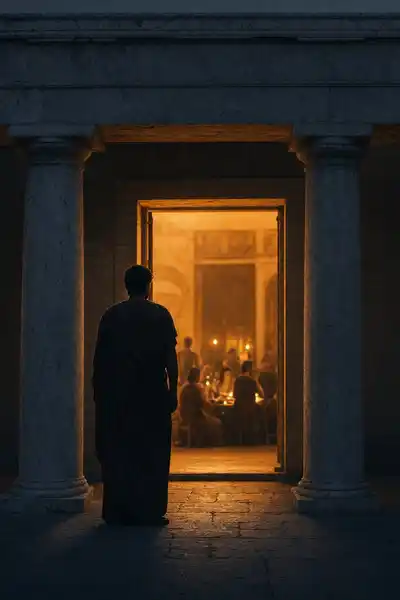
What makes it strange is that the guests never quite agree on what they are praising. One calls love the oldest of the gods; another says there are two of them, a noble one and a vulgar one. A doctor turns it into a theory of bodily balance. A comic playwright tells a myth about creatures cut in half. And then Socrates arrives, having stood motionless in a neighbor's porch for hours, and reframes the whole thing by claiming his wisdom about love came from a woman. By the end, a drunk Alcibiades crashes in and delivers a speech about Socrates himself.
Twenty-four centuries on, the Symposium keeps getting pulled into arguments its guests could not have imagined — about sexuality, about gender, about whether desire is a wound or a wing. It is a book people quote without having read and read without agreeing on. That is part of why it endures: it stages a debate rather than settling one, and the debate happens to be about the thing everyone claims to be an expert on and nobody can define.
The question we’re asking : When a room full of Athenians tried to praise love, what did they end up saying about desire, gender, and what human beings actually are?What we’ll see : A single night of speeches that turns a party game into one of the oldest arguments about who we are.
Table of contents
01 Chapter 1 — A drinking party with a rule
The setting matters more than it looks. A symposium in classical Athens was a codified thing: men reclining on couches, wine mixed with water, entertainment, and a good deal of philosophical showing-off. Plato takes this ordinary social form and drains it of the usual excess. The men agree to send the flute-girl away and to talk instead — each giving a set-piece in praise of Eros, going around the room in order. The party game becomes the structure of the book, and the structure is the argument: love gets examined from six angles, and no single angle is allowed the last word.
The frame is deliberately unreliable. We are not hearing the dinner directly. We are hearing Apollodorus retell it to a friend, years after the fact, based on what a man named Aristodemus told him — and Aristodemus was there but admits he does not remember everything, and Socrates apparently corrected some of it later. Plato buries the famous night under layers of hearsay, as if to warn us that what follows is polished memory, not a recording. The most influential account of love in the Western canon opens by confessing it is secondhand.

02 Chapter 2 — Six speeches, six ways to praise love
The first speeches build a kind of staircase. Phaedrus opens with love as the oldest and most ennobling of forces — the thing that makes people brave, because no one wants to look like a coward in front of someone they love. Pausanias corrects him by splitting Eros in two: a common love, aimed at bodies and gratification, and a heavenly love, aimed at character and mind. This is where the book becomes frank about its world. The love Pausanias praises is that between an older man and a younger one, and much of the dialogue assumes that setting as the natural home of the highest affection — a fact modern readers have to sit with rather than smooth over.
Then the register shifts. Eryximachus, a doctor, hijacks Eros for medicine and cosmology, arguing that love is really the principle of balance running through bodies, music, weather, the whole universe. It is the driest speech, and Plato seems half to be teasing the professional who reduces desire to a theory of harmony. The point lands anyway: even the physician cannot resist making love the key to everything he already knew about.
03 Chapter 3 — The split creatures and the ladder
Aristophanes tells a myth that has outlived its author's intentions. Once, he says, human beings were round, doubled creatures with four arms, four legs, and two faces — some male-male, some female-female, some male-female. They were powerful enough to threaten the gods, so Zeus sliced each of them in two, and ever since, every half wanders the earth looking for the other half it was cut from. That searching is what we call love: not a desire for pleasure, but a longing to be made whole again, to fuse back into the creature we once were.
It is a comic story, told by a comedian, and Plato clearly means some of it as a joke. But it is also the first place in Western writing where romantic desire is described as the pursuit of a missing other half, and where same-sex and opposite-sex attraction are given the same mythic origin, treated as variations of one human longing rather than as separate categories. People today reach for it to talk about soulmates, about being someone's other half, about the orientation of desire — often without knowing they are quoting a two-thousand-year-old joke that Plato may have wanted us to smile at even as it moves us.
04 Chapter 4 — What the party still says about us
Strip away the couches and the wine, and the Symposium is a book about what desire reveals. Its guests disagree on almost everything, but Socrates plants an idea that outlasts the disagreement: we want what we lack. Desire is not a sign that we are full and overflowing; it is a sign that we are incomplete, reaching for something we do not possess. That single move turns love from a topic into a mirror. Tell me what you long for, the book implies, and I will tell you what kind of being you are — a creature defined less by what it has than by what it is missing.
This is why the dialogue keeps getting drafted into modern arguments it never anticipated. When people debate whether attraction is fixed or fluid, whether gender categories are natural or made, whether the point of love is union or self-transcendence, they are, often unknowingly, redistributing the speeches of that Athenian dinner. Aristophanes gave us the language of halves and wholeness. Diotima gave us the idea that eros can be redirected upward, sublimated into art or thought — a notion that runs, quietly, all the way to Freud. The party did not settle these questions; it opened them, and left them open.
05 Conclusion
By dawn the party has thinned out. Most guests are asleep or gone; Socrates is still talking, arguing to a fading Agathon and Aristophanes that the same person should be able to write both comedy and tragedy — before he too gets up, washes, and goes about his ordinary day. The great night of speeches ends not with a conclusion but with people drifting off, half-convinced, half-drunk, carrying different versions of what was said. Plato lets the evening dissolve the way real conversations do, without a verdict.
Related books