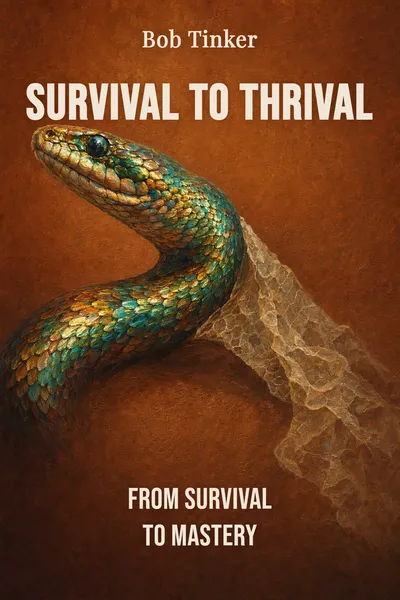
Survival to Thrival
From survival to mastery
Description
Bob Tinker spent eight years building MobileIron, a mobile-security company that went from four people in a room to a public company worth more than a billion dollars. Somewhere in the middle of that ride, he noticed something odd. The things that had kept the company alive in year one — the improvised bets, the founder saying yes to everything, the tiny team that could turn on a dime — were the exact things starting to break it in year five. What had worked was now in the way. And nobody had warned him it would happen.
That gap between what got you here and what gets you there is the subject of the book he later wrote with Tae Hea Nahm, an investor who had watched the same pattern play out across dozens of companies. Their word for the shift is thrival: the messy, unglamorous stretch after a startup has proven it won't die, when it has to figure out how to actually grow. Survival is binary — you make it or you don't. Thrival is harder, because success itself becomes the thing you have to manage. The company that survives is rarely the company that's built to thrive, and turning one into the other is where most founders get stuck.
Tinker's argument is that this transition isn't luck or genius. It's a set of recognizable, repeatable shifts — in the company, in the team, and in the founder personally — that can be named ahead of time and prepared for. He writes as someone who lived it rather than theorized it, and the book reads less like a manual than like a founder pulling us aside to say: here's what nobody told me.
The question we’re asking : How does a company that has merely survived learn to actually thrive — and what has to change for it to happen?What we’ll see : A founder-operator's map of the shifts that separate staying alive from growing up, drawn from the ride he took himself.
Table of contents
01 Chapter 1 — The two companies inside one startup
The first idea Tinker plants is deceptively simple: the company that survives and the company that thrives are not the same company. They share a name, an office, sometimes a logo. But they run on different physics. Survival is about finding a reason to exist — proving that someone, somewhere, will pay for the thing you built. Thrival is about turning that single proof point into a repeatable, scalable machine. Confuse the two and you optimize for the wrong thing at the wrong moment.
In the survival phase, everything is a hunt. There is no playbook, because there's no pattern yet to codify. The founder chases every deal, tries every message, pivots on a dime, and holds the whole strategy in their head. Chaos isn't a bug here — it's the correct operating mode. A startup that tries to be orderly before it has found what works is just organizing its way to death. Tinker is blunt that the mess of the early days is a feature, not a failure of discipline.

02 Chapter 2 — Building the team that fits the phase
If the company changes shape between survival and thrival, so must the people running it — and this is where Tinker is at his most useful and least sentimental. The team that got you through survival is, statistically, not the team that will get you through scale. Not because those early people are weak, but because the job itself has changed underneath them. The generalist who could do six roles at once in year one is now competing against specialists who do one role at world-class depth. Loyalty and capability start pulling in different directions.
Tinker frames the early team as "do-ers" and the scaling team as "builders." A do-er executes; a builder builds the machine that executes and the team that runs it. Both are valuable, but they are not interchangeable, and the same person rarely holds both instincts at the moment the company needs them. The uncomfortable consequence is that some of the people who bled for the company in its hardest year will not have a seat in its best year. Tinker doesn't dress this up. He treats it as one of the genuinely hard costs of growth, one founders tend to avoid until the avoidance itself becomes the problem.
03 Chapter 3 — Founders don't scale — they change
The hardest transition in the book isn't organizational. It's personal, and it happens inside the founder. Tinker's own story is the spine here: the CEO who was celebrated for being in every deal, every product call, every hire, slowly discovering that his greatest strength had become the company's ceiling. The reflex that built the company — do it yourself, decide fast, stay close to everything — is precisely the reflex that has to be unlearned. And nothing about founder wiring makes that easy.
He describes the shift as moving from doing the work to building the machine that does the work, and then to leading the people who build the machine. Each step forces the founder to let go of something that once defined them. The product visionary has to stop touching the product. The relentless closer has to stop closing and start building a sales org. Every promotion is also a small grief — a piece of identity handed off to someone else, usually someone who does it differently, sometimes better. Tinker is candid that this feels less like growth and more like loss, at least while it's happening.
04 Chapter 4 — When the whole company crosses the same bridge
Step back from the founder's private struggle and a larger pattern comes into view. The transitions Tinker maps — company, team, self — are not three separate problems that happen to arrive together. They're the same transition experienced at three altitudes, and they have to move roughly in sync. A founder who evolves while the team stays stuck creates friction; a team that scales while the founder clings to control creates a bottleneck at the top. Thrival happens when the whole organization crosses the bridge together, not when one part of it drags the rest.
This is where Tinker's most quietly radical claim sits. Thriving isn't a trait some companies or people are born with. It's a set of learnable, nameable transitions — and the reason so many startups stall isn't lack of talent or market, but the failure to recognize that a crossing is even underway. What looks like a strategy problem is usually a phase problem: the organization is running survival-era instincts in a thrival-era world. Once the transition has a name, it stops being a mysterious loss of momentum and becomes something a team can talk about, plan for, and staff against.
05 Conclusion
MobileIron went public in 2014, and Tinker eventually handed the company to leaders built for the next phase — the final move in a story about learning to let go. What he took from the eight years wasn't a formula for a hit product but a map of the crossings that every fast-growing company makes and that almost nobody sees coming. Survival earns you the right to keep playing. Thrival is the harder, longer game of turning that survival into something that compounds.
Related books