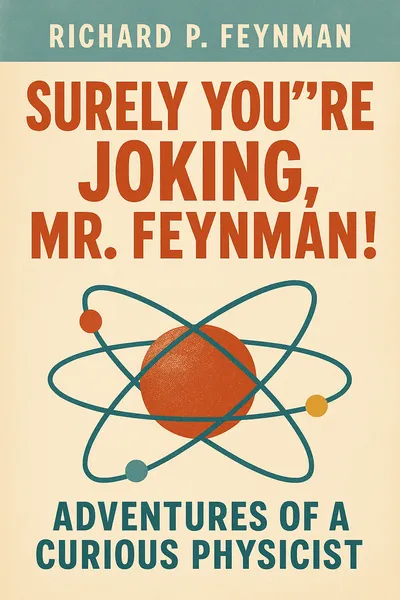
"Surely You're Joking, Mr. Feynman!"
Adventures of a curious physicist
Description
Richard Phillips Feynman's 'Surely You're Joking, Mr. Feynman!' presents a compelling thesis that the pursuit of scientific knowledge and intellectual curiosity transcends institutional boundaries and conventional academic expectations, revealing the fundamentally playful and subversive nature of authentic scientific inquiry. Feynman's autobiographical collection emerges from the unique position of a Nobel laureate physicist who deliberately cultivated an anti-establishment persona within the scientific community. Published during the height of Cold War technocracy, when science had become increasingly institutionalized and bureaucratized, this work presents a counter-narrative to the conventional image of the serious, methodical scientist. The anecdotal format serves as a vehicle for examining the relationship between individual creativity and institutional scientific practice, positioning the author as both insider and outsider to academic culture.
The work addresses a central research question: How does authentic scientific curiosity manifest itself when freed from institutional constraints and social expectations? Feynman defends the thesis that scientific excellence emerges not from conformity to academic norms but from maintaining childlike curiosity and intellectual playfulness. The main stake involves demonstrating that the bureaucratization of science threatens the very spirit of inquiry that makes scientific discovery possible. Through his narrative, Feynman constructs a compelling argument for scientific practice rooted in curiosity rather than careerism, demonstrating how institutional pressures can diminish the creative potential of scientific inquiry. His anecdotal approach successfully illustrates the productive tension between individual genius and collective scientific enterprise, while revealing the performative dimensions of academic authority. The work's enduring popularity reflects its resonance with broader cultural anxieties about technocratic governance and professional expertise.
Table of contents
01 The Performative Construction of Scientific Identity
Feynman's narrative reveals the deliberate construction of a scientific persona that challenges traditional academic hierarchies through calculated irreverence. His anecdotes function as performative acts that establish authority not through institutional credentialing but through demonstrated intellectual agility and problem-solving creativity. The author employs humor and self-deprecation as rhetorical strategies to deflate academic pretension while simultaneously asserting his superior understanding of natural phenomena.

02 The Democratization of Scientific Knowledge
The work challenges the elitist gatekeeping mechanisms that restrict scientific discourse to credentialed experts by demonstrating how complex physical principles can emerge from everyday observations and amateur experimentation. Feynman's encounters with non-academics often yield genuine insights that escape formal scientific investigation, suggesting that institutional science may systematically exclude valuable perspectives. His interdisciplinary wanderings into biology, psychology, and art represent acts of intellectual trespassing that violate academic territorial boundaries while producing novel understanding.
03 The Subversion of Institutional Authority
The narrative systematically exposes the arbitrary nature of academic and governmental bureaucracy through episodes of institutional resistance and non-compliance. Feynman's refusal to engage with administrative procedures, committee work, and formal recognition ceremonies represents a fundamental rejection of the organizational structures that enable large-scale scientific research. His critique extends beyond mere personal preference to reveal how institutional demands can corrupt scientific integrity and divert energy from genuine inquiry.
04 The Ethics of Intellectual Freedom
The work raises profound questions about the moral responsibilities of scientists within institutional frameworks that may compromise ethical integrity. Feynman's selective engagement with various institutions reflects an attempt to maintain intellectual autonomy while benefiting from collective scientific resources and infrastructure. His casual treatment of security protocols and classification systems suggests a privileged position that allows him to ignore consequences that might affect less established researchers.
05 Critical Assessment and Contemporary Implications
The work's celebratory tone toward Feynman's iconoclastic behavior obscures important questions about privilege and access within scientific institutions. His ability to disregard administrative requirements and social conventions relies on exceptional achievement and institutional protection unavailable to most researchers. The anecdotal format, while engaging, lacks systematic analysis of the structural forces shaping scientific practice and may inadvertently reinforce individualistic myths about scientific discovery that ignore collaborative dimensions of research. However, the author's privileged position as an established Nobel laureate enables a form of institutional criticism that may not be available to more vulnerable members of the scientific community. The narrative ultimately affirms the possibility of maintaining intellectual integrity within compromised institutional contexts while acknowledging the significant personal and professional costs of such resistance.
Related books