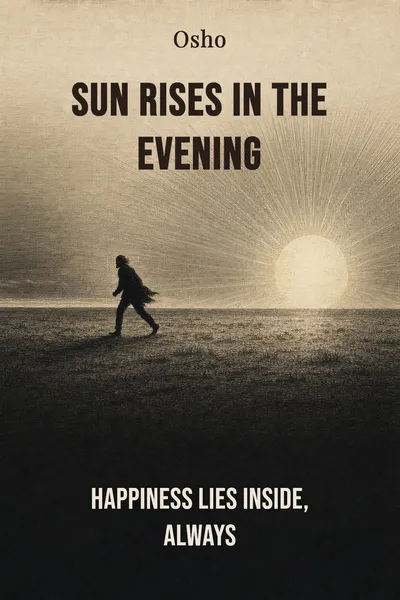
Sun Rises in the Evening
Happiness lies inside, always
Description
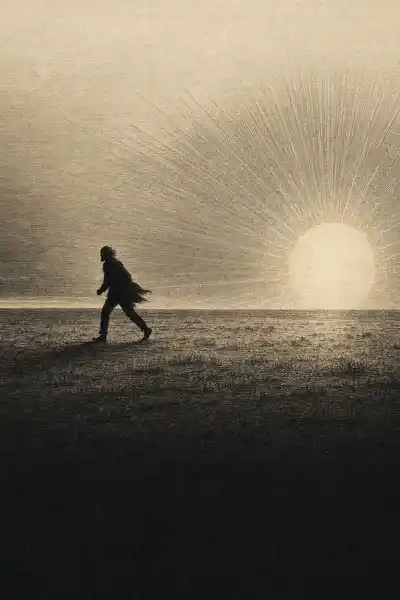
There's a phrase Osho keeps circling back to across his talks, and it gives the collection its odd, contrary title: the sun rises in the evening. On its face it's nonsense — the kind of line that sounds like a Zen riddle designed to short-circuit the reasonable mind. That's exactly the point. Osho, the Indian mystic born Chandra Mohan Jain in 1931, spent his life poking holes in the reasonable mind. He argued that our whole approach to happiness runs backwards: we treat it as a sunrise we're chasing on the horizon, always ahead of us, always somewhere we haven't reached yet. And so we run east, toward the dawn, our entire lives — and die having never noticed the light was behind us the whole time.
The insight underneath the book is unglamorous once you say it plainly. We look for happiness in the wrong direction. We reach outward — money, status, the next relationship, the better job, the trip we've been saving for — and each acquisition delivers a brief flare of relief before the wanting resumes. Osho isn't the first to say this; ascetics and Stoics said versions of it for millennia. What he does differently is refuse the moralizing tone. He doesn't tell us to want less or to be good. He tells us we've simply misread where the thing we're after actually lives.
That relocation — from outside to inside — is the whole argument, and it's harder than it sounds, because the self that goes looking is itself part of the problem. Osho's teaching turns on a strange loop: the seeker is the obstacle to what's sought. Which raises the question of what, exactly, we're supposed to do with that, and whether there's anything to do at all.
The question we’re asking : If happiness isn't out there waiting to be found, then why do we spend our whole lives searching outward for it?What we’ll see : How Osho relocates contentment from the world to the moment, and what that costs the self we've spent a lifetime assembling.
Table of contents
01Chapter 1 — The chase that never ends
Osho starts with a picture we all recognize. We tell ourselves a simple story: when the promotion lands, when the house is bought, when the right person shows up, then we'll be happy. Happiness is scheduled for after. It's a destination, and life is the commute. The trouble, he points out, is that the commute never ends, because every arrival immediately becomes a new departure. Get the promotion and there's a higher one. Buy the house and it needs a bigger one. The horizon, by definition, recedes as you walk toward it.
What interests Osho is not that this is a mistake but that it's such a durable one. Why do we keep running when the running so plainly doesn't deliver? His answer is that the chase itself has become a way of not being present. As long as we're reaching for the future, we never have to sit inside the current moment, which is the only place anything actually happens. The wanting is a kind of anesthetic. It keeps us pleasantly busy and permanently absent.

02Chapter 2 — The mind is the problem, not the tool
If happiness is inside, the obvious next question is why we can't just reach in and grab it. Osho's answer locates the obstacle precisely: the mind. Not the brain as an organ, but the ceaseless internal commentary — the planning, the rehearsing, the replaying, the judging — that we mistake for our very self. This chatter, he says, is almost never in the present. It lives in a remembered past or an imagined future, dragging regret behind it and worry ahead of it. The one place it cannot go is now, and now is where we happen to be alive.
He makes a distinction that reorganizes everything. The mind is a wonderful instrument and a terrible master. Used as a tool — to solve a problem, to build something, to think a thing through — it's magnificent. The catastrophe is that it never switches off. It runs when there's nothing to run about. We've handed the instrument the controls, and so we experience life through a permanent film of thought, never touching the thing itself, only the mind's endless narration of it.
03Chapter 3 — Meditation as the way back
The practical heart of the book is meditation, though Osho means something looser and more alive than the word usually implies. He is wary of the solemn, effortful version — sitting rigidly, straining toward some pure blank state, treating stillness as an achievement to be earned. That, he says, is just the ambition of the marketplace smuggled into the temple. It's the chase again, wearing spiritual clothes. Real meditation, for him, is not a doing but an undoing, a relaxing back into what is already the case.
His central technique is witnessing. Rather than trying to stop the thoughts, you simply observe them, the way you'd watch clouds cross a sky or traffic pass on a road — with interest but without getting in the cars. The thoughts keep coming; that's fine. What changes is your relationship to them. You stop being the traffic and become the one watching it. Over time, Osho claims, the sky between the clouds grows more noticeable, and it is in that spaciousness, that gap, that happiness quietly turns out to have been waiting.
04Chapter 4 — Freedom from the borrowed self
Step back from the techniques and a larger claim comes into view, one that makes Osho's project more radical than a stress-management program. He argues that the self who has been unhappy is largely borrowed — a construction assembled from other people's expectations, inherited beliefs, the roles society handed us before we could refuse them. We were told what to want, what success looked like, what a life was for. And then we spent decades chasing a happiness defined by voices that were never ours. The search failed partly because the searcher was a fiction.
This is why the relocation of happiness from outside to inside is, for Osho, inseparable from a kind of shedding. To find the joy that arises on its own, you have to stop performing the person you were conditioned to be. That's a heavier demand than it first appears. It means loosening your grip on the ambitions, the opinions, the very identity you've spent a lifetime defending. Most people, he observes, would rather stay unhappy inside a familiar self than risk the vertigo of setting it down.
05Conclusion
Return to the impossible image. The sun does not rise in the evening — not for the man running east all his life, straining toward a horizon that keeps stepping back. Osho's collection is one long attempt to make us turn around. The happiness we chase through jobs and possessions and relationships is not ahead of us and never was; it's the quiet ground underneath the noise, available in any moment we stop long enough to notice it. The mind that translates every experience into a problem is the cloud; the watching awareness beneath it is the sky.
Related books