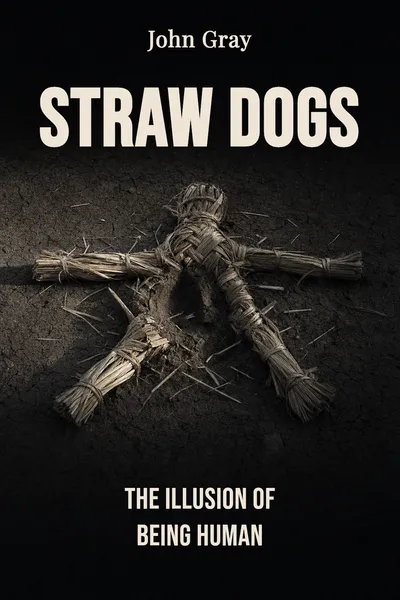
Straw Dogs
The illusion of being human
Description
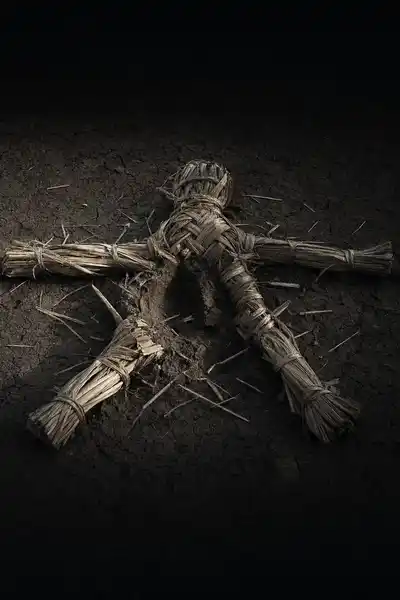
In 1971, Sam Peckinpah made a film called Straw Dogs, a brutal study of a mild academic who turns violent when cornered. John Gray borrowed the title for his 2002 book, but the phrase comes from further back — from the ancient Chinese text of Lao Tzu, where straw dogs were ceremonial figures, treated with great care during a ritual and then tossed aside and trampled once it was over. Heaven and earth, Lao Tzu wrote, are ruthless; they treat the ten thousand things as straw dogs. Gray takes that line and turns it on us. We are the straw dogs. Nature is not cruel to us, and not kind. It simply does not have us in mind at all.
That is not the sort of thing most of us are built to hear. For roughly two and a half thousand years, the Western tradition has told a flattering story: that human beings are set apart, that we possess reason, souls, free will, a destiny to master the earth and improve ourselves without limit. Plato and Christianity said it one way, the Enlightenment another, Marx and the liberals another still. Gray's claim is that these are all versions of a single faith — humanism — and that faith survived Darwin without so much as flinching. We accept in principle that we are animals. We behave as though we are something else.
Straw Dogs is a short, jagged, deliberately unsettling book, less an argument than a sustained refusal. It works by taking the beliefs we lean on hardest — progress, the self, morality, the special value of truth — and quietly removing the floor beneath each one. What it offers instead is not comfort, and not despair either. It is something stranger.
The question we’re asking : What is left of the human self-image once we stop believing we are anything more than a clever, restless animal?What we’ll see : How one philosopher takes the West's most cherished convictions about what we are and, one by one, declines to grant them.
Table of contents
01 Chapter 1 — The animal we refuse to be
Gray starts with the one fact everybody claims to accept and almost nobody digests. Darwin showed that humans are not a separate creation but one species among millions, thrown up by the same blind process that produced beetles and bacteria. There is no ladder with us at the top, no plan working itself out through evolution, no reason we should be here rather than not. We arrived by accident and we will leave the same way. This is settled science, taught in every classroom. And yet, Gray notes, hardly any serious thinker builds on it. The moment we start talking about what humans ought to do, the animal quietly vanishes and something loftier takes its place.
The trick, he argues, is that humanism kept the shape of Christianity while dropping its God. Christianity gave us the idea that humans are unique, made in a divine image, saved from the mere animal fate of the rest of creation. When faith declined, that self-image did not go with it. It was simply transferred. Where believers had looked to salvation, the secular West now looks to science, reason, progress — different vehicle, same passenger. We still expect to be redeemed. We have just stopped naming the redeemer.

02 Chapter 2 — Progress is a myth we can't shake
Of all humanist beliefs, the one Gray works hardest to dislodge is the faith in progress. We take it as obvious that history moves forward, that knowledge accumulates, that on the whole things get better and will keep doing so if we try. Gray does not deny that some things advance. Science genuinely grows: we know more about the atom than the Greeks did, and that knowledge does not slide back. Medicine cures what once killed. His argument is narrower and harder. Growth in knowledge is real. Growth in wisdom, in decency, in the human capacity to live well — that is the illusion.
The distinction matters because we smuggle the two together. Because our tools improve, we assume we improve. But every advance in knowledge, Gray points out, hands new powers to the same flawed creature. The technology that heals also builds better weapons. The chemistry that feeds billions also produced the gas chambers. Knowledge is cumulative; ethics is not. Each generation starts more or less from scratch on the question of how to treat one another, and the historical record gives no sign that later generations do it better. The twentieth century, the most scientifically advanced in history, was also the most murderous.
03 Chapter 3 — The self nobody's driving
Having questioned progress, Gray turns inward, to the thing we feel most sure of: the self. We each experience ourselves as a single, continuous person, an author sitting behind our thoughts and choosing our actions. This, Gray argues, may be the deepest illusion of all. What science and honest introspection suggest instead is a bundle of processes, largely unconscious, that throw up the sensation of a unified 'I' after the fact. The self is less a driver than a story the brain tells about a journey it did not decide.
Free will goes the same way. We are certain we could have done otherwise, that our decisions issue from a free centre of choice. But the more closely the mind is examined, the less room there is for such a centre. Experiments suggest the brain has already begun to act before we become conscious of deciding. Our sense of authorship arrives late, like a spokesman explaining a policy that was set without him. Gray does not present this as tragedy. He presents it as what an animal's inner life would look like if we stopped dressing it up.
04 Chapter 4 — Living without the story
Step back from the individual demolitions and a question presses: what does Gray want us to do with all this? Here the book turns quietly radical, because the honest answer is nothing. Straw Dogs is not a new philosophy to adopt in place of the old ones. That would be one more human project, one more scheme for improving ourselves, and Gray's whole point is that the compulsion to have a project is the sickness, not the cure. Even his own atheism, he notes, is usually just Christianity in a hurry — the same faith in salvation, now expecting science to deliver it.
What he gestures toward instead he calls, borrowing the phrase, simply seeing. Other animals do not spend their days searching for the meaning of life; they live it. They are not burdened by the demand that existence justify itself. Gray suggests the good in a human life might lie in the same direction — not in achieving some final purpose, but in the ordinary, unredeemed business of perception, contemplation, the sheer fact of being alive and aware for a while. He points to art and to poetry, and to the animals themselves, as showing this better than any argument can.
05 Conclusion
Lao Tzu's straw dogs were honoured for a day and then thrown on the fire, and no one wept for them, because they had never been anything but straw. Gray takes that image and hands it back to us as a description, not an insult. We are the ceremonial figures who mistook the ceremony for the cosmos, who assumed the care we lavish on ourselves must be mirrored somewhere in the order of things. It is not. Nature is not against us. It has simply never been for us either.
Related books