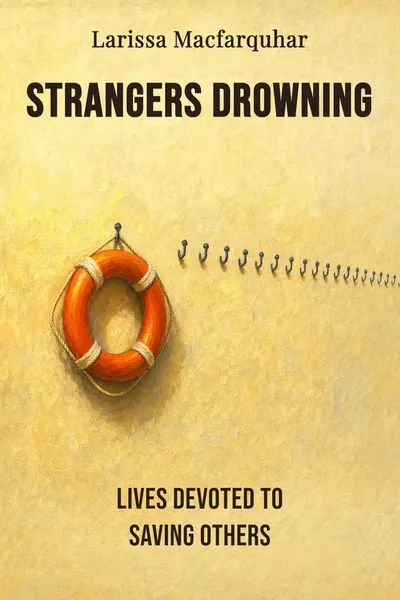
Strangers Drowning
Lives devoted to saving others
Description
There's a thought experiment the philosopher Peter Singer likes to pose. You're walking past a shallow pond and see a child drowning. You could wade in and save the child, but you'd ruin your shoes and be late for work. Almost everyone agrees you should wade in. Then Singer tightens the screw: a child is dying somewhere right now of a preventable disease, and the cost of saving that child is roughly the price of those shoes. Why does distance change the math? Most of us don't have an answer we'd say out loud. We just don't wade in. We buy the shoes.
Larissa MacFarquhar, a longtime writer at the New Yorker, spent years with the people who do wade in — again and again, at real cost to themselves and often to those closest to them. Her 2015 book Strangers Drowning is a collection of intimate portraits of extreme do-gooders: a couple who adopt many children, a woman who founds a leprosy mission in India, a man who gives away his money until he's living on almost nothing, people who donate a kidney to a total stranger. She calls them, borrowing an older word, moral saints. And she notices something uncomfortable: we don't quite like them.
That dislike is the real engine of the book. MacFarquhar isn't writing hagiography, and she isn't debunking. She's interested in the gap between how much we say we admire selflessness and how deeply we distrust it when it stands in front of us, unsmiling, asking why we've stopped at one drowning child when there are so many more.
The question we’re asking : Why do we admire selfless devotion in the abstract and recoil from it in person?What we’ll see : We meet the people who take helping others to its logical extreme — and watch what that costs them, and what it exposes in the rest of us.
Table of contents
01 Chapter 1 — The person who does the math on your life
MacFarquhar opens with the do-gooders themselves, because they're stranger than any argument about them. Take a committed utilitarian — someone who genuinely tries to live by the principle that every life counts equally and that he should do the most good possible with what he has. That sounds noble until you follow it all the way down. If a dollar spent on your own comfort could instead save a fraction of a stranger's life, then comfort starts to look like theft. Some of the people in the book give away everything past the bare minimum. One couple keeps their spending brutally low so they can donate the rest, year after year, to people they will never meet.
The trouble is that this logic doesn't stop at strangers. It runs straight through the people you love. If a birthday gift for your daughter could instead buy anti-malaria nets, the utilitarian math says the nets win — your daughter is not worth more than a child you'll never see. MacFarquhar's subjects feel this pressure constantly. They aren't monsters; several of them agonize over exactly where to draw the line, and some refuse to draw it at all. That refusal is what unsettles us. We want our morality to have a fence around it, a zone where our own people matter more. The moral saint tears the fence down.

02 Chapter 2 — The old word for what we can't quite stand
MacFarquhar reaches back for a vocabulary we've mostly lost. The word saint used to describe exactly this kind of person, and she notes how our modern discomfort has a long philosophical pedigree. In 1982 the philosopher Susan Wolf published an essay arguing, more or less, that moral saints make bad company — that a person wholly devoted to being good would lack the range of interests, tastes and mild selfishness that make someone likable. A saint who spends no time on tennis or gossip or good wine is, Wolf suggested, missing something we value. MacFarquhar takes this seriously without conceding it. She wonders whether our defense of the well-rounded life is really a defense, or just a way of excusing ourselves.
03 Chapter 3 — Adoption as a full-time occupation
One of the book's most vivid stories is a couple who turn helping into the entire architecture of their household. They adopt children — many of them, and often the ones no one else will take: kids with severe disabilities, kids scarred by abuse, kids who will need care for the rest of their lives. The house fills up. The parents' own comfort shrinks to almost nothing. MacFarquhar renders it without sentimentality: the sleepless nights, the medical crises, the sheer logistical grind of a home run like a small institution devoted to salvage.
What she captures is the dilemma buried inside the generosity. Every additional child is one more life pulled toward safety — and also a thinner slice of attention for the children already there. The couple must constantly weigh the stranger who could be saved against the family they've already built, which is Singer's pond problem lived out over decades at the dinner table. There is no clean answer. Sometimes they take the next child and something in the household frays. Sometimes they don't, and a child somewhere else goes without. MacFarquhar refuses to tell us they got it right.
04 Chapter 4 — What we're really arguing about when we argue about them
Step back from the individual portraits and MacFarquhar's true subject comes into focus, and it isn't the saints — it's us. The book is a long, patient examination of the fence ordinary morality quietly builds around itself: the unspoken agreement that we owe a great deal to our own and very little to strangers, that a life spent mostly on ourselves is not just permitted but healthy. The do-gooders don't accept that fence, and their refusal turns them into a kind of mirror. Everything we say to explain why they've gone too far is also an explanation of why we haven't gone far enough.
She's fair to both sides. There are genuine arguments against the saintly life — that it can neglect the near in favor of the far, that it risks a coldness dressed as principle, that human beings may simply not be built to love everyone equally. But MacFarquhar keeps noticing how eagerly we reach for these arguments, and how rarely we apply the same scrutiny to our own restraint. We call the do-gooder naive, rigid, self-righteous. We almost never call ourselves complacent, even though the drowning children are, on the utilitarian math, exactly as real as they say.
05 Conclusion
MacFarquhar ends where she began, with the flinch. She never argues that we should all become moral saints, and she never argues that the saints are fooling themselves. She leaves the tension intact, because the tension is honest. The people in her book have done something most of us won't: they've taken the equal worth of strangers seriously enough to reorganize their entire lives around it, and paid for it in the currency of ordinary comfort, of family strain, of being found a little hard to love.
Related books