

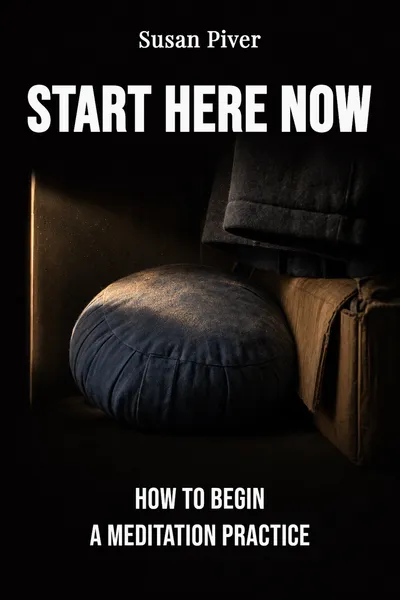
Start Here Now
How to begin a meditation practice
Description
Somewhere between the yoga app subscription and the third abandoned journal, most of us have decided we should meditate. We know it's supposed to be good for us — calmer, kinder, less reactive, all of it. And yet the cushion stays in the closet. The problem, according to the meditation teacher Susan Piver, is rarely that people can't do it. It's that they've built the thing up into something enormous: a discipline for saints, a talent you either have or you don't, a project with a finish line where enlightenment presumably waits. Her book Start Here Now, published in 2015, is an attempt to talk everyone down from that ledge.
Piver has been teaching meditation for years, much of it online through the Open Heart Project, a community that grew to tens of thousands of members who wanted exactly this — a way in that didn't require moving to a monastery. She draws on the Tibetan Buddhist tradition she trained in, but she strips away almost everything that makes it feel like a foreign country. What's left is close to instructions a friend might give: sit down, do this with your attention, expect it to be harder and stranger than you thought, come back anyway.
The surprise of the book is how little it asks. There's no promise that we'll become serene. There's a fair amount of admitting that the mind is a mess and will stay a mess. What Piver offers instead is a different relationship to that mess — one built on returning rather than winning. It's a small shift, and it changes what the whole thing is for.
The question we’re asking : How does someone actually begin a meditation practice, and why do so many of us stall before we start?What we’ll see : A teacher's case that sitting still is simpler, stranger and kinder than the version we've been avoiding.
Table of contents
01Chapter 1 — The technique is almost embarrassingly simple
The first thing Piver does is take the mystery out of the mechanics. The form of meditation she teaches, drawn from the Shambhala tradition of Chögyam Trungpa, comes down to a few physical instructions and one mental one. Sit down — on a cushion on the floor, or on a chair if that's what the body wants. Let the spine be upright but not rigid, the way a mountain sits rather than the way a soldier stands. Rest the hands on the thighs. Let the eyes stay open, gaze soft and lowered a few feet ahead. Then place the attention lightly on the breath, particularly the out-breath, and let it go out with the air.
That's essentially the whole apparatus. Piver is deliberately unglamorous about it. There is no special breathing to master, no mantra to memorize, no image to visualize behind closed eyes. The eyes even stay open, which surprises people who assumed meditation meant retreating inward — the point, she notes, is not to escape the world but to be present in it, this room, this body, this ordinary afternoon.

02Chapter 2 — What the mind actually does when we sit
The moment people begin, they run into the same wall, and they nearly all draw the same wrong conclusion from it. They sit, they aim at the breath, and within seconds the mind produces an unbroken stream of noise — memories, plans, worries, songs, a running commentary on how badly the meditation is going. From this they conclude they are uniquely bad at it, that their mind is somehow more chaotic than everyone else's, and that they should probably stop. Piver's response is to laugh, kindly, and tell them this is exactly what a mind does. All minds. There is no version of the practice where the thinking stops.
This is the reframe the book turns on. We tend to imagine meditation as the achievement of a blank, quiet mind, and so we measure every session against that fantasy and fail. Piver replaces the fantasy with something more honest and more useful: meditation is not the absence of thought but a changed relationship to it. We are not trying to empty the mind. We are learning to notice thoughts as they arise, without climbing aboard each one and riding it to the next town.
03Chapter 3 — The obstacles are the practice
Much of Start Here Now is devoted to the objections people bring, and Piver takes each one seriously rather than swatting it away. There's the person who says they don't have time, to whom she gently points out that we find time for the things we've decided matter, and that ten minutes is not, in fact, an hour. There's the person who is bored, or restless, or suddenly furious for no reason they can name. There's the person who cries. And there's the very common one who says: I tried, and I'm just not good at this.
Her move, every time, is to fold the obstacle back into the practice instead of treating it as an interruption of it. Boredom, restlessness, doubt, the itch to check the phone — these aren't detours from meditation, they're what shows up on the road. Sitting still long enough, we start to meet whatever we usually stay busy enough to avoid. That can be uncomfortable. Piver's counsel is not to fix it or analyze it but to notice it with some tenderness, the way we might toward a friend having a hard afternoon, and then come back to the breath.
04Chapter 4 — A place to sit, and enough excuses to never sit there
Set the technique and the obstacles side by side and something larger comes into view about why we struggle with all of this. Piver's meditation asks for almost nothing — a few minutes, a spot on the floor, a willingness to keep returning — and yet we resist it fiercely. The resistance, she suggests, isn't really about the difficulty of the task. It's about what the task exposes. Sitting quietly with ourselves, we come face to face with a mind we've spent most of our lives distracting, managing and outrunning.
What her approach quietly refuses is the frame almost everything else puts around this. Meditation, in the wellness economy, has become another optimization — a way to be more productive, more focused, a sharper version of the self we're already anxiously trying to improve. Piver's version isn't that. She's not offering a tool to fix us. She's offering a way to be with ourselves that doesn't start from the assumption that we're broken. The cushion is not a workshop. It's a place to stop trying to become someone better for a few minutes a day.
05Conclusion
The cushion in the closet was never waiting for a better version of us. That's the quiet argument running underneath every page of Start Here Now: the practice isn't something we earn our way into once we've become calm, disciplined, or spiritually serious. It's something we do exactly as we are, with the mind we happen to have today. Piver takes what looks like an intimidating discipline and returns it to its actual size — a few minutes of sitting, a soft gaze, a breath, and the small, repeatable act of noticing we've drifted and coming back.