Stalingrad 1942
The battle reported from inside
Description
In the autumn of 1942, a British-born correspondent named Alexander Werth was in the Soviet Union, filing for the BBC and the Sunday Times, watching a war that most of his Western readers understood only as a line on a map moving east. Werth had a rare advantage. He spoke Russian, he had grown up partly in St Petersburg, and Soviet authorities let him travel to the front and talk to the men who had been there. When he later gathered his wartime dispatches and notes into the book that carries the city's name, he was not writing military history from an archive. He was writing down what he had heard from soldiers with their boots still wet, in the weeks the fighting was still going on.
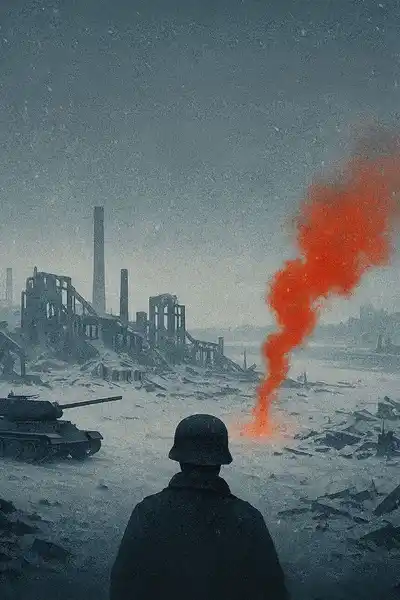
The subject was a single industrial city on the Volga, strung out along the west bank, that by late summer had been reduced to a landscape of burned factories and cellars. The German Sixth Army, one of the strongest formations Hitler had, was pushing into it block by block. For months the world assumed the city would fall the way so much else had fallen since June 1941. Then, in November, it did not fall — and something turned that would not turn back. Werth was close enough to feel the change before the communiqués caught up with it.
What makes his account worth revisiting is not the strategy, which has been mapped a thousand times since. It is the texture: the smell of the ruins, the exhaustion in a captured general's face, the flat voices of men describing what a hundred and forty days on the Volga had actually been. Werth trusted the eyewitness over the map, and the war looks different told that way.
The question we’re asking : How did one reporter's ground-level view of Stalingrad capture a turning point that the maps and communiqués were still catching up to?What we’ll see : Through Werth's dispatches — the city that could not be surrendered, the fighting waged room by room, the encirclement that swallowed an army, and what the correspondent read in the ruins.
Table of contents
01Chapter 1 — The city that could not be given up
Werth is careful, early on, about why this particular city mattered so much to both sides — and his answer is not only the one the textbooks give. Yes, it sat on the Volga, the great artery carrying oil up from the Caucasus. Yes, it was a manufacturing center turning out tanks and guns. But he keeps returning to something less tidy: the name. A city called after Stalin was not going to be handed over quietly, and a German army that took it would have taken more than a river crossing. Both leaders, Werth suggests, invested the place with a weight it had not asked for.
By the time the German advance reached it in the late summer of 1942, the situation looked close to hopeless from the Soviet side. Werth records the mood of those weeks without softening it — the retreats across the southern steppe had been long and grim, and there was real fear that the whole front was coming apart. The order that circulated that summer, remembered as "Not a step back," was not rhetoric. It described a decision to stop running, whatever it cost, and to stop running here.

02Chapter 2 — A war fought street by street
The heart of Werth's account is the strange kind of war the city produced. This was not the war of sweeping arrows across a map that the German army had won everywhere else. It was fighting reduced to its smallest possible scale — a stairwell, a floor of a factory, the two ends of a single street. The Germans had air superiority and more armor, but neither counted for much among rubble where the front line ran through a building and the enemy might be one wall away. The soldiers, Werth relays, had a phrase for the closeness of it, the sense that the distance between the armies had shrunk to the length of a grenade's throw.
He listens to how men described the days. There were no clean lines. A block could change hands several times before nightfall, be lost again by morning, then be contested house by house for another week. A well-known grain elevator, a department store, a hill above the city called Mamayev Kurgan — these ordinary landmarks became the objects of fighting so prolonged that soldiers spoke of them the way earlier wars spoke of famous forts. The hill in particular changed hands so often that Werth's informants seemed to lose count.
03Chapter 3 — The trap closes on the Sixth Army
While the Germans exhausted themselves inside the city, the Soviet command was doing something the fighting in the streets concealed. In November 1942 came the counterstroke — a double envelopment that struck not at the strong German center but at the weaker allied armies holding the flanks on the open steppe to the north and south. The two Soviet pincers drove in and met behind the city within days. The Sixth Army, which had spent months trying to take the last few blocks of the west bank, woke to find itself surrounded.
Werth conveys how completely the situation reversed. The besiegers had become the besieged. Inside the pocket were something on the order of a quarter of a million men, cut off from resupply as the winter set in hard. An attempt to break through from outside and relieve them fell short. A promise to keep them fed by air failed against the weather and the distances and the sheer number of mouths. Hitler forbade a breakout while it might still have worked, and the ring only tightened.
04Chapter 4 — What the ruins told the correspondent
Standing in the wreckage after the fighting stopped, Werth grasped something that the running tally of casualties and captured guns could not carry: that this had been the psychological hinge of the entire war in the East, and probably of the war as a whole. Until Stalingrad, the German army had known mostly advance. Its soldiers, and its enemies, had half-absorbed the idea that it could not be stopped. In the ruins on the Volga that idea died, and Werth understood that its death mattered as much as the ground itself.
His reporting insists on the scale of what the numbers stood for. This was not a battle measured in the thousands but in the hundreds of thousands, on each side, over less than half a year, concentrated in and around a single city. Werth had walked through enough of the aftermath — the fields of frozen dead, the gutted factories, the survivors — to refuse any account that made it abstract. The cost was the point. A victory of this weight could only be understood by someone who had seen what it was made of.
05Conclusion
Werth had spent the winter listening to men who had lived through something the rest of the world would only read about, and his book is, at bottom, an attempt to keep their account intact before it hardened into monument. He came away with the smell of the ruins in his notes and the faces of the captured in his memory, and he set them down without ornament. The city that could not be surrendered had held; the army that could not be stopped had surrendered instead. He had watched the reversal from close enough to trust his own eyes over the communiqués.
Related books