Spy the Lie
Read the signs of a lie
Description
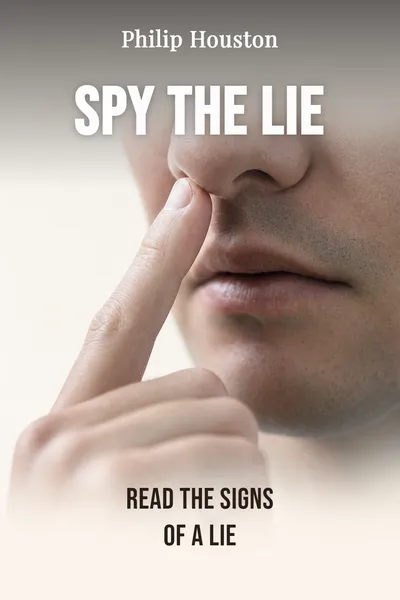
A man sits across a table in a room with bad lighting. He is being asked, calmly, whether he had anything to do with a theft. He answers the question with a question. He touches his nose. He says he'd swear on his mother's grave. He tells the interviewer, unprompted, that he's an honest guy, always has been. None of these things, taken alone, means anything. Together, in the seconds after a pointed question, they form a pattern — and to the three former CIA officers who wrote Spy the Lie, that pattern is worth paying attention to.
Philip Houston spent years in the Agency running interviews where getting the read wrong could cost lives. Along the way he built a method for spotting deception, later refined with colleagues Michael Floyd and Susan Carnicero, that was less about hunches and more about a repeatable way of listening and watching. The book takes that method out of the counterterrorism and criminal-investigation world where it was forged and hands it to the rest of us — the boss who may or may not be leveling with us, the job candidate polishing a résumé, the teenager explaining a dented fender.
The promise is seductive, and the authors know it. Who wouldn't want a reliable way to tell when someone is lying? But the method they describe is stranger and more disciplined than the folklore about shifty eyes and sweaty palms. It asks us to ignore most of what we think we know about liars, and to watch for something quieter instead.
The question we’re asking : How do three former intelligence officers claim to catch a lie, and does their method hold up when we take it home?What we’ll see : A way of reading deception built inside the CIA, the specific signs it watches for, and the single rule that keeps it from turning us into paranoids.
Table of contents
01 Chapter 1 — The interrogation room and a method born from failure
The story Houston tells starts with a problem the Agency had for decades: people are terrible at spotting lies, and confidence makes them worse. Study after study — the kind the authors reference in passing rather than parade — puts the average person's accuracy at coin-flip levels, barely above fifty percent. Trained professionals, police officers and judges included, do not score dramatically better. What they do have is more certainty about being right, which is arguably worse than being wrong, because it closes the case in their head before the evidence does.
The reason we're so bad at it is that we chase the wrong thing. We look for signs of lying, and lying, it turns out, is a bad thing to look for directly. There's no Pinocchio's nose, no single gesture that fires only when someone deceives. So the interviewer who watches for 'the tell' ends up cataloguing nervousness, and nervousness is exactly what an innocent person feels when a serious person accuses them of something in a small room.

02 Chapter 2 — Why the truth is quiet and lies are busy
The central intuition of the book is almost anticlimactic once you see it: the truth doesn't need much help. When people are telling us what actually happened, they tend to answer the question, more or less, and stop. When people are deceiving, they have a harder job. They have to manage what they say, monitor how it's landing, and suppress the true version that keeps trying to surface. All of that management costs energy, and the energy leaks out in behavior. Deception, in this frame, is simply busier than honesty.
So the authors teach us to notice the busyness rather than the content. A truthful denial is often flat and unbothered — 'No, I didn't take it' — and moves on. A deceptive one gets decorated. It arrives late, or early, or wrapped in reassurances nobody asked for. The person needs us to believe them, and the need shows. Houston frames this as looking for deceptive behaviors, not for proof, and the difference matters: he is never claiming to see the lie itself, only the strain of producing it.
03 Chapter 3 — The verbal tells that leak through the script
The signs the authors catalogue split into two families, and the verbal ones are the heart of the book because they're the hardest to fake and the easiest for the rest of us to hear. The first is the non-answer. Ask a direct question and a deceptive person may answer a slightly different one, or answer a question with a question — 'Why would I do that?' — which buys time and lets them read the room before committing. Repeating the question back verbatim does the same work: it stalls while the mind assembles a safe reply.
Then come the qualifiers and hedges, the little verbal cushions. 'Basically,' 'for the most part,' 'to be honest,' 'as far as I know.' Each one carves out a trapdoor, a way to be technically not-lying while still not telling us what happened. The authors are careful here — plenty of honest people hedge out of habit — which is why a hedge only matters when it lands right on top of the pointed question, not scattered through ordinary conversation.
04 Chapter 4 — The clusters, and why one sign proves nothing
If there's a single rule that keeps Spy the Lie from being a dangerous toy, it's the cluster rule, and stepping back, it reveals what the whole method actually believes about people. No behavior on its own means a thing. A nose scratch is a nose scratch. A qualifier is a verbal habit. The method only lets us act when two or more of these deceptive behaviors arrive together, tied to the same question, inside that short window. One sign is noise. A cluster, timed to the stimulus, is worth a follow-up — not a verdict, a follow-up.
That constraint is not modesty for its own sake. It follows from the authors' core premise: deception is a behavior under pressure, not a fixed trait of a certain kind of person. There is no such thing as a liar's face, because lying isn't who someone is — it's what they're doing in a particular moment when the truth is too expensive. Which means the method reads situations, not souls. It cannot tell us that a person is dishonest. It can only tell us that a specific answer, right now, deserves another question.
05 Conclusion
Back in that badly lit room, the man who answered a question with a question, touched his nose, swore on his mother's grave and volunteered that he's an honest guy has not proven anything. He has produced a cluster — several deceptive behaviors, stacked in the seconds after a pointed question. The method Houston built doesn't close the case there. It tells the interviewer to lean in and ask again, more precisely, and watch what happens next. That, in the end, is all the technique claims to do.
Related books