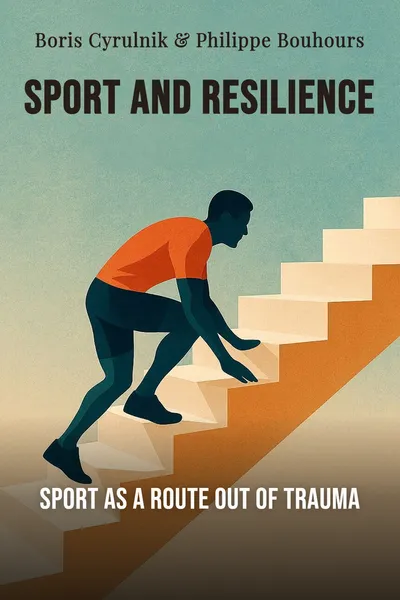
Sport and Resilience
Sport as a route out of trauma
Description
Boris Cyrulnik knows the subject from the inside before he knows it as a scientist. As a child in wartime France, he lost his parents to the camps, escaped a roundup, and grew up carrying a hole that could have swallowed the rest of his life. It didn't. He became a neuropsychiatrist, and the word he spent decades turning over — resilience — describes exactly that: the capacity of a person to knit a livable life over a wound that never fully closes. In this book, written with the sports educator Philippe Bouhours, he takes that idea onto the field, the mat, the pool, and asks a plain question. Can moving a body help repair a broken life?
It sounds like the kind of thing a motivational poster would say, and that is precisely the reflex the two authors want to disarm. Sport, in the popular telling, saves people. The troubled kid finds boxing and straightens out; the survivor runs a marathon and comes back whole. Cyrulnik and Bouhours have seen enough of these stories to distrust the tidy ones. They have also seen enough of the real ones to know that something in physical practice does reach places that talking cannot. Between the cliché and the clinic, there is a mechanism worth taking seriously.
What interests them is not whether sport helps — sometimes it plainly does — but why, and under what conditions. The same tackle that rebuilds one child humiliates another. The same discipline that anchors one survivor isolates the next. A resilient outcome, they insist, is never guaranteed by the activity alone. It depends on what surrounds it.
The question we’re asking : Can moving a body help repair a broken life — and if so, how?What we’ll see : How two authors, one a survivor turned neuropsychiatrist, trace the path from physical practice to recovery — and the fragile conditions that decide whether it works.
Table of contents
01Chapter 1 — The wound doesn't have the last word
Resilience, as Cyrulnik uses the term, is not toughness and it is not forgetting. He borrowed the word from metallurgy, where it names a metal's ability to absorb a shock without shattering, and carried it into psychology to describe something more delicate: the way a person who has been hurt can, over time, build a coherent life around the injury. The trauma stays. What changes is its place. It stops being the whole story and becomes one chapter among others.
This matters because trauma, left alone, tends to freeze. A frightening event doesn't simply pass; it lodges in the body and the memory, replaying, keeping the nervous system braced for a threat that has already happened. The survivor lives partly in the past tense. Cyrulnik's long clinical experience — with war orphans, with abused children, with adults carrying old catastrophes — taught him that recovery is rarely a matter of confronting the memory head-on. It is a matter of finding new ground to stand on, new proofs that one is competent, connected, alive.

02Chapter 2 — What a body does that words can't
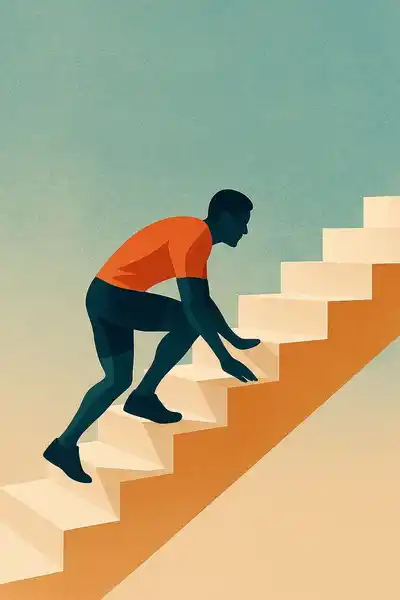
The particular power of physical practice, in this account, is that it works on the parts of a person that language struggles to reach. Trauma is often stored below the level of speech — in muscle tension, in a startle reflex, in a breathing pattern that never quite relaxes. Bouhours, from years coaching young people and adults marked by hard histories, describes bodies that arrive braced, hunched, guarded. You cannot reason a body out of that posture. But you can move it, and in moving it, slowly change what it expects.
Repetition is the quiet engine. A movement drilled until it becomes reliable gives the nervous system something it has been starved of: predictability. For someone whose early world was chaotic or violent, the experience of a gesture that works the same way every time — the same stroke, the same stance, the same rhythm — is not trivial. It is a small daily rehearsal of the idea that effort produces expected results, that the world can be, in this corner at least, trustworthy. Order enters through the muscles.
03Chapter 3 — The coach, the team, the meaning
If the book has a single insistence, it is that sport does not repair anyone in isolation. The muscle work is necessary but never sufficient; what turns exercise into resilience is the human bond woven around it. Cyrulnik has spent his career on this point in every context — a wounded child recovers only if there is at least one person who looks at them with warmth and belief. In sport, that person is often the coach, and Bouhours writes about the role less as a technician than as what Cyrulnik would call a tutor of resilience: someone whose steady attention tells the practitioner, without words, that they are worth the trouble.
The gaze of that adult does something the drills alone cannot. A survivor of humiliation carries a permanent inner witness telling them they are contemptible; a coach who is demanding and kind in the same breath offers a competing witness. Over months, the outside voice can begin to overwrite the inside one. This is why, the authors argue, the coach's ethics matter as much as their expertise — a brilliant program run coldly can leave the wound exactly where it was, while a modest program run with genuine regard can move mountains inside a person.
04Chapter 4 — When sport wounds instead of mends
The reason Cyrulnik and Bouhours refuse the inspirational version is that they have watched the same practice cut the other way. Sport is not a benign force that happens to help; it is a powerful one that amplifies whatever surrounds it. Placed in a punitive, humiliating, or purely competitive setting, it can confirm a traumatized person's worst convictions about themselves — that they are weak, that they fail, that they don't belong. The wound is not neutral clay. Push it wrongly and it hardens.
This is where the book steps back from its own hopeful thesis to name the conditions. Physical practice repairs when it offers achievable challenge, reliable structure, and above all a relationship that holds. It harms when the challenge only exposes inadequacy, when the coach's regard is conditional on winning, when the group closes rather than welcomes. High-level competitive sport, the authors note, contains plenty of the second kind — cultures of pressure and disposability that can traumatize as efficiently as they build. The activity is the same. The context decides.
05Conclusion
Cyrulnik returns, as he always does, to the child he was — the one who might have been defined forever by what was taken from him and instead built a life and a science on the far side of it. The book's argument is that other wounded people can find comparable footing, and that a body in motion, well accompanied, is one of the surest places to find it. Not because effort is noble or sweat is cleansing, but because mastery, rhythm, and belonging enter a person through the muscles when they will not enter through words.
Related books