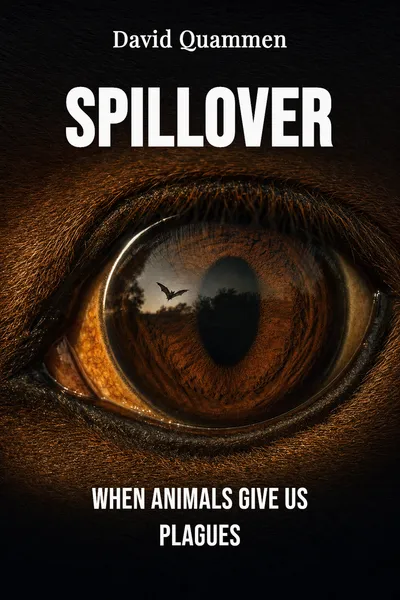
Spillover
When animals give us plagues
Description
In September 1994, in a suburb of Brisbane called Hendra, a champion racehorse named Drama Series fell sick and died within days. Then more horses died. Then the trainer who had cared for them, a man named Vic Rail, died too. The Australian authorities were baffled — a new virus had appeared out of nowhere, killing horses and humans with brutal efficiency, and nobody could say where it came from. It would take years of patient work to trace it back to its quiet reservoir: fruit bats, roosting in the trees at the edge of town, shedding a virus that had lived with them, harmlessly, for a very long time.
David Quammen opens his 2012 book Spillover with stories like this one — Hendra, then Ebola, then SARS, then the slow global catastrophe of AIDS — and makes an argument that reorganizes how we read the news. These outbreaks look like separate accidents, isolated horrors flashing across our screens and then fading. They are not separate. They are variations on a single process. Each of these diseases began in a wild animal and crossed, at some traceable moment, into a human body. Scientists call that crossing spillover, and Quammen spent years following the people who study it.
The estimate he keeps returning to is stark: roughly sixty percent of human infectious diseases are zoonotic, meaning they originate in other animals. That figure turns a scattering of scary headlines into a coherent and unsettling picture. If most of what threatens us comes out of the animal world, then the way we treat that world — how deep we push into it, how fast we move around it — is not incidental to the danger. It is the danger.
The question we’re asking : Why do lethal new diseases keep emerging from wild animals, and what makes some of them explode into the human world?What we’ll see : A reporter's journey with the scientists who chase these viruses to their source, and the logic that connects the outbreaks — and points toward the one still coming.
Table of contents
01 Chapter 1 — The pattern nobody was connecting
The word at the center of the book is deliberately plain. Spillover is the moment a pathogen living in one species — its reservoir host, where it usually causes little or no harm — passes into a new species and starts causing trouble. Most spillovers go nowhere. A virus lands in a human, the human's immune system shrugs it off or the human dies before infecting anyone else, and that's the end of it. But occasionally the pathogen finds it can move from person to person, and then a local misfortune becomes something larger. Quammen's project is to take this technical idea and show how much of modern epidemic history it explains.
Once we have the word, the disparate stories start to rhyme. Hendra came from bats. So, it turned out, did Nipah, which killed pig farmers in Malaysia in the late 1990s. Ebola appears to live, at least part of the time, in bats deep in Central African forests. SARS, which erupted out of southern China in 2002 and 2003 and spread to dozens of countries in a matter of weeks, was eventually traced through the exotic-animal markets back to horseshoe bats. AIDS, the slowest and largest of them all, began as a spillover of a chimpanzee virus somewhere in the Congo basin, probably in the early twentieth century, and smoldered for decades before anyone noticed.

02 Chapter 2 — Following the virus into the field
What gives Spillover its texture is that Quammen does not report from a desk. He goes with the scientists to the places where the viruses live, and the fieldwork is often grim, uncomfortable, and faintly absurd. He nets bats at night in southern China, where researchers handle the animals in full protective gear because a scratch could carry SARS's ancestors. He helps trap monkeys in Bangladesh, where the animals live cheek by jowl with people and swap pathogens across the boundary daily. He tracks gorillas in the Congo, in forests where Ebola has killed both apes and the humans who found their carcasses.
The people doing this work become the real characters of the book. They are ecologists and virologists who spend careers on questions the rest of us would rather not think about — where exactly does Ebola hide between outbreaks, why does Marburg surface in a particular cave, how does a virus jump the gap between a fruit bat and a pig and then a farmer. Quammen lets us feel both the tedium and the stakes. Much of the work is trapping, drawing blood, labeling vials, and waiting. Then, occasionally, a piece of the puzzle snaps into place and the origin of a killer becomes suddenly, chillingly clear.
03 Chapter 3 — Why the spillovers are speeding up
If spillover is an ancient process, why does it feel like it's happening more often and getting worse? Quammen's answer is that we have changed the conditions dramatically, and almost all the changes point the same way. There are more of us — over seven billion when he wrote — pressing into places humans rarely went before. We cut roads into forests, we log, we mine, we farm land that was recently wilderness. Each incursion breaks open ecosystems that had held their pathogens in a kind of equilibrium, and lets those pathogens find new hosts.
The animal reservoirs are often disturbed in the process. Stressed, displaced, or crowded together as their habitat shrinks, bats and other hosts may shed more virus, or shed it closer to where people live. The Hendra outbreaks in Australia coincided with fruit bats moving into suburban trees as their natural feeding grounds vanished. Deforestation does not just remove trees; it redraws the map of who touches whom, and the new map favors the microbes.
04 Chapter 4 — The math of the next big one
The question that haunts Spillover, the one Quammen puts to nearly every scientist he meets, is whether there will be a Next Big One — a pandemic on the scale of the 1918 influenza, or worse. The consensus answer he collects is not comforting. Not whether, but when. And the leading candidate the experts kept naming was a novel influenza, or a coronavirus, emerging from an animal reservoir somewhere in the crowded interface of Asia. Reading the book after 2020, that prediction lands with a weight it did not have on publication.
But Quammen resists the disaster-movie register, and this is where the book steps back into something larger than epidemiology. A pandemic, in his framing, is not nature turning malevolent. It is feedback. Every species that grows too abundant, that outstrips the checks around it, eventually meets forces that push back — predators, starvation, or disease. Humanity has escaped most of those checks through ingenuity. Pathogens are the one category we have not escaped, because they evolve as fast as we adapt. The spillovers are, in a sense, the biosphere's response to a species behaving like an outbreak itself.
05 Conclusion
The horses of Hendra, the hunter by the Sangha River, the doctor in the Hong Kong hotel — they look, at first, like unrelated tragedies scattered across decades and continents. Quammen's achievement is to show that they belong to one story, told over and over with different animals and different viruses but the same underlying grammar. A pathogen lives quietly in a wild host. A human being crosses its path. Sometimes nothing happens. Sometimes the world changes.
Related books