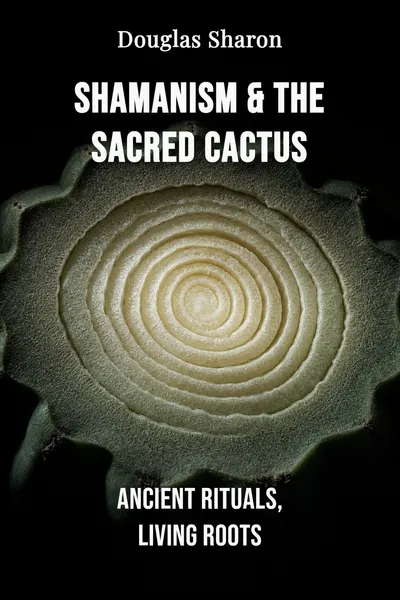
Shamanism & the Sacred Cactus
Ancient rituals, living roots
Description
Somewhere on the north coast of Peru, on a table laid out in the dark before a night of ritual, a curandero arranges his tools. There are staffs and swords, seashells and stones, images of saints, small heaps of herbs. And there is a brew, thick and bitter, cut from the ribbed green flesh of a cactus that grows on the dry slopes of the Andean foothills. The healer calls the object in front of him a mesa. Over the course of the night he will drink, sing, whistle, and diagnose — working through what he sees to draw the sickness out of the people who came to him. This is the world Douglas Sharon set out to describe, first as a young anthropologist in the late 1960s, apprenticing himself to one of these practitioners rather than merely interviewing him.
The cactus at the center of that night is Trichocereus pachanoi, better known as San Pedro. It is psychoactive, mescaline-bearing, and it has been growing on those slopes for a very long time. That last part is what turns an ethnographer's field notes into something bigger. Sharon kept noticing that the objects on a modern healer's mesa, and the gestures around them, rhymed with images carved and painted on temples that were already ancient when the Spanish arrived. The cactus appeared in stone. The same postures, the same animals, the same double-sided logic of a healer who is half light and half dark.
That coincidence is the spine of the book. It reaches back through the coastal cultures of northern Peru, through Chavín and Moche and the desert kingdoms, and forward to a man drinking San Pedro on a Tuesday night in the twentieth century, and it asks whether the line between them is real. Not a metaphor for continuity — an actual thread that never quite broke.
The question we’re asking : Can a plant, and the ritual built around it, connect a living Peruvian healer to a temple carving thousands of years older than he is?What we’ll see : How an apprenticeship on the north coast of Peru turned into a case for one of the longest unbroken threads in the Americas.
Table of contents
01 Chapter 1 — A healer's mesa in the northern desert
Sharon's method was unusual for its time. Rather than treating the curandero as an informant to be catalogued from a safe scholarly distance, he became an assistant to one — Eduardo Calderón, a fisherman and artist turned healer who worked near Trujillo. The choice mattered. What a healer does is not fully legible from the outside; it lives in the handling of objects, the timing of songs, the way a night session is paced from the arranging of the mesa to the dawn accounting of who was sick with what. Sharon learned it the way it is actually transmitted, by being inside it.
The mesa itself is the organizing image. It is a ritual field laid on the ground, divided into zones — a side of the good, a side of the dark, and a middle where the two are balanced. Each object on it carries a charge and a function: a staff for one kind of force, a blade for another, a stone brought back from a sacred lagoon high in the mountains. The healer does not treat these as decoration or symbol. They are instruments he plays across the night, and the San Pedro is what lets him see the board clearly enough to play it.

02 Chapter 2 — San Pedro, the cactus that keeps its own time
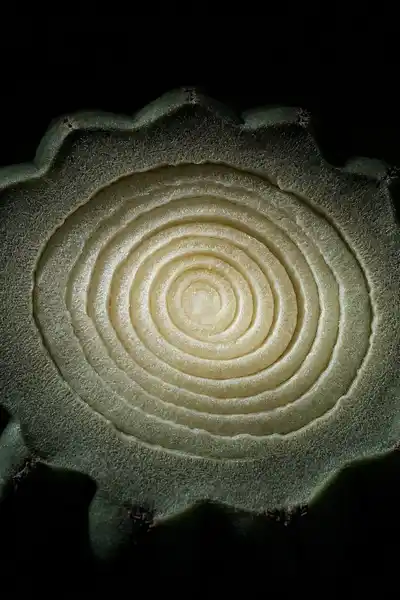
San Pedro is a columnar cactus, tall and ribbed, that grows across the Andean highlands and their western slopes, roughly between two and three thousand meters. Its Christian-era name — Saint Peter, keeper of the keys — is a colonial gloss on a much older role: the plant that opens the door. Chemically, the door is mescaline, the same phenethylamine alkaloid found in the peyote of Mexico, though San Pedro carries it in a different plant and a different ritual grammar.
What makes it useful to an archaeologist is precisely what makes it easy to overlook. It is not exotic or fragile. It grows readily, propagates from cuttings, tolerates poor soil, and has been within reach of coastal and highland peoples for millennia. There was never a moment when it had to be rediscovered or reintroduced. If a ritual attached itself to this cactus in deep antiquity, the cactus would simply have stayed available, generation after generation, as a continuous physical anchor for the practice.
03 Chapter 3 — Reading four thousand years off a temple wall
The physical evidence turns out to be startlingly direct. At Chavín de Huántar, the great highland ceremonial center whose influence spread across the northern Andes in the first millennium BCE, a carved stone figure holds a length of San Pedro cactus in its hand — an anthropomorphic being clutching the plant like a staff. The image is not ambiguous once you know the cactus by its ribs. The plant is being shown as an instrument of ritual power, at a site whose entire architecture seems built to stage transformation and encounter.
Chavín is not the only witness. San Pedro turns up on Moche ceramics, in Cupisnique iconography, and in textile and pottery traditions strung along the coast and foothills over thousands of years. Alongside it appear the recurring companions of the shaman's world: the jaguar or feline that stands for the healer's transformed self, the owl and the hummingbird, the double figure that is at once human and animal, benevolent and dangerous. These are the same dualities Sharon watched Eduardo work with on the mesa.
04 Chapter 4 — When the archive is a living practitioner
Step back from the Peruvian coast and the San Pedro case poses a general problem about how we read the past at all. Archaeology mostly works with what outlasts people: stone, ceramic, bone, the durable residue of things done. The doing itself — the song, the gesture, the intention behind a carved figure — rots away first. We are usually left interpreting the instrument without ever having heard the music. A cactus in a stone hand can mean almost anything to someone who has never seen it used.
Sharon's book is an argument that, in rare cases, the music never stopped. Where a tradition is anchored to a common living plant and transmitted through apprenticeship rather than only through texts or objects, the practice can carry itself forward across the very centuries that erase the perishable record. The living curandero is not a colorful footnote to the archaeology. He is a surviving stretch of the same archive, still running, and that changes what the excavated object is allowed to tell us.
05 Conclusion
The night ends the way it began, with a healer and a table of objects in the desert dark, and a bitter cup of cactus that lets him see. What Sharon added to that scene is depth of field. Behind the curandero stands the carved figure at Chavín holding the same plant; behind the mesa stand the painted and modeled shamans of coastal cultures that rose and fell for millennia. The cup is a point on a very long line.
Related books