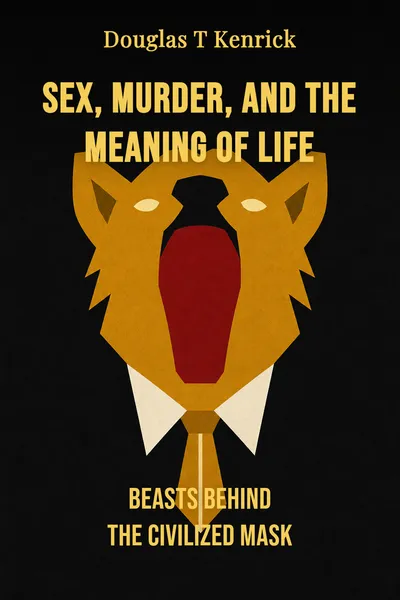
Sex, Murder, and the Meaning of Life
Beasts behind the civilized mask
Description
Douglas Kenrick will tell you, without much prompting, that he spent a good chunk of his younger life imagining how he might kill people who annoyed him. Not planning it — imagining it, in vivid, satisfying detail. He grew up among rough Irish relatives in a New York shantytown, got expelled from high school more than once, and drifted through a couple of broken marriages before landing, somewhat improbably, as a respected social psychologist at Arizona State University. The homicidal daydreams stayed with him. So he did what a scientist does with a private embarrassment: he studied it, and found that almost everyone else was having them too.
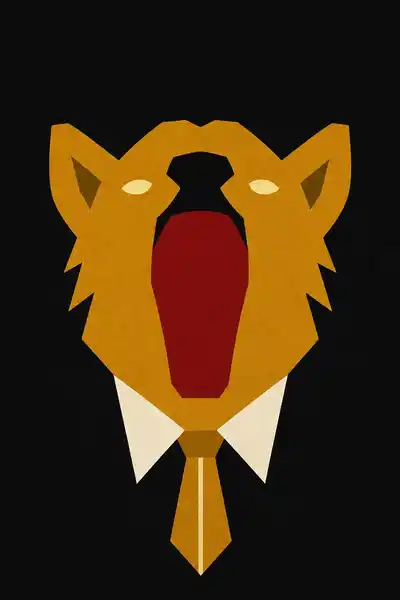
That research became one of the threads in his 2011 book Sex, Murder, and the Meaning of Life, a title that sounds like a provocation and turns out to be a fairly literal table of contents. Kenrick's argument is that under the polite surface of modern life, our heads are full of the same equipment that served our ancestors on the savanna — appetites, jealousies, snap prejudices, urges toward one violent solution or another. We are, in his phrase, a lot like howling hyenas that learned to wear suits. But that is only half the story, and the half most people stop at.
The other half is the surprising one. Those same crude, self-interested mechanisms, Kenrick claims, are exactly what produce our most generous and creative achievements — love, family, art, cooperation on a scale no other animal manages. The beast behind the mask is not the enemy of civilization. It is the thing civilization is built out of. Which raises an uncomfortable question about where our better nature actually comes from.
The question we’re asking : If our minds are still running ancient, selfish survival software, how do we end up with generosity, art, and love?What we’ll see : How an evolutionary psychologist rereads our darkest impulses as the hidden engine of everything we admire about ourselves.
Table of contents
01 Chapter 1 — The professor who used to think about murder
Kenrick opens the book by refusing to let himself off the hook. Rather than describe human aggression as something that happens to other people, he starts with his own head. In one line of research he asked ordinary students, faculty, and community members a simple question: have you ever fantasized about killing someone? The answers were startling in their frequency. Something like three quarters of men and more than half of women admitted to at least one homicidal fantasy, usually detailed, usually aimed at a specific person — a cheating partner, a bullying stepfather, a rival. Almost nobody acts on these. But almost everybody has them.
The point is not that we are all secret murderers. It is that the fantasy machinery is standard equipment, and it runs along predictable lines. Men's fantasies skewed toward status threats and rivals; the triggers tracked, uncannily well, the situations that would have cost a Pleistocene ancestor his reproductive future. Kenrick reads the daydream not as a moral failing but as a readout of an old decision-making system talking to itself, weighing threats it will almost never act on.

02 Chapter 2 — Deep rationality, not caveman stupidity
The easy version of evolutionary psychology treats us as clumsy cavemen, running outdated programs that misfire in the modern world. Kenrick pushes hard against that caricature. His central concept is what he calls deep rationality: the idea that behaviors which look irrational on the surface are often exquisitely well-tuned to the ancestral problems they evolved to solve. The apparent stupidity is in our expectations, not in the behavior.
Take conspicuous consumption — the sports car, the oversized watch, the willingness to spend a month's salary on a signal nobody strictly needs. A standard economist might call this waste. Kenrick, drawing on the logic of costly signaling that biologists use to explain the peacock's tail, sees something else. An expensive, useless display is credible precisely because it is expensive and useless: only someone with resources to spare can afford it. In his experiments, men primed to think about attracting a partner became measurably more willing to spend and show off, while women shifted toward displays of a different kind. The spending isn't a glitch. It's an ancient courtship device wearing modern clothes.
03 Chapter 3 — The many minds inside one skull
Kenrick proposes that inside each of us sits a set of what he calls subselves — distinct functional systems, each built to handle one of the recurring problems our ancestors faced. There is a subself for self-protection, one for avoiding disease, one for making friends and holding status, one for finding a mate, one for keeping a mate, one for caring for kin. They do not usually operate at once. The situation you're in acts like a switch, bringing one to the front while the others wait offstage.
This is not a metaphor stretched for effect; it makes concrete predictions. When people are made to feel afraid, their judgments about strangers shift in specific ways — they become more attentive to out-group men, more prone to see anger in ambiguous faces. When people are made to think about romance, their risk tolerance, spending, and even creativity change, and they change differently for men and women. Kenrick and his colleagues ran versions of these studies for years, and the pattern held: the same person will give measurably different answers depending on which subself is at the wheel.
04 Chapter 4 — When selfish parts build unselfish wholes
Here Kenrick makes his boldest move, and it's where the book stops being a tour of dark impulses and becomes an argument about how everything human gets built. He borrows from complexity theory — the study of how simple rules, repeated among many interacting agents, generate patterns nobody designed. Ant colonies build elaborate structures with no architect; each ant follows a handful of local rules, and the cathedral emerges from below. Kenrick's claim is that human society works the same way. Simple, selfish mental mechanisms, interacting across millions of people, throw off staggering complexity that no individual intended.
The love a parent feels for a child is, at the mechanical level, a kin-caring subself doing what it evolved to do: protect the carriers of shared genes. But scale that up, weave it through families and generations, and you get the whole institution of family life, with its loyalties, its art, its self-sacrifice that no gene-counting logic would predict on its own. The selfish part is still there at the base. What emerges on top of it is genuinely generous, and genuinely new.
05 Conclusion
The book ends more or less where it began, with Kenrick himself — no longer the expelled teenager rehearsing revenge, but a scientist and, in his own account, a devoted father to two sons born twenty-six years apart. The homicidal fantasies never fully vanished; he simply came to understand them as one voice in a crowded committee, not the whole man. That self-understanding is the quiet argument underneath all the provocation in the title. We are not improved by pretending the beast isn't there. We are improved by knowing what it is for.
Related books