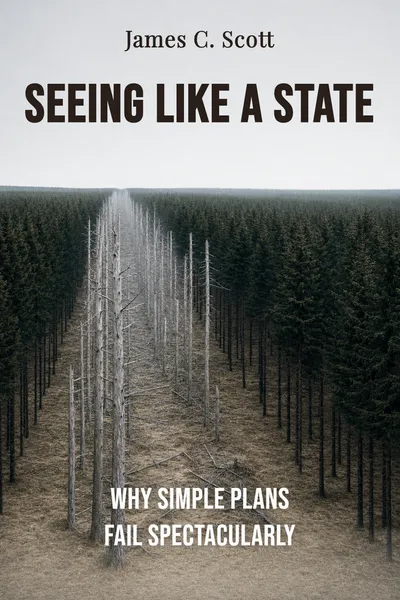
Seeing Like a State
Why simple plans fail spectacularly
Description
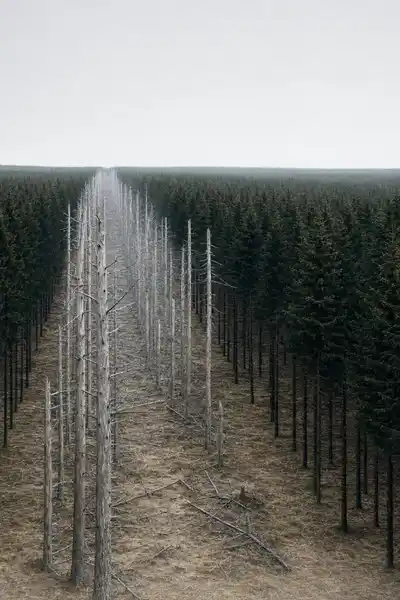
In the late eighteenth century, Prussian and Saxon foresters set out to make their woodlands behave. The old forest was a tangle — oaks, beeches, undergrowth, fallen wood, mushrooms, grazing animals, villagers gathering kindling. None of it appeared cleanly in a ledger. So the foresters cleared it and planted Norway spruce in straight, even-aged rows, a single species arranged for easy counting and cutting. The first generation grew beautifully. Yields were predictable, harvests efficient, the whole enterprise visible at a glance. Then the second generation came in, and something went wrong.
The soil, stripped of the messy web that had fed it for centuries, began to fail. Pests that the old diversity had held in check swept through the uniform rows. The Germans even coined a word for it — Waldsterben, forest death. The tidy plantation that had looked like the triumph of reason turned out to be a slow-motion collapse, and the foresters could not understand why, because the thing that had been killing the forest was precisely the thing they had removed to make it legible. James C. Scott opens his book with this scene because it is a miniature of a much larger pattern he traces across two centuries and several continents.
That pattern is the ambition of the modern state to make society readable — to flatten local complexity into standardized units it can see, count, tax, and govern from a distance. Scott calls the recurring failures that follow a story not of villains but of a particular kind of confidence, one that keeps producing disaster in the name of order and improvement.
The question we’re asking : Why do sweeping, rationally designed schemes to improve the human condition so often produce the opposite of what they promised?What we’ll see : How a state learns to see, what it stops seeing in the process, and why the difference matters more than any single plan.
Table of contents
01Chapter 1 — The forest that stopped growing
The scientific forest was, in its way, a masterpiece of administration. A ruler wanted to know how much timber a woodland would yield and for how many years, and the sprawling real forest gave no clean answer. So foresters built an abstraction: they treated trees as standing volumes of commercial wood and replanted accordingly, in monocultures, in rows, all the same age. The forest became a machine for producing one output, and for the first time a manager in a distant office could open a table and know what he owned.
What that table left out was almost everything that had made the old forest work. The fungi and insects, the birds, the leaf litter that fed the soil, the villagers whose foraging and grazing kept the system churning — none of it counted as timber, so none of it was planned for. Scott's point is not sentimental. The excluded elements were not decorative. They were the load-bearing parts of a living system, and the plantation had quietly disassembled them.

02Chapter 2 — Measuring the world into a grid
Before a state can plan, it has to be able to see, and Scott spends much of the book on the unglamorous machinery of seeing. Consider land. In pre-modern Europe, a village might measure a field not in fixed acres but in how much seed it took to sow, or how long it took to plow — units that folded in soil quality, slope, and custom. Useful locally, useless to a tax collector in the capital, who needs one number that means the same thing everywhere.
So states imposed standard measures, cadastral maps, and surveyed boundaries. They replaced the thick tangle of overlapping local rights — this family may graze here, that one may gather wood there after harvest — with clean, individual freehold title. The permanent surname, which we now take for granted, was itself largely a state project, invented so that a person could be reliably tracked for taxation and conscription. Each step made the population easier to count, and each quietly erased arrangements that had done real work.
03Chapter 3 — The city drawn from the air
Nowhere is that ambition more visible than in the modern planned city. Scott turns to Brasília, the Brazilian capital built almost from nothing in the late 1950s under the influence of Le Corbusier's ideas. It was meant to be the anti-city: no chaotic street life, no mixed-use jumble, just clean zones for living, working, and governing, laid out along vast axes and superblocks, best appreciated, as such plans often are, from an airplane or a scale model.
On paper it was a utopia of order. In practice, residents discovered they were living in a place stripped of the accidents that make a city feel alive. There were few street corners, few plazas, few of the spontaneous encounters that happen when shops, homes, and sidewalks pile together. Inhabitants coined the term brasilite — Brasília-itis — for the peculiar malaise of the place. And the workers who built the city, unwilling to live in it, spontaneously threw up unplanned settlements around it: a living rebuke to the design, and proof of what the design had left out.
04Chapter 4 — What the planner cannot see
Step back from the forests and cities and a single diagnosis emerges. Scott argues that the truly catastrophic failures — and he includes the forced Soviet collectivization of agriculture and Tanzania's ujamaa villagization among them — share four ingredients. First, the administrative simplification of a complex society. Second, a high-modernist faith: an overweening confidence that scientific and technical progress can be used to redesign social life wholesale. Third, an authoritarian state willing and able to impose the design. Fourth, a civil society too prostrate to resist. When all four coincide, the results can be lethal on a vast scale.
But the deepest layer of his argument is about a kind of knowledge the state structurally cannot capture. Scott borrows the Greek word metis — the practical, hands-on, hard-to-articulate know-how of the sailor reading a squall, the farmer who knows this particular field, the local who knows which shortcut floods in spring. Metis is dispersed, contextual, and mostly untaught in books. It is exactly what the villagers' seed-based land measures encoded and what the cadastral grid erased. High modernism fails not because its designers are stupid but because they are working with only the thin, legible slice of reality, blind to the thick, illegible knowledge that keeps real systems running.
05Conclusion
The Prussian foresters got their tidy rows and, a generation later, their dying trees. The lesson Scott draws from the pattern is not that we should stop measuring, mapping, or planning — a modern society cannot function without doing all three. It is that every act of making the world legible is also an act of leaving something out, and the something left out is usually the local, tacit knowledge that lets a system bend instead of break. The neater the plan looks from above, the more of that knowledge it has probably erased.
Related books