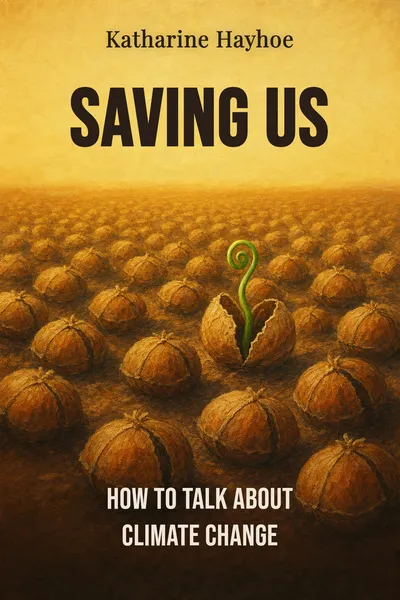
Saving Us
How to talk about climate change
Description
Katharine Hayhoe spends her working life measuring a warming planet. She's an atmospheric scientist at Texas Tech, has contributed to national climate assessments, and can talk isotopes and emissions curves for as long as anyone wants to listen. She also lives in Lubbock, Texas, one of the more conservative corners of the United States, married to an evangelical pastor, surrounded by people who, for years, assumed her science was a political attack aimed squarely at them. That gap — between what she knows and who she lives among — is where her 2021 book Saving Us begins.
For most of her career, Hayhoe did what scientists are trained to do: she answered doubt with data. More graphs, better graphs, clearer graphs. It rarely moved anyone. People who dismissed climate change didn't lack information; they'd sorted the whole subject into a box marked "not for people like us" and closed the lid. Piling on facts just made the lid heavier. Something else was going on, and no amount of peer-reviewed evidence was going to reach it.
So Hayhoe changed tactics. Instead of trying to correct people, she started talking with them — beginning not from carbon but from whatever they already loved: their kids, their town, their faith, their hunting grounds, their bottom line. The results surprised her. Saving Us is her account of that shift, and of why the single most powerful climate tool we have isn't a solar panel or a spreadsheet. It's a conversation.
The question we’re asking : If the science has been settled for decades, why does telling people the facts so rarely change what they do?What we’ll see : How a climate scientist stopped arguing and started listening, and what that quiet pivot reveals about moving people who've already made up their minds.
Table of contents
01 Chapter 1 — The most important thing is the last thing you'd expect
Hayhoe opens with a line she's repeated so often it's become a kind of motto: the single most important thing anyone can do about climate change is talk about it. It sounds almost too soft to be true. We picture climate action as machinery — turbines, electric cars, treaties signed in cavernous halls. Talking feels like a warm-up, not the main event. But her point is that all the machinery depends on something upstream, and that something is whether people care enough to want it in the first place.
The trouble is that almost nobody talks about climate change. Surveys she cites suggest a large majority of people are worried, yet only a small fraction ever discuss it, even with family. It has become one of those subjects we avoid at the table alongside money and religion — too charged, too likely to end in someone leaving the room. And silence has a cost. When a thing is never mentioned, it quietly reclassifies itself as unimportant, or as somebody else's problem. Our collective quiet has convinced us that hardly anyone else cares, which is the opposite of the truth.

02 Chapter 2 — Why more facts almost never work
To understand why data fails, Hayhoe borrows from psychology, and the finding is uncomfortable for anyone who trusts evidence to win. On politically charged topics, more information doesn't narrow disagreement — it widens it. People who are better informed and more numerate often become more polarized, not less, because they use their smarts to defend the position their group already holds. She points to the work of researchers like Dan Kahan, whose studies show that on issues fused to identity, reasoning serves loyalty rather than truth.
This has a name she keeps returning to: solution aversion. Much of what looks like doubt about the science is actually discomfort with the solutions people assume are coming — bigger government, higher taxes, a lecture about how they live. Reject the fix and it becomes convenient to reject the diagnosis too. So when a scientist arrives with yet another curve trending upward, she isn't landing on neutral ground. She's confirming the listener's suspicion that this whole subject is a Trojan horse for values they distrust.
03 Chapter 3 — The values already in the room
If facts can't carry the conversation, what can? Hayhoe's answer is shared values, and the phrase she uses for the method is disarmingly simple: bond, connect, inspire. Start by finding something you genuinely have in common — not as a tactic, but because it's real. Then connect that shared thing to a changing climate. Then point toward something hopeful that's already happening. The order matters. You don't open with the problem; you open with the person.
The examples she gives are concrete because the whole approach depends on specifics. With fellow parents, the entry point is children and the world they'll inherit. With people of faith, it's stewardship of creation, a value woven through scripture. With farmers and ranchers, it's the weather they already watch obsessively and the soil they depend on. With business owners, it's cost, risk, and the money to be made in cleaner technology. In each case the climate isn't imposed from outside; it's shown to already threaten something the person loves. She isn't asking them to adopt her priorities. She's showing them that their own priorities lead here.
04 Chapter 4 — From talking to doing, without the doom
Step back from carbon for a moment, and Saving Us reads as a book about how any hardened conviction actually changes — which is almost never through defeat in argument. Hayhoe is describing the mechanics of persuasion on any issue that has fused with identity, from vaccines to guns to the culture wars we all recognize. Her claim is that minds move sideways, through relationship and belonging, not head-on through evidence. We adopt what our people adopt. Change the sense of who "our people" are and what they value, and the positions follow.
That's why she spends so much energy on hope, and treats fear as a poor engine for the long haul. Doom, she argues, mostly produces paralysis: overwhelmed people disengage, and despair is as immobilizing as denial. The alternative isn't naive optimism but what she calls active hope — hope earned by pointing to solutions already in motion, to towns and companies and ordinary people changing things right now. Hope, in her framing, is not a feeling you wait to receive. It's something you generate by acting, and then pass to others by talking.
05 Conclusion
The scientist who once answered doubt with graphs now spends her days looking for common ground first. Hayhoe still trusts the data completely; what changed is her understanding of how it travels. Facts don't persuade people who feel judged — they persuade people who feel heard, and hearing has to come first. The turbines and the treaties still matter. But they sit downstream of a conversation that, for most of us, hasn't happened yet.
Related books