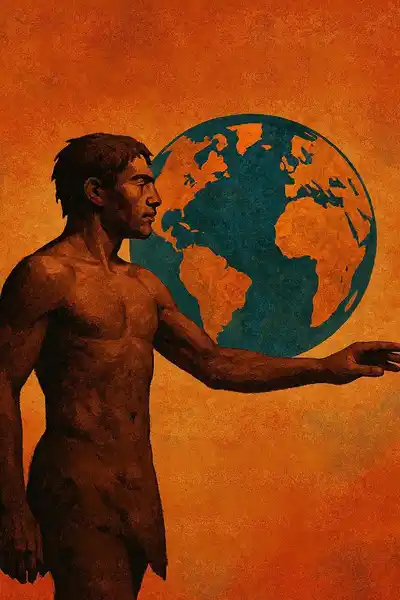
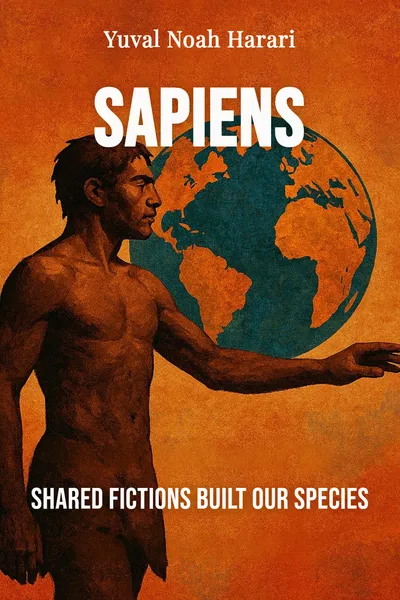
Sapiens
Shared fictions built our species
Description
Around 70,000 years ago, a fairly unremarkable primate living in the corner of Africa did something odd. It started to talk about things that did not exist. Not just "there's a lion by the river" — plenty of animals can flag a real danger — but "the lion is the spirit-guardian of our tribe." That second sentence has no referent anywhere in the physical world, and yet, in Yuval Noah Harari's telling, it is the single most consequential thing our species ever learned to do. Published in Hebrew in 2011 and in English in 2014, Sapiens: A Brief History of Humankind takes that small linguistic trick and runs it across the whole of the human story.
Harari, a historian at the Hebrew University of Jerusalem, wrote a book that refuses to stay in its lane. It sprints from the emergence of Homo sapiens to gene editing in roughly four hundred pages, and it does so by holding onto one thread: the things that hold large human groups together — money, nations, laws, gods, human rights, the limited liability company — are, strictly speaking, fictions. Not lies exactly. Shared stories. Nothing in physics contains a euro or a corporation. They exist because enough of us agree to act as if they do.
That is a provocative frame, and it is what turned a scholarly-sounding survey into a book that has sold tens of millions of copies and sat on Barack Obama's and Bill Gates's recommendation lists. It also raises an uncomfortable follow-up. If cooperation on a massive scale is our superpower, and if it runs entirely on collective make-believe, then what exactly have we been paying for it all this time?
The question we’re asking : How did a middling African ape come to run the planet — and what did organizing ourselves around shared fictions cost us?What we’ll see : How Harari reads the whole human story through the stories we agree to believe together.
Table of contents
01Chapter 1 — The ape that told stories
For most of our existence, Homo sapiens was one human species among several, and not obviously the most impressive. Neanderthals had bigger brains and thicker bodies. We shared the planet with the diminutive Homo floresiensis and others, and there was no cosmic guarantee that our particular branch would be the one left standing. Harari opens Sapiens by insisting on this: for around two million years, humans of various kinds were unremarkable middle-of-the-food-chain creatures, more likely to be eaten than to eat.
Then, somewhere between 70,000 and 30,000 years ago, something shifted. Harari calls it the Cognitive Revolution — a change in the way sapiens brains handled language, probably driven by a genetic accident. Suddenly our ancestors were producing art, trading over long distances, planning elaborate hunts, and inventing tools at a pace no other species could match. The physical body barely changed. What changed was what the mind could do with words.

02Chapter 2 — Money, empires, and other useful lies
If the Cognitive Revolution gave us the tool, history is the record of what we built with it. Harari's second act is the Agricultural Revolution, roughly 12,000 years ago, when humans in a handful of regions began domesticating wheat, rice, and animals. The usual story treats farming as progress — the moment we settled down and civilization became possible. Harari tells it more darkly, but its real payoff is that surplus food allowed dense populations, and dense populations needed something to hold them together.
What held them together were ever larger fictions. As villages became cities and cities became kingdoms, personal loyalty was no longer enough. People invented codes of law, presented not as human inventions but as the will of gods or the order of the cosmos. The Code of Hammurabi, carved around 1776 BCE, declares a rigid hierarchy of superiors and commoners and slaves as simply the way reality is. The American Declaration of Independence, thousands of years later, declares that all men are created equal and endowed with unalienable rights. Both, Harari notes coolly, are imagined orders. Neither equality nor natural rights is written into biology. We agree to believe them, and the agreement does real work.
03Chapter 3 — The luxuries that trapped us
One of the book's most quoted provocations concerns wheat. We like to say that humans domesticated wheat. Harari flips it: wheat domesticated us. Ten thousand years ago the plant was an unremarkable wild grass confined to a small patch of the Middle East. Within a few millennia it covered vast stretches of the planet, and it managed this by bending human beings to its needs — clearing its rivals, watering it, guarding it, bending their spines to tend it.
And the deal was bad for most individuals. Foragers ate a varied diet, worked fewer hours, and were less exposed to famine and epidemic. Early farmers ate a monotonous, starch-heavy diet, worked harder, suffered slipped discs and worn joints, and lived crammed together with animals in conditions that bred disease. Skeletal evidence suggests the switch to agriculture often made people shorter and sicker. Harari calls it history's biggest fraud: farming produced more food and therefore more people, but more people living worse lives is not the same as a better life. The species multiplied; the individual suffered.
04Chapter 4 — The stories will not hold still
Step back from the sweep of Sapiens and a hard question surfaces, one Harari keeps returning to: has any of this made us happier? He devotes a late chapter to exactly that, and his answer is deflating. Foragers were probably no less content than we are. Wealth, empire, and technology multiplied our numbers and our power without reliably improving how a given human being feels day to day. If history has a direction, it is toward more people and more control — not toward more well-being. The shared fictions optimized for scale, and scale was never the same thing as satisfaction.
There is also a moral bill attached to the imagined orders. The same fictions that let strangers cooperate also let them dominate one another at scale. Hierarchies of caste, race, and gender were dressed up as natural or divine so that they would feel permanent and unquestionable — Harari is blunt that most large-scale human orders have been unjust, and that their injustice was precisely what made them stable. And the animals paid too: the domestication that fed our empires turned billions of creatures into inputs, in what he calls perhaps the greatest crime in history. Cooperation on this scale has never been free.
05Conclusion
The book that began with an unremarkable ape by an African river ends with that same lineage holding the tools to redesign itself. In between, Harari has run a single idea across the entire human story: our dominance was never about strength or even intelligence in the narrow sense. It came from the peculiar ability to believe, together, in things that do not exist — spirits, then gods, then money, nations, and rights. Those fictions let millions of strangers pull in the same direction, and that coordination is the whole game.
Related books