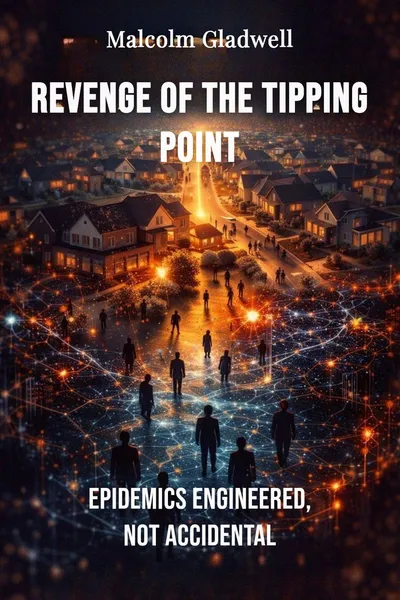
Revenge of the Tipping Point
Epidemics engineered, not accidental
Description
In 2015, the town of Palo Alto had a problem it could barely say out loud. Over roughly a decade, a cluster of high schoolers had died by suicide, many of them stepping in front of the same commuter trains that ran through the wealthy heart of Silicon Valley. The rate was several times the national average, and it did not fade the way tragedies usually do. It clustered. It returned. Guards were posted on the tracks. Investigators from the CDC came to study what was happening in one of the most privileged zip codes in America. And the question they kept circling was not why one child had died, but why this particular place, with all its advantages, kept producing the same terrible outcome again and again.
Twenty-five years ago, Malcolm Gladwell wrote a book about how small things catch fire and spread — the sticky idea, the connector who knows everyone, the moment a trend crosses an invisible line and becomes an epidemic. The Tipping Point sold in the millions and gave a generation of marketers a vocabulary. Now he has come back to the same territory with something closer to regret. The new book is a correction and a confession. Epidemics, he argues, are not weather. They do not simply happen to us. They have shapes we can read, engines we can name, and — this is the part that unsettles — people who build and steer them on purpose.
Revenge of the Tipping Point is Gladwell revisiting his most famous idea with darker eyes. The mechanics still hold. What has changed is his sense of who is at the controls, and whether we should be so cheerful about learning how the machine runs.
The question we’re asking : If social epidemics have engineers, then who is engineering them — and why did the original story of the tipping point leave that part out?What we’ll see : How a cluster of tragedies, a stubborn threshold, an invisible shared story and a handful of deliberate actors reshape a friendly theory into an uneasy one.
Table of contents
01Chapter 1 — The town that wasn't supposed to happen
Gladwell opens where his optimism runs out. The Palo Alto suicide clusters sit at the center of the book because they refuse the comforting frame that wealth protects children. If anything, the density of achievement in these schools seemed to feed the thing that killed. He treats it as an epidemic in the technical sense: not a run of unrelated tragedies, but a contagion with a local shape, transmitting through a specific community in a specific way, resistant to the interventions that worked elsewhere.
The concept he leans on is the idea that some environments generate their own outbreaks. He compares the schools to a coral reef — a place whose very structure concentrates and sustains what passes through it. A high-pressure culture of relentless comparison, in a small and closed social world, does not merely coincide with despair. It manufactures a channel for it, so that one death becomes a template rather than an anomaly, and the template spreads to children who share the same corridors and the same expectations.

02Chapter 2 — The magic third and the rule of the small group
From the coral reef, Gladwell moves to a set of thresholds that decide whether a group stays as it is or flips into something new. His central number is the proportion — often around a third — at which a minority stops being a minority and begins to set the tone for everyone. Below that line, a new group is absorbed and assimilated by the majority. Above it, the newcomers keep their own culture, and the whole environment starts to change around them. It is a tipping point measured not in ideas but in bodies.
He tracks this through boardrooms, neighborhoods and schools. When a company's board crosses roughly a third women, the behavior of the whole board shifts, not because any single person is more powerful but because the group has crossed a proportion at which the outnumbered feel free to speak as themselves. The same arithmetic, applied to housing, explains the ugly history of white flight: communities held together up to a threshold, then emptied with startling speed once a perceived proportion was breached. The number is the same. The moral coloring depends on the direction.
03Chapter 3 — The story in the air we breathe
The idea Gladwell wants us to carry away is what he calls the overstory. Borrowing the term from forestry — the canopy of tall trees that determines what grows in the shade below — he uses it for the shared narrative that hangs over a community and quietly decides what its members believe is possible. The overstory is rarely stated. It is the ambient story, the thing everybody absorbs without being taught, and it shapes behavior more powerfully than any single message pushed from below.
He argues that his earlier work overrated the small, visible triggers — the sticky slogan, the well-placed influencer — and underrated this larger atmosphere. A message only spreads if the canopy above it permits growth. Change the overstory and you change what can take root; leave it intact and even the cleverest campaign withers. This is why some ideas catch instantly in one place and die in another that looks identical on paper. The seed was the same. The canopy was not.
04Chapter 4 — The people who pull the levers
Step back and the book's real subject comes into focus. Where The Tipping Point read like a nature documentary — here is how contagion works, isn't it wonderful — the sequel reads like an accusation. If epidemics have shapes, thresholds, and canopies, then they can be built. And Gladwell's revenge, the twist his title promises, is the discovery that many of the epidemics we take for spontaneous were assembled by identifiable hands.
His hardest case is the American opioid crisis, which he treats not as a wave of weakness that washed over vulnerable towns but as an engineered outbreak. He follows the deliberate work of manufacturing an epidemic — the sales forces, the massaged science, the targeting of communities chosen precisely because they were susceptible, the overstory of pain relief carefully seeded so that the pills could spread. Hundreds of thousands of deaths, in his reading, were not an accident of chemistry. They were the output of people who understood tipping points and used that understanding on purpose.
05Conclusion
The book ends where it began, back in the shadow of the trains in Palo Alto, and the earlier optimism is gone. What Gladwell offers now is not a formula for making things spread but a warning about how legible that spreading has become — and to whom. The coral reef, the magic third, the small group, the overstory: each is a genuine mechanism, and each is a place where a determined actor can intervene. The theory that once flattered marketers has become, in his hands, closer to a study of manipulation.
Related books