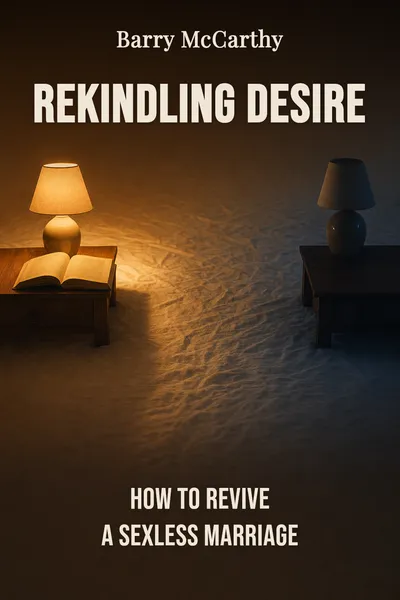
Rekindling Desire
How to revive a sexless marriage
Description
Somewhere in the second or third year of a marriage that, on paper, is going fine, a couple notices the calendar has quietly gotten longer. Two weeks since the last time. Then a month. Then a stretch nobody counts anymore because counting would mean saying it out loud. Nothing dramatic happened — no affair, no blowup, no cooling that either partner could point to and name. The sex just receded, the way a tide goes out so slowly you only register it when you look up and the water is gone. This is the scene Barry McCarthy, a clinical psychologist and sex therapist who spent decades in a Washington practice, opens with in his book on rekindling desire, written with his wife Emily. It is the most common story he heard, and the one couples were most ashamed to tell.
McCarthy's estimate, drawn from his practice and the research he leaned on, is that roughly one in three married couples in the United States is dealing with a low-sex or no-sex arrangement at any given time — where "no-sex" is the working clinical threshold of fewer than about ten encounters a year. What struck him was not the frequency but the silence around it. Couples who could discuss money, in-laws, and their children's report cards could not manage a single honest conversation about the thing that had gone missing from their bedroom, often for years.
His book is not a pep talk and not a list of positions. It is a structured program, built on the premise that desire in a committed relationship is not a spark that either survives or dies on its own, but a thing two people either tend or let go quietly to seed. The tools he offers are unglamorous, sequential, and — for couples who had given up — surprisingly hopeful.
The question we’re asking : When the sex quietly disappears from a marriage that is otherwise fine, what does it actually take to bring it back?What we’ll see : How McCarthy reads the silence, and the deliberate, step-by-step work he prescribes to rebuild desire from the ground up.
Table of contents
01 Chapter 1 — The couple who stopped, and never quite said so
The couples who arrived in McCarthy's office were rarely in crisis. That was the puzzle. They liked each other. They ran a household together, raised children, made plans for retirement. What they had lost was the sexual thread, and the loss had happened without a decision. One partner reached out less, the other stopped reaching out to avoid the awkwardness of being turned down, and within a year or two a pattern had hardened into an unspoken agreement neither had signed. McCarthy calls this the trap of avoidance: not a lack of feeling, but a slow accumulation of small evasions that becomes its own momentum.
The shame is what kept them stuck. McCarthy found that couples treated a low-sex marriage as a private failure, a sign that something was fundamentally broken in them or in the relationship. Popular culture did not help — it sells the idea that real love produces spontaneous, effortless desire, so a marriage without it must be defective. McCarthy's first move, in the office and on the page, was to strip that assumption out. A dip in sexual frequency, he argued, is one of the most ordinary things that happens to long-term couples. It is common, it is reversible, and it is not a verdict.

02 Chapter 2 — What the numbers were actually measuring
Once a couple names the problem, the temptation is to fix the frequency directly — to schedule sex, hit a target, get the number back up. McCarthy considered this both the obvious move and the wrong one. Frequency, in his reading, is a symptom, not the disease. A couple can force themselves back to a weekly encounter and still feel nothing, because the number was never the thing that mattered. What had actually eroded was the intimacy underneath it, and the number was just where the erosion showed.
His central concept here is what he calls the intimate connection between touch and desire. In healthy couples, physical affection flows continuously — a hand on the back, a kiss that is not a prelude to anything, holding each other on the couch. In struggling couples, this affection has usually dried up alongside the sex, and often before it. The problem, McCarthy observed, is that these couples have collapsed the entire range of touch into a single meaning: any physical contact becomes a demand or an offer of intercourse. So they stop touching altogether, because every touch now carries a bill attached.
03 Chapter 3 — Touch before the finish line
The practical engine of the program is a set of graded exercises McCarthy adapted from the pioneering sex therapists William Masters and Virginia Johnson, whose work in the 1960s and 70s reshaped the field. The best-known of these is sensate focus. A couple sets aside time to touch each other with a single, strict rule: no intercourse, and at first no touching of genitals or breasts at all. The task is simply to give and receive touch, and to pay attention to how it feels — nothing more.
The rule against intercourse is the whole point, and couples find it counterintuitive. By taking the endpoint off the table, McCarthy removes the performance pressure that had been quietly strangling the encounter. A man worried about maintaining an erection, a woman braced for an obligation she does not feel — both can relax when nothing is expected to arrive anywhere. The exercise reconnects touch to pleasure rather than to achievement. Over successive sessions, the couple gradually reintroduces more — sensual touch, then playful and genital touch — but only once each stage feels comfortable, and only by mutual agreement.
04 Chapter 4 — The intimacy team
Step back from the exercises and the through-line of McCarthy's book comes into focus: desire in a long marriage is made, not found. This is a quiet but genuinely radical claim, because it runs against nearly everything the culture teaches about sex. We are told desire is a feeling that visits us, evidence of chemistry, proof that a relationship is alive or that it is dying. McCarthy's whole method rests on the opposite premise — that in a committed relationship, desire is closer to a garden than to weather. It responds to attention, structure, and repeated small acts, and it withers from neglect no matter how strong the initial spark once was.
This reframing does something useful for couples who had come to read their dry spell as a diagnosis. If desire is something the relationship generates rather than something it passively contains, then a low-sex marriage is not proof that the love has died. It is proof that the couple stopped doing the things that make desire. And what can be stopped can, in principle, be started again — which is why McCarthy is so relentlessly hopeful in a subject area that usually traffics in resignation.
05 Conclusion
The couple from the opening scene — the one that stopped without ever deciding to — is, in McCarthy's telling, entirely recoverable. Not by recapturing the version of themselves that fell in love, and not by hitting a magic number on the calendar, but by sitting down, saying the thing out loud, and beginning the slow, deliberate work of touch and anticipation and honesty. The program is unromantic in the way that most durable things are. It asks for intention where the culture promised spontaneity, and patience where couples had been hoping for a spark.
Related books