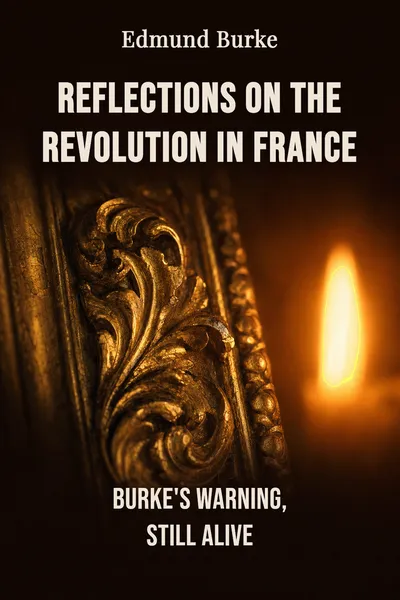
Reflections on the Revolution in France
Burke's warning, still alive
Description
In November 1790, a British member of Parliament published what he claimed was a private letter to a young French acquaintance. The book ran to nearly four hundred pages. Its author, Edmund Burke, was sixty-one, a Whig who had spent his career defending the American colonists, opposing the abuses of the East India Company, and generally siding with reform against entrenched power. Which is what made the letter so strange. Everyone expected Burke to cheer the fall of the Bastille the way his friends did — the way the poets did, the way half of literary London did. Instead he wrote a furious, mournful, brilliant attack on the whole enterprise, and predicted it would end in confiscation, chaos, military dictatorship, and blood.
At the time, the prediction looked eccentric. The Revolution of 1789 seemed, to sympathetic observers across the Channel, like a well-mannered constitutional adjustment — a nation politely rearranging itself along rational lines. Burke's old ally Charles James Fox called the new French constitution the greatest edifice of liberty ever built. Thomas Paine fired back at Burke within months with the Rights of Man. Burke had, it seemed, lost his nerve and possibly his mind. Then the Terror arrived, then the guillotine, then Napoleon, and the eccentric old man began to look uncomfortably like a prophet.
The book has never gone out of print. It is read today less as reportage on a two-hundred-year-old event than as a way of thinking — a case for why some revolutions curdle and why inherited institutions are harder to rebuild than to burn. Burke lost the argument in his own lifetime and won it slowly afterward, which is roughly the fate of most warnings.
The question we’re asking : Why did a lifelong reformer become the fiercest critic of the century's most celebrated revolution — and why does the case he made still get republished?What we’ll see : How a private letter turned into the founding text of a whole political temperament, and what its argument about change, inheritance and abstraction still asks of us.
Table of contents
01 Chapter 1 — A letter that became a bombshell
The occasion was almost trivial. A young Frenchman named Charles-Jean-François Depont had written to Burke asking, in effect, for a reassuring word about events in Paris. He expected sympathy. What he got, after some delay, was a book. Burke had begun drafting a reply in late 1789 and kept expanding it until it swelled into the Reflections, published on the first of November 1790. The intimate framing survived — it still reads as a letter to a friend — but the target had grown to encompass the entire revolutionary project and its English admirers.
Those English admirers were the real provocation. A dissenting minister named Richard Price had preached a sermon celebrating the French events and drawing a line from them back to England's own Glorious Revolution of 1688, as if the two were of a piece. Burke found the comparison not just wrong but dangerous, and much of the Reflections is a sustained effort to pull them apart. The 1688 settlement, he argued, had been about preserving an existing constitution against a king who threatened it. The French were doing the opposite: tearing up everything and starting from a blank page.

02 Chapter 2 — The state as inheritance, not blueprint
At the centre of the book sits a single image: society as something inherited rather than designed. Burke described the state as a partnership — but not a commercial one, dissolvable at will. It was a partnership between the living, the dead, and those yet to be born. To treat the present generation as free to scrap the whole arrangement and rebuild from scratch was, on this view, a kind of vandalism against people who could not object, because they were dead or not yet here.
From this comes his defence of what he called prejudice, a word he used almost provocatively. He did not mean bigotry. He meant the accumulated, half-articulate wisdom folded into customs, manners, and institutions — the settled habits that let people act well without having to reason everything out from first principles every morning. Institutions that have lasted, Burke suspected, usually last for reasons their inhabitants have forgotten but would be foolish to ignore. Reason alone, cut loose from that inheritance, is a thinner guide than the philosophers believed.
03 Chapter 3 — Abstract rights and the guillotine Burke never saw
The deepest quarrel in the Reflections is with abstraction. The revolutionaries spoke of the rights of man — rights derived from human nature in general, valid everywhere, owed to everyone equally regardless of place or history. Burke did not deny that people had rights. What he denied was that you could deduce a workable government from them. Real rights, he insisted, are concrete and inherited: the specific liberties an Englishman holds because his ancestors won and kept them, entailed like an estate, not conjured from a definition.
His objection was practical as much as philosophical. Abstract rights, stated absolutely, admit no compromise, and politics is nothing but compromise — the adjusting of competing claims that can never all be satisfied at once. A government built on metaphysical maxims has no room for the patient trading and balancing that actually holds a society together. Push a principle to its logical end and you eventually reach the point where anyone who obstructs it becomes an enemy of the principle, and therefore expendable.
04 Chapter 4 — Why the argument outlived its occasion
Strip away the specifics of 1789 and what remains is a posture toward political change — a way of asking questions rather than a fixed set of answers. Burke's method is to judge a proposal not by how good it sounds in the abstract but by what it is likely to do, by what it disturbs that was quietly working, and by whether its authors understand the thing they propose to replace. It is a temperament of caution before large, irreversible action, and it does not belong exclusively to any party. It is why the book keeps being republished long after the monarchy it mourned turned to dust.
That afterlife is worth noticing on its own terms. The scholar J. G. A. Pocock produced an edition of the Reflections that reads, its publisher liked to say, as two classics in one — Burke's book and Pocock's reflections on Burke and the eighteenth century wrapped around it. The point is that the Reflections has become a document people argue about, not merely a document they consult. It anchors the English conservative tradition, gets claimed and disowned in equal measure, and functions as a permanent counterweight to the revolutionary impulse it was written against.
05 Conclusion
Burke died in 1797, before Napoleon confirmed the last of his predictions and long before the book settled into the canon. In his own moment he had lost. Paine outsold him, Fox unfriended him, and the fashionable view held that the old man had panicked. The vindication came the way vindications usually do for warnings — slowly, partially, and too late to help the people who had ignored them.
Related books