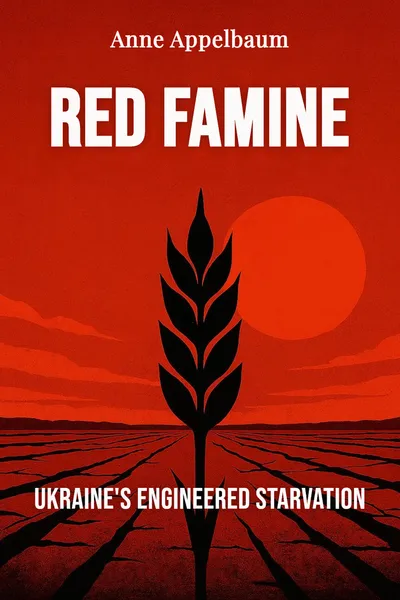
Red Famine
Ukraine's engineered starvation
Description
In the winter of 1932 and the spring of 1933, in the most fertile farmland of the Soviet Union, people starved to death in the millions. Not in a desert, not after a crop failure of biblical proportions, but in Ukraine — the black-earth region that had fed empires. Villages emptied. Roads filled with peasants walking toward cities that had been ordered to turn them away. In Anne Appelbaum's account, drawing on archives that only opened after the Soviet collapse, the estimate she settles on is close to 3.9 million direct deaths in Ukraine alone, out of a wider Soviet famine that killed more still.
What makes the episode almost impossible to file under "natural disaster" is how much of it was administered. There were grain quotas set beyond what the land could yield, then raised again when they weren't met. There were brigades that searched homes for hidden food, taking not just grain but beans, potatoes, the last jar on the shelf. There were blacklists that cut whole villages off from trade, and a border sealed so the hungry couldn't leave to find bread. Each of these was a decision, signed somewhere, carried out by someone.
Appelbaum's book sits inside a much older argument — over what to call this, and whether Stalin's regime meant to kill Ukrainians as Ukrainians, or simply didn't care who died as it broke the countryside to its will. The distinction has shaped how the events have been remembered, denied, and, eventually, named. It is not a footnote to the history. In many ways it is the history.
The question we’re asking : How did a famine in the Soviet Union's richest farmland become something an author can describe as engineered, and why did it take so long to name?What we’ll see : How the starvation was built and run from above — and the long fight over what to call it afterward.
Table of contents
01Chapter 1 — A grain quota that could not be met
To understand the famine, Appelbaum starts before the hunger, with collectivization. From 1929, the Soviet state moved to abolish private farming and herd peasants into collective farms, the kolkhozy. The stated logic was modernization: large mechanized units would out-produce millions of small holdings and deliver a reliable surplus to feed the cities and finance industry. The reality on the ground was chaos, slaughtered livestock, and fierce resistance, especially in Ukraine, where the peasantry was both numerous and, in Moscow's eyes, dangerously attached to its land and its language.
The regime's answer to resistance was to identify an enemy. The kulak — the supposedly wealthy, exploiting peasant — became the target of a campaign of "dekulakization." In practice the label was elastic, applied to anyone who objected, owned a second cow, or simply fell foul of a local official. Hundreds of thousands of families were deported to the north and to Central Asia. The category did the work that the category was built to do: it turned neighbors into class enemies and made expropriation look like justice.

02Chapter 2 — The machinery of starvation
When the quotas weren't met, the response escalated. In late 1932 the Soviet leadership dispatched commissions to Ukraine and the North Caucasus armed with new powers. Vyacheslav Molotov led the effort in Ukraine. The instructions were to extract the grain regardless, and to treat shortfall as a crime. What followed was less a food-collection drive than a punitive occupation of the countryside by its own government.
Appelbaum documents the search brigades in detail. Activists — some local, some sent in — went house to house looking for hidden food. They used long metal rods to probe floors, gardens, and thatch. When grain ran out, they took everything edible: potatoes, dried beans, pickles, seed set aside for spring. Livestock, tools, and household goods were confiscated as fines for failing to deliver. Families were left in emptied houses in the middle of winter with nothing at all. The searches were not accidents of overzealous locals; they were the intended method.
03Chapter 3 — The blacklists and the sealed border
Two further measures, in Appelbaum's telling, pushed the disaster from severe famine toward something harder to explain as neglect. The first was the system of blacklists. Villages and whole districts that failed to meet their quotas were placed on the "black board." A blacklisting meant more than shame. It cut the community off from all trade, banned the sale of manufactured goods, halted the movement of any remaining supplies in, and often triggered the removal of what food was left. It was, functionally, a sentence of collective starvation imposed on a place for the crime of not producing grain it did not have.
The second measure closed the last exit. In January 1933 the regime issued a directive restricting peasants from leaving Ukraine and the North Caucasus in search of food. Roadblocks and travel controls turned back the hungry trying to reach cities or cross into neighboring regions where bread might be found. Tens of thousands were detained and sent home to villages that had nothing. A starving population was, in effect, fenced inside the zone of its own starvation. People who might have survived by walking to where food existed were prevented, by policy, from doing so.
04Chapter 4 — The word that took decades to say
What the famine has always come down to, in the end, is a word. For decades the Soviet state's position was that the deaths of 1932-33 either had not happened at all or had been an ordinary consequence of a difficult time — never a distinct, deliberate event with a name. The very word Holodomor, from Ukrainian roots meaning to kill by hunger, could not be spoken publicly inside the USSR. To name it was already to make a claim the regime could not tolerate: that this had been done, and done to someone in particular.
Appelbaum's book is, among other things, an argument about that naming. She weighs the harder charge — genocide, the intent to destroy Ukrainians as a people — with more caution than some Ukrainian historians and less than some Western skeptics. Her account holds that Stalin's regime used the famine to break Ukrainian resistance and Ukrainian national aspiration, and that the specific measures aimed at Ukraine were not incidental. Whether that meets the legal definition of genocide is a question she treats as genuinely contested, not as settled by outrage.
05Conclusion
By the summer of 1933 the worst was over, not because the policy softened out of mercy but because there was little left to take and the death rate had made the point. The countryside was hollowed out; new settlers were moved into abandoned villages; the census that would have counted the missing was suppressed, and the statisticians who ran it were shot. The silence that followed was itself part of the design — a famine that had been administered would now be administratively erased, kept out of the record for as long as the state that made it survived.
Related books