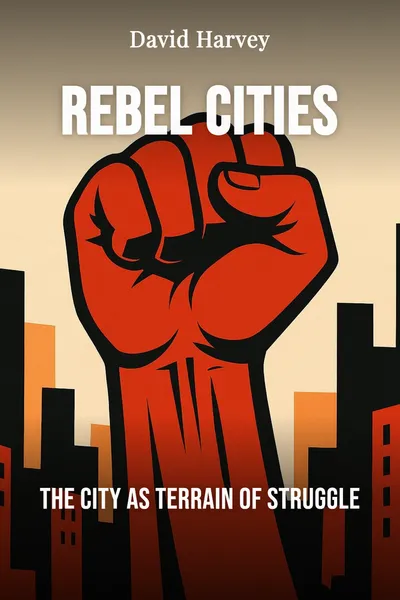
Rebel Cities
The city as terrain of struggle
Description
In 2011, as protesters occupied squares from Cairo's Tahrir to Madrid's Puerta del Sol to Zuccotti Park in Lower Manhattan, a seventy-six-year-old geographer named David Harvey was finishing a short, sharp book. Harvey had spent a career — much of it at the City University of New York — arguing that capitalism does not merely happen in cities; it is made through them. The occupations seemed to confirm something he had long suspected. The people filling those squares were not workers walking out of a single factory. They were residents of the city itself, reclaiming a space that had been built by everyone and captured by a few.
Rebel Cities, published in 2012, gathers that argument into a compact case. Its title borrows from a line Harvey traces back to the French thinker Henri Lefebvre, who in 1968 coined a phrase that would outlive him: the right to the city. Lefebvre meant something larger than the right to whatever the city already offers. He meant the right to make and remake the city, and to make ourselves in the process — a collective power over the shape of urban life that had been quietly stripped away.
Harvey's move is to take that phrase and give it an economic spine. He asks where the money that builds skyscrapers and gut-renovates neighborhoods actually comes from, why cities boom and bust in near-synchrony with financial markets, and who ends up displaced when the cranes arrive. The answer turns the city from a backdrop into a battleground — and turns the fight over rent, land and public space into something closer to class struggle by other means.
The question we’re asking : When we talk about the right to the city, what exactly are we claiming a right to — and who took it?What we’ll see : How Harvey reads urban development as the engine of capital, and turns the fight over urban space into a political one.
Table of contents
01Chapter 1 — The right to the city, reclaimed
Harvey begins with the phrase itself, because it has been worn smooth by overuse. City governments invoke the right to the city in glossy strategy documents; NGOs put it in charters; developers borrow its language to sell luxury towers as community. Harvey wants to recover its teeth. When Lefebvre wrote it down in the ferment of 1968, he did not mean a consumer's right of access to what the city produces — a nicer park, a cleaner subway, a seat at a consultation. He meant a right to intervene in the production of urban space, to shape the city according to the desires of the people who live in it rather than the imperatives of those who profit from it.
That distinction carries the whole book. A right of access leaves the fundamental decisions — what gets built, for whom, at what rent — in the same hands as before. A right to make and remake puts those decisions up for grabs. Harvey insists the second reading is the only one worth fighting for, and the only one capitalism has consistently denied. We build the city collectively, through millions of daily acts of labor and habitation, yet almost none of us hold any power over what it becomes.

02Chapter 2 — How urbanization absorbs surplus capital
To understand why the city matters so much, Harvey turns to a problem that has haunted capitalism from the start: what to do with the surplus. A profitable economy throws off more capital and more labor than can be immediately reabsorbed, and that excess has to go somewhere or the system seizes up. Building cities, Harvey argues, has long been one of capitalism's favorite outlets. Vast quantities of surplus can be sunk into land, roads, housing and offices — a fix that soaks up money and workers alike, at least for a while.
He reaches back to Second Empire Paris to make the case concrete. After the crisis of 1848, Baron Haussmann was handed the job of rebuilding Paris, and his boulevards were not merely aesthetic. They were a colossal program of debt-financed construction designed to absorb idle capital and restless labor, stabilizing the social order by putting both to work. The strategy held until it overreached and helped tip France into the financial crisis of 1868. The pattern — urban building boom, followed by overextension and crash — would repeat across the next century and a half.
03Chapter 3 — The city as factory, the neighborhood as picket line
Traditional Marxism located class struggle at the point of production — the factory floor, the assembly line, the workplace where labor confronts capital directly. Harvey argues that this focus has become too narrow to capture where the fight now happens. The classic industrial proletariat has been dispersed, outsourced and automated; in many cities the largest workforces are in services, construction, cleaning, transport and care, scattered across the urban fabric rather than concentrated behind one factory gate. If we keep looking only at the workplace, we miss the struggle unfolding in the city as a whole.
So Harvey proposes widening the frame. The production of urban life — the daily labor of building, servicing, cleaning and moving through the city — is itself a site of exploitation and therefore of possible revolt. The people who make the city livable are frequently those least able to afford living in it. From this angle, a rent strike, a fight against eviction or a campaign for public transit is not a lesser cousin of the labor strike; it is class struggle conducted on urban terrain, over the conditions of collective life rather than the wage alone.
04Chapter 4 — The urban commons and the question of who governs the city
Step back from the mechanics and Harvey's argument points at a single political question: who governs the city, and on whose behalf? He frames it through the idea of the commons — not as a fixed thing to be protected, like a shared meadow, but as an ongoing relation between a community and the resources it produces and depends on. A neighborhood's vibrancy, its social networks, its accumulated character are collective goods, made by residents over time. And capital, Harvey observes, is expert at enclosing exactly these commons: it lets communities build up value through their own life together, then captures that value as rising rent and land price, and moves on.
Gentrification, in this reading, is the enclosure of an urban commons. Residents make a district desirable through their presence and their labor, and are then dispossessed of it by the very market their desirability attracts. The right to the city is, at bottom, the demand that the people who create this common wealth retain control over it — that its surplus be governed democratically rather than skimmed off by speculators. This is why Harvey keeps returning to power rather than access: the question is not whether the city is pleasant, but who decides what it is for.
05Conclusion
Harvey wrote Rebel Cities as the squares were still full, and the book carries the urgency of that moment — the sense that something long dormant was stirring in the world's cities. His wager was that those uprisings were not scattered discontents but glimpses of a shared demand: for collective power over the spaces we build together and then watch slip into other hands. Whether the movements of 2011 could convert their energy into durable governance was, he admitted, an open question. Many of them could not. But the frame he offered outlasted the occupations.
Related books