Propaganda
A global history of manufactured consent
Description
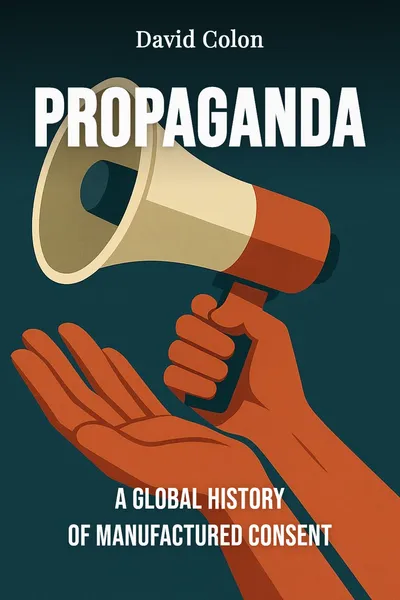
In 1928, a nephew of Sigmund Freud published a slim book with a title that sounds today like an accusation. Edward Bernays called it, simply, Propaganda, and he meant every word of it as a compliment. Manipulating public opinion, he wrote, was the legitimate work of a democratic society — an "invisible government" that organized the chaos of mass opinion into something manageable. Bernays had already convinced American women to smoke in public by rebranding cigarettes as "torches of freedom," and he would go on to sell bacon-and-eggs breakfasts, fluoridated water, and, less proudly, a coup in Guatemala. He was not ashamed of the word. Almost nobody was, yet.
This is where the historian David Colon begins his sweeping account of the twentieth century's most powerful and least understood force. His book, Propaganda, traces manufactured consent from those confident early theorists through the total states that industrialized it, and back into the liberal democracies that never actually gave it up — they only stopped using the name. The story he tells is not a comfortable one, because it refuses the flattering line we usually draw between the regimes that lied to their people and the ones that inform them.
What emerges is a global history in which the techniques travel freely across borders and ideologies, borrowed by fascists from ad men, by ad men from wartime governments, by Cold War agencies from the enemies they claimed to oppose. The methods have a life of their own, indifferent to whose hands they land in. Colon's argument is that we have never left the age Bernays opened — we have only grown better at not noticing it.
The question we’re asking : How did the deliberate engineering of public opinion become a permanent feature of the modern world, in dictatorships and democracies alike?What we’ll see : A century of the same techniques changing hands, from the men who named them to the states that industrialized them, and where they live now.
Table of contents
01Chapter 1 — The word before it went dark
The word itself has a genealogy Colon is careful to recover. It comes from the Catholic Church — the Congregatio de Propaganda Fide, the body set up in 1622 to spread the faith against the Reformation. For three centuries "propaganda" carried no sinister charge. It simply meant the propagation of a doctrine, and a Church could be as proud of it as a political party or a temperance league.
What changed the word was the First World War. Between 1914 and 1918, every belligerent state discovered that modern warfare required not only soldiers and shells but the mobilization of entire populations — and that populations had to be persuaded. Britain built a secret propaganda bureau at Wellington House, staffed by novelists and journalists, and ran an information war so effective that German commanders spent the interwar years insisting they had been beaten by words rather than armies. The atrocity stories, the doctored photographs, the recruitment posters that followed you with their eyes: this was the first industrial-scale manufacture of opinion.

02Chapter 2 — The machinery the twentieth century perfected
If the liberal democracies invented the tools, the total states of the 1930s built the factory. Colon devotes his most detailed pages to the regimes that treated propaganda not as a wartime expedient but as the permanent nervous system of the state. In Germany, Joseph Goebbels ran a Ministry of Public Enlightenment and Propaganda that controlled every newspaper, every film, every radio broadcast, and understood, before almost anyone, that the emotional register mattered more than the argument. Goebbels studied Bernays. He also, according to Bernays himself, kept his books.
The Nazi innovation was less any single technique than the totality of the ambition — the fusion of image, sound, ritual, and repetition into an environment from which there was no exit. The Nuremberg rallies were choreographed for the camera; the cheap Volksempfänger radio was designed to receive German stations and little else; Leni Riefenstahl turned a party congress into a work of cinema. Colon insists on the craft, because underestimating it is a way of misunderstanding how ordinary people were carried along.
03Chapter 3 — The scientists of consent
Alongside the propagandists ran a second history, quieter and more respectable: the researchers who turned persuasion into a science. Colon follows the thread through the American social sciences, where the study of propaganda became, paradoxically, one of the engines of its refinement. Harold Lasswell mapped its structure; the sociologist Paul Lazarsfeld, an émigré from Vienna, built the survey methods that let campaigns measure what actually moved people rather than guess.
The Second World War accelerated everything. Frank Capra's Why We Fight films, produced for the US Army, were tested on soldiers to see which arguments changed minds. Psychologists studied morale, rumor, and the conditions under which an audience would accept a message from a source it distrusted. The findings crossed effortlessly from the war effort into the peacetime economy. The men who had persuaded a nation to fight came home to persuade it to buy, and the advertising industry of the 1950s absorbed the wartime science wholesale.
04Chapter 4 — The tools belong to everyone
The step Colon asks his reader to take is the one we resist most. It is easy to house propaganda safely in the past, in totalitarian regimes and grainy black-and-white footage. His book refuses that quarantine. The techniques he tracks did not die with the dictators; they were inherited, refined, and normalized by the open societies that defeated them, which had helped invent them in the first place. The line between informing a public and manufacturing its consent turns out to be far thinner, and far more porous, than democratic self-image allows.
Consider how much of the modern apparatus is simply the old apparatus with better instruments. Public relations, political consulting, corporate communications, and government "strategic messaging" are all direct descendants of Bernays and the Creel Committee, operating in plain sight and often with pride. The emotional targeting the total states pioneered by intuition is now performed by measurement — focus groups, sentiment analysis, and, in the digital age, the microtargeting of individual voters with messages tuned to their private anxieties. Colon reads the data-driven campaigns of recent years not as a rupture but as a continuation, the same logic running on faster machinery.
05Conclusion
Edward Bernays lived to a hundred and three, long enough to watch the word he had proudly claimed become unspeakable and his methods become ubiquitous under kinder names. The century that Colon surveys is bracketed by that irony: the technique flourished exactly as its name went into hiding. Public relations, communications, messaging, information — the vocabulary keeps changing, and the changes are themselves a kind of propaganda, a way of persuading us that persuasion has stopped.
Related books