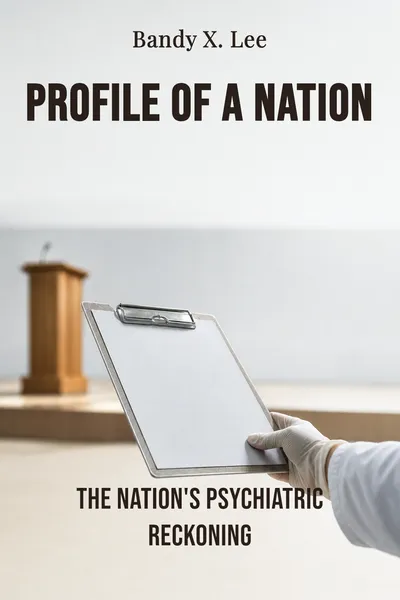
Profile of a Nation
The nation's psychiatric reckoning
Description
In the fall of 2017, a psychiatrist at Yale named Bandy X. Lee organized a small conference and then edited a book that a lot of people wished she hadn't. The book was called The Dangerous Case of Donald Trump, and it collected essays from twenty-seven mental health professionals. Profile of a Nation, published in 2020, was her longer, single-author follow-up — a book-length attempt to lay out the argument in full rather than as a chorus. The premise was blunt: a group of clinicians believed the president of the United States showed signs of psychological instability serious enough that staying silent felt, to them, like a professional failure.
The reaction was immediate and split along a fault line that has run through psychiatry for decades. Some read the project as a long-overdue warning from people trained to notice things the rest of us miss. Others read it as a group of experts abandoning the caution that makes their expertise worth anything — diagnosing a man they had never examined, on a subject they were explicitly told to stay out of. Both sides invoked ethics. Both meant it.
What Lee wrote is less a verdict on one man than a case about who gets to raise an alarm, on what evidence, and at what cost to their own standing. She frames it as a public-health question rather than a partisan one, which is precisely where the argument gets slippery — and where it gets interesting to follow.
The question we’re asking : When mental health professionals believe a public figure is dangerous, does their training oblige them to speak — or bind them to silence?What we’ll see : How a psychiatrist built her case, what her colleagues claimed to observe, the professional rule they knowingly broke, and what the whole episode reveals about expertise and self-rule.
Table of contents
01Chapter 1 — The oath that came due
Lee's book opens not with Trump but with a duty. She spent much of her career studying violence — its prevention, its warning signs, the moment before it happens rather than the autopsy after. That work gave her a particular reflex: when the signs are present, you act. In her telling, the medical principle she leans on is old and uncontroversial in every other context. A doctor who sees a patient about to harm someone has an obligation to warn. The famous version is the Tarasoff duty, named for a 1976 California case that established a clinician's responsibility to protect a potential victim even against confidentiality. Lee takes that logic and asks why it should stop at the edge of politics.

02Chapter 2 — What the clinicians said they saw
The observable behavior is where Lee and her contributors do most of their work. They avoid, at least in principle, the language of formal diagnosis, and reach instead for patterns. The recurring one is grandiosity paired with fragility — a self-image so inflated that any contradiction registers as an attack, and any attack must be answered. Lee reads the pattern of impulsive reactions, the difficulty tolerating dissent, the tendency to describe the world in absolute loyalty and betrayal, as signs of a mind that struggles to hold complexity. In her frame, these are not personality quirks. In a person with ordinary power they might be private. In a president, she argues, they become a public safety concern.
She builds the case from the public record rather than from any private access, which is both the strength and the vulnerability of the method. Everything she cites — the statements, the reversals, the responses to criticism — is available to anyone. Lee's claim is that clinical training lets her see structure where a layperson sees noise, the way a cardiologist reads an ordinary-looking chart differently. Her contributors describe what they take to be a detachment from shared reality, a comfort with falsehood that goes beyond ordinary political spin, and a capacity to draw supporters into the same detachment.
03Chapter 3 — The rule they chose to break
Every clinician who signed onto this project knew they were violating something. The something has a name: the Goldwater rule. In 1964, a magazine polled psychiatrists on whether Barry Goldwater, the Republican presidential nominee, was fit for office. Thousands answered; many offered armchair diagnoses of a man they had never met. Goldwater sued and won. In response, the American Psychiatric Association adopted a formal ethics guideline in 1973 forbidding members from offering a professional opinion about a public figure they have not personally examined and whose consent they do not have. For half a century it has been treated as settled.
Lee's response is not to deny the rule but to reinterpret its scope. She argues the Goldwater rule governs diagnosis — the naming of a specific disorder — and that she and her colleagues are doing something else. Assessing dangerousness, she contends, is a separate professional act with its own long history, one that clinicians perform routinely without a full examination when someone appears to threaten harm. She also invokes what she frames as a competing and superior duty: the duty to warn and protect, which she argues should override a guideline designed, in her reading, mainly to protect the profession's reputation. When a house is on fire, she suggests, you do not wait for the resident's permission to shout.
04Chapter 4 — When a profession weighs a person
Strip the specifics away and the episode is a study in a problem democracies rarely resolve cleanly: what happens when a body of experts believes it knows something urgent about a figure the public has already chosen. Voters had elected the man Lee was warning about. That fact does not vanish because clinicians raise a concern, and Lee does not pretend it does. But it sharpens the question she is really asking. In a self-governing society, who has standing to declare a democratically selected leader a danger — and by what authority does a specialist's judgment outrank a ballot?
Lee's answer is that expertise carries obligations that do not dissolve at the voting booth. A structural engineer who spots a failing bridge is not overruled by the commuters who use it; their preference does not change the physics. She wants dangerousness treated the same way — as a matter of professional observation that the public deserves to hear, even if it complicates a choice the public has made. The appeal of the analogy is obvious. Its weakness is that a bridge cannot object to being assessed, and a psychology read through media coverage is not a stress test with a clear result.
05Conclusion
Profile of a Nation ends more or less where it began: with a clinician who decided that the cost of speaking was lower than the cost of silence, and who spent a book explaining why. Lee never claims certainty about the inner life of the man she assesses. Her wager is narrower — that observable behavior, read with trained eyes, can signal danger, and that a profession which refuses to say so when the stakes are national has misunderstood what it is for. Whether one accepts the wager depends heavily on whether one accepts the distinction she builds it on.
Related books