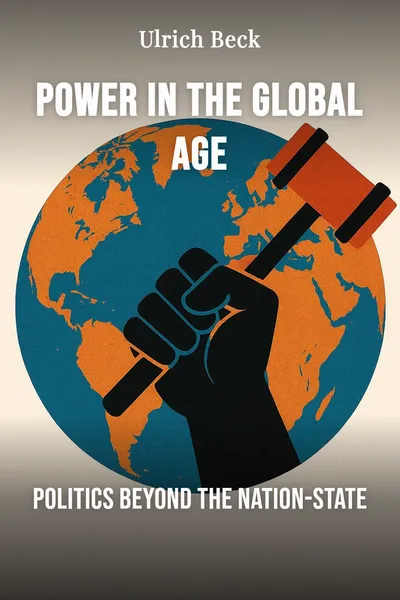
Power in the Global Age
Politics beyond the nation-state
Description
In the early 2000s, a German sociologist named Ulrich Beck sat down to write about a word most political theory had left comfortably alone: power. He had already spent two decades arguing that modern societies were being reorganized around risk rather than wealth — that pollution, financial collapse and nuclear fallout ignored the borders drawn on maps. Now he wanted to ask what that did to authority itself. Who actually rules, he asked, when the things that threaten us — climate, capital, terror, contagion — refuse to stop at customs? His answer, published as Power in the Global Age, took aim at an assumption so deep that almost nobody noticed they were making it: that politics happens inside nations.
For roughly three centuries, that assumption held. The nation-state was the container of politics, the place where votes were counted, laws were passed and power was fought over. Beck's claim was that globalization had quietly cracked the container. Not by abolishing states — they are still very much here — but by allowing the most decisive actors to slip out of their reach. Capital could relocate overnight. A financial tremor in one capital could empty pensions in another. And the state, still expected to answer for all of it, found itself holding responsibility without holding the levers.
Beck was not writing a lament, and that is what makes the book unusual. He saw in the same crisis the raw material for a new kind of politics — one that took the borderless nature of danger seriously instead of pretending it away. The book is his attempt to map that terrain: who has gained power, who has lost it, and what an authority worthy of the global age might look like.
The question we’re asking : What happens to political authority when the forces that shape our lives — money, risk, danger — no longer respect the borders of the nation-state?What we’ll see : How Beck rethinks power once it escapes the national container, and where he thinks a legitimate global politics could begin.
Table of contents
01Chapter 1 — The nation-state loses its monopoly
Beck begins with a distinction that runs through the whole book: the difference between the first modernity and the second. The first modernity was the world of the nation-state — a neat arrangement in which one territory held one people, one economy and one government, and politics was the business of that container. Society and state were assumed to be the same shape. For a long stretch of the twentieth century, this worked well enough that it felt natural, almost invisible. It was the water everyone swam in.
The second modernity, in Beck's telling, is what happens when that container starts leaking. Money, information, migrants, pollutants and threats begin to move across borders faster than any government can track them. The state does not disappear — that is the common misreading Beck is at pains to correct. It stays, with its flag and its parliament and its army, but its monopoly is gone. It is now one actor among several, and often not the most powerful one in the room.

02Chapter 2 — How capital learned to leave
The engine of Beck's argument is what he calls the power of the possible exit. Global capital, he observes, rarely needs to fight the state directly. It does not have to win a vote or storm a ministry. It simply has to be able to leave — to move a factory, a headquarters or an investment fund to a friendlier jurisdiction. The mere credible threat of departure is enough to bend national policy toward lower taxes, looser regulation and cheaper labour. Power here is exercised not by acting but by the option of withdrawal.
This is why Beck describes the new corporate power as strangely quiet. A twentieth-century industrialist confronted the state as an adversary in open struggle. The transnational firm of the second modernity does something subtler: it makes states compete against one another for its favour. Countries bid down their own rules to attract or retain investment, and each concession looks voluntary, even rational, from the inside. No coercion is visible. Yet the cumulative effect is a steady transfer of decision-making from elected governments to actors accountable to no electorate.
03Chapter 3 — The politics of manufactured risk
Risk is where Beck's earlier work meets his politics of power, and it is the hinge of the book. Modern threats, he argues, are increasingly manufactured — produced by our own industrial and technological choices rather than by nature. Climate change, financial contagion, nuclear accidents, engineered pandemics: these are not floods sent from outside but consequences generated from within the machinery of progress. And crucially, they do not respect borders. A meltdown, a market crash or a warming atmosphere spreads regardless of passports.
This borderlessness has a strange political upshot. Because the danger is shared, it forces people and governments into relationships they never chose. The country that emits carbon changes the coastline of a country that did not. The bank that fails in one financial centre wipes out savings continents away. Beck calls this an involuntary community of risk — a togetherness produced not by solidarity or agreement but by exposure to the same threats. We are bound to strangers by what could harm us all.
04Chapter 4 — Cosmopolitan realism, not idealism
The move Beck makes at the end of Power in the Global Age is to argue that cosmopolitanism has stopped being a moral dream and become a practical necessity. For most of its history, the cosmopolitan idea — that we belong to a single human community — was a philosopher's aspiration, something to admire and ignore. Beck's claim is harder-edged: in a world of borderless risk, thinking beyond the nation is no longer idealism but realism. The dreamers, he suggests, are now the people who believe a single country can still guarantee its own security and prosperity alone.
What he proposes is a cosmopolitan realism built on the recognition that shared threats demand shared authority. If capital operates globally and risk travels globally, then the institutions that regulate them must operate at that scale too. This does not mean a world government — Beck is wary of that fantasy — but rather transnational bodies, cross-border agreements and new forms of cooperation that can bind mobile power to some form of accountability. The goal is to close the gap he diagnosed at the start, between the state's legitimacy and the state's shrinking reach.
05Conclusion
Beck set out to ask a simple question with unsettling answers: who holds power once the things that shape our lives stop obeying borders? His reply is that the nation-state still carries the legitimacy of politics while much of its capacity has drained away — to mobile capital that rules by threatening to leave, and to manufactured risks that bind us to strangers we never chose. The old container of national politics has cracked, and both money and danger have poured through the gaps.
Related books