Polio
The race to cure polio
Description
In the summer of 1916, New York City counted more than nine thousand cases of a disease nobody understood. Parents kept children indoors in the heat. Public pools closed, movie theaters emptied, and families with the means fled the city. The paralysis came without warning: a child complained of a stiff neck and a fever, and within days a leg or an arm had gone slack, sometimes the muscles that let a body breathe. Officials posted quarantine placards on doors. And still no one could say how it spread, who would catch it, or why some children walked away untouched while the child next door never walked again.
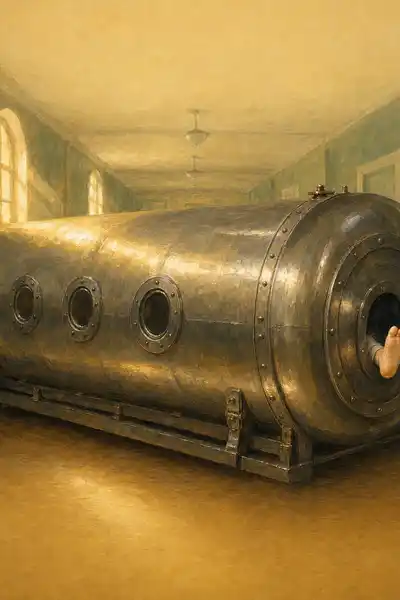
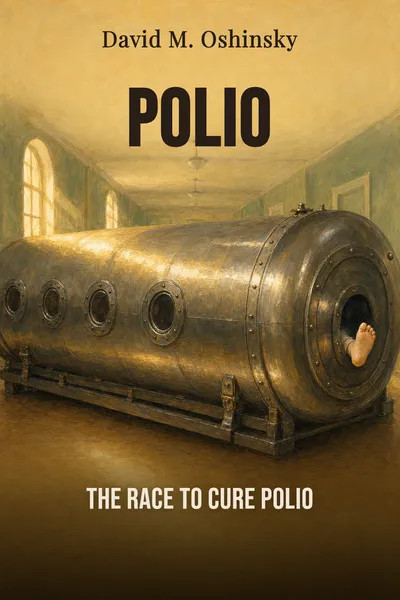
That fear became a fixture of American life for the next four decades. Polio was not the deadliest disease of its era — tuberculosis and influenza killed far more — but it struck at the young, it struck in summer, and it left survivors in leg braces, on crutches, or inside the iron lung, a metal cylinder that breathed for those who no longer could. In his history of the epidemic, the historian David M. Oshinsky traces how a comparatively rare illness came to dominate the national imagination, and how the effort to defeat it became one of the most public scientific races the country had ever staged.
The story runs through a president who hid his own paralysis, a fundraising machine that turned spare change into laboratories, a forgotten woman who may have been the best researcher of them all, and two ambitious scientists whose loathing for each other shaped the science itself. It is a story about how a cure gets made — and about everything that surrounds the making that has nothing to do with the lab bench.
The question we’re asking : How did a relatively rare disease become the target of the most public, most personal scientific race in American history?What we’ll see : How fear, money, ambition, and rivalry converged on a single childhood illness — and produced two vaccines and a national myth.
Table of contents
01 Chapter 1 — The summer everyone feared the water
Polio was, in a strange way, a disease of progress. For most of human history, infants encountered the poliovirus early, while still carrying maternal antibodies, and shrugged it off with mild or invisible infections that left them immune for life. Better sanitation delayed that first exposure. Children now met the virus later, when the protection was gone, and the result was paralysis. The cleaner a community, the more vulnerable its children — which is why polio hit hardest not in the tenements but in comfortable suburbs and small towns, among the well-scrubbed families who had done everything right.
This is part of what made the disease so terrifying. It did not respect the usual logic that the poor and the crowded suffer while the careful stay safe. It could arrive in any household, in the best neighborhoods, in the warm months when children swam and played outside. Parents learned to dread August. They watched for a limp, a headache, a reluctance to climb the stairs, and they knew that by the time the symptoms were obvious it was already too late to do anything but wait.

02 Chapter 2 — A charity that invented the modern fundraiser
The most famous polio survivor in the country was Franklin Delano Roosevelt, stricken in 1921 at the age of thirty-nine, his legs permanently paralyzed. He spent enormous energy concealing the full extent of it, and with the press's cooperation he largely succeeded — the public knew he had been ill but rarely saw him struggle to stand. In 1926 he bought a run-down resort in Warm Springs, Georgia, whose mineral waters he believed eased his condition, and turned it into a rehabilitation center for fellow patients. Warm Springs became the emotional center of his relationship to the disease.
In 1938, Roosevelt and his law partner Basil O'Connor launched the National Foundation for Infantile Paralysis. O'Connor, a sharp Wall Street lawyer with no medical training, would run it for decades and effectively invent modern disease philanthropy. The comedian Eddie Cantor coined a phrase on the radio, urging Americans to send their coins straight to the White House: the March of Dimes. The response buried the mail room. Hundreds of thousands of envelopes arrived, many stuffed with actual dimes.
03 Chapter 3 — Two men who could not stand each other
Before either famous name appears, Oshinsky pauses on a researcher too often left out: Isabel Morgan, working at Johns Hopkins in the 1940s. She demonstrated that a killed-virus vaccine could protect monkeys from polio — an achievement that put her, arguably, ahead of everyone in the field. She had the talent, the results, and the momentum. Then she married, moved, and left research to raise a family. Oshinsky's suggestion is quiet but pointed: had she stayed, she might well have reached the prize before anyone else. The race that history remembers as a two-man contest could easily have had a different protagonist.
The two men were Jonas Salk and Albert Sabin, and their dislike was mutual and durable. Salk, based in Pittsburgh, was younger, ambitious, and impatient. He pursued a killed-virus vaccine — poliovirus grown, then chemically inactivated so it could provoke immunity without causing disease. Sabin, older and more established, considered the approach crude and possibly dangerous. He wanted a live, weakened virus taken orally, which he believed would produce stronger, longer-lasting immunity closer to a natural infection.
04 Chapter 4 — The vaccine as a national project
What the polio fight really pioneered was not a single laboratory technique but a way of doing medical research in public. Before the March of Dimes, the search for cures was a quiet affair, funded by universities, foundations, and a thin trickle of government money, conducted largely out of view. Polio changed that. It made research a mass participatory cause, financed by dimes from strangers, dramatized by celebrities, and reported like a sporting event with named competitors and a finish line. The vaccine belonged, in a sense, to the whole country that had paid for it.
That model had extraordinary strengths. It generated resources on a scale no ordinary budget could match, and it created a public that felt genuinely invested in the outcome. But it also carried strains that Oshinsky does not hide. The hunger for a triumphant result pushed the timeline. Weeks after the 1955 announcement, the Cutter incident revealed the cost of that pressure: a batch of Salk vaccine from one manufacturer had not been fully inactivated, and it paralyzed and killed children who had lined up expecting protection. The disaster exposed how thin the margin was between a public triumph and a public catastrophe.
05 Conclusion
The iron lung wards emptied. In the United States, wild polio cases fell from tens of thousands a year to a handful within a decade, and by the late twentieth century the disease had been eliminated across most of the world. The fear that had closed swimming pools and darkened summers simply lifted, so completely that later generations struggled to imagine it had ever existed. Salk and Sabin remained cordial adversaries to the end, each convinced his approach had been the right one, neither willing to grant the other the last word.
Related books