Plato at the Googleplex
What Plato still teaches us
Description
There's a particular argument that keeps resurfacing, usually delivered by someone who works with instruments or equations. It goes like this: philosophy had its run, back when we didn't know how the universe was put together, but the sciences have since taken every real question off its plate. Cosmology explains where things come from. Neuroscience explains what a mind is. Whatever's left for the philosophers is a kind of parlor game — clever, harmless, and finished. Rebecca Goldstein, a philosopher who also writes novels and once trained in the philosophy of science, had heard this often enough to want to answer it properly.
Her answer, published in 2014, is a book with an odd premise. It's called Plato at the Googleplex, and its strangest move is to take Plato — dead roughly twenty-four centuries — and drop him into the present. He shows up at Google's headquarters, on a cable news panel, at a bookstore reading, in a neuroscientist's lab. Between these invented scenes, Goldstein writes straight intellectual history: who Plato was, what Athens was like, what he was actually trying to do. The two registers braid together, and the effect is not a gimmick. It's an argument about whether the oldest questions we have are still live.
The gamble is that Plato, of all people, survives the trip. Not because he was right about everything — Goldstein is clear that he wasn't — but because the moves he made are the ones we're still making, often without noticing whose footprints we're standing in. When someone on television insists that morality is just opinion, or that expertise is elitist, or that a crowd's answer is as good as a specialist's, there's a Platonic dialogue that already staged the fight.
The question we’re asking : If science now answers the questions philosophy once owned, why do the ancient arguments keep showing up in our newest debates?What we’ll see : How a twenty-four-century-old Athenian, dropped into Silicon Valley and cable news, turns out to be arguing about the same things we are.
Table of contents
01 Chapter 1 — Philosophy that keeps getting buried, and keeps digging out
The complaint Goldstein sets out to answer is old and reputable. Stephen Hawking had recently declared philosophy dead, killed by physics. The sentiment is common among people who build things that work: the universe yields to measurement, the brain yields to scanning, and the residue of unanswerable questions looks like leftover superstition. On this view, asking a philosopher about reality is like asking an astrologer about the weather. Charming, but why would you.
Goldstein doesn't dismiss this. She takes it as the serious position it is, and she concedes a lot of ground. Philosophy really has handed off enormous territory. Questions about matter, motion, life, and mind that were once philosophical are now scientific, and the handoff was a good thing. Where she pushes back is on what the handoff implies. The fact that philosophy keeps losing questions to science doesn't mean philosophy is failing. It might mean philosophy is doing exactly what it's for — pushing a question until it becomes precise enough to leave home.

02 Chapter 2 — The man who invented the examined life
To make the case, Goldstein spends a good part of the book on who Plato actually was, and the portrait resists the marble. He was born around 424 BCE into an aristocratic Athenian family, in a city that had just spent decades tearing itself apart in war and would soon execute the man who mattered most to him. Athens in his lifetime was loud, litigious, and unstable — a democracy capable of brilliance and of putting Socrates to death by vote. Plato grew up inside that contradiction and never got over it.
Socrates is the hinge. He wrote nothing himself; almost everything we have of him comes through Plato's dialogues, where he wanders the city asking people what they mean when they use big words. What is justice. What is courage. What is piety. The people he asks are confident, and the questions unravel them, and the unraveling is the point. Socrates' claim was that an unexamined life isn't worth living — not as a slogan but as a working method. You find out what you actually believe by having it taken apart.
03 Chapter 3 — Plato walks into a media studio
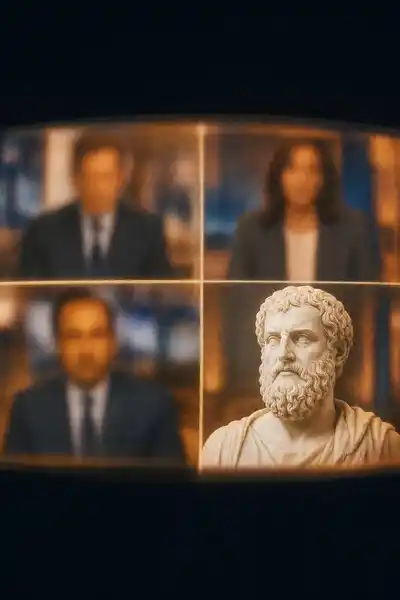
This is where the invented scenes earn their keep. Goldstein imagines Plato touring Google, sitting for a cable panel, fielding questions from a crowd, consulting a neuroscientist — and in each setting the modern confidence runs straight into a Socratic wall. At Google, the assumption is that with enough data and enough users, any question can be crowd-sourced to a good answer. Plato, who watched a crowd vote his teacher to death, is not persuaded that aggregating opinions gets you to truth. More voices can mean more agreement, not more knowledge.
The cable-news scene is sharper still. A confident pundit, a life coach with a bestseller, insists that morality is personal — that no one gets to tell anyone else how to live, that values are just preferences we happen to hold. Plato's Socrates has heard this before; it's roughly the sophist position he spent his career dismantling. His counter isn't to shout a rule from on high but to ask questions until the relativist notices he's smuggling in a standard even as he denies there is one. If nothing is really better or worse, on what ground do we condemn cruelty? The pundit doesn't have an answer, only a brand.
04 Chapter 4 — What philosophy actually does when we say it does nothing
Step back and Goldstein's real claim comes into focus, and it's more radical than a defense of a dusty subject. Philosophy, she argues, makes progress precisely by erasing its own tracks. Its wins don't accumulate as findings you can point to; they accumulate as the shape of what we now consider obvious. That's why it can look, from inside any given century, as if nothing has been settled — because everything that got settled quietly changed sides and became the assumptions we argue from rather than the claims we argue about.
This is why Plato survives the trip to the Googleplex, and it's not nostalgia. The reason the ancient questions keep surfacing in cosmology, neuroscience, crowd-sourcing, and cable news is that those fields answer the how brilliantly and then reach, almost against their will, for a should or a why they can't derive from their instruments. What counts as a good life, whether a crowd's verdict tracks truth, whether describing a mind exhausts it, why every person's standing counts equally — these aren't gaps that better data will close. They're the questions that generate the next round of inquiry, and they're recognizably Platonic.
05 Conclusion
Goldstein set out to answer a specific charge — that philosophy is finished, its work either done or done better by others — and she answered it by refusing to argue in the abstract. Instead she resurrected the man who arguably started the whole enterprise and let him walk through our institutions, where the oldest questions are being asked again by people who think they invented them. The image that lingers isn't Plato bewildered by search engines. It's Plato entirely at home, because the debates haven't changed as much as the technology has.
Related books