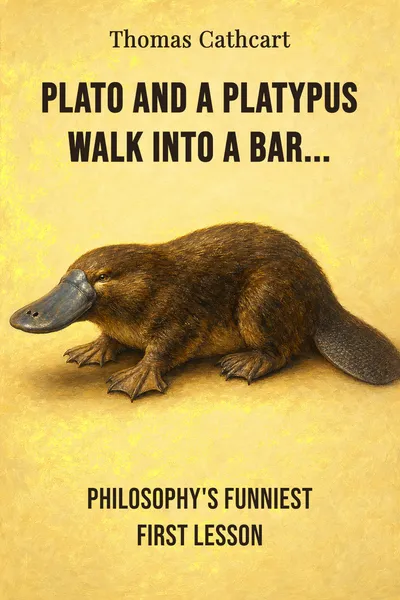
Plato and a Platypus Walk into a Bar...
Philosophy's funniest first lesson
Description
A man walks into a bar. So do Plato, a platypus, and, over the course of two hundred-odd pages, roughly every dead philosopher worth arguing with. That is the conceit of Plato and a Platypus Walk into a Bar, the small book Thomas Cathcart wrote with his college friend Daniel Klein and published in 2007. Both had studied philosophy at Harvard in the late 1950s, then spent decades doing almost anything else — Cathcart drifted through hospital work and ministry, Klein wrote gags for comedians and pulp under pen names. Late in life they discovered they had been collecting the same thing all along: jokes that happen to smuggle in a philosophical point.
The wager of the book is disarmingly simple. A good joke and a good philosophical argument do the same work. Both set up a premise, lead us somewhere we agreed to go, then pull the floor out from under us. The laugh and the insight arrive by the same mechanism — a sudden shift in how we were framing things. So instead of opening with Descartes and a definition, Cathcart and Klein open with two guys at a bar and let the definition sneak up behind it. Metaphysics, logic, ethics, the philosophy of language: each gets a joke as its front door.
It sounds like a gimmick, and part of the pleasure is watching it refuse to be one. The jokes are not decoration glued onto a lecture; they are the lecture, told in the one register that gets us to lower our guard. What that pairing turns out to reveal — about jokes, about arguments, and about the odd moment when a hard idea suddenly lands — is the real subject underneath the gags.
The question we’re asking : Can a joke actually teach philosophy, or is it just sugar on a dull pill?What we’ll see : How two lapsed philosophy students turned a lifetime of jokes into a working guide to the questions philosophers never stopped chewing on.
Table of contents
01Chapter 1 — The joke that thinks it's an argument
Cathcart and Klein start from a claim that sounds like a setup but is meant seriously: philosophy and comedy are built out of the same material. A joke works by leading us down one path and then revealing, in the punchline, that we were on a different path all along. A philosophical argument does something structurally identical — it takes an assumption we hadn't noticed we were making and turns it over so we see its underside. The difference is mostly the soundtrack. One ends in a laugh, the other in a raised eyebrow and a long pause.
Take their favorite kind of example, the joke about a man asking his rabbi why God made two of everything and being told, gently, that the man has misunderstood the whole category. The humor lives in the gap between what the question assumes and what the answer reveals about that assumption. That gap — the moment a hidden premise gets exposed — is exactly what a philosopher means by clarifying a concept. The joke does the clarifying without ever using the word.

02Chapter 2 — A whole curriculum told over drinks
What keeps the book from being a joke anthology is that it is quietly organized like a syllabus. Cathcart and Klein march through the standard divisions of philosophy — metaphysics, logic, epistemology, ethics, the philosophy of language, philosophy of religion — and hang each one on a comic hook. The reader who finishes it has, almost by accident, walked the same route a first-year course would take, minus the reading list and the exam.
Metaphysics gets the questions about what is really there: whether the world is as it appears, whether time and identity hold together, whether a ship that has had every plank replaced is still the same ship. Epistemology gets the questions about what we can know and how we could ever be sure. Ethics gets the ones about what we owe each other, with utilitarians and Kantians standing in for the two guys arguing at the end of the bar. Each branch arrives with its own comic register, because the questions have different textures.
03Chapter 3 — When the punchline is also the paradox
The most satisfying stretches of the book are where a single joke turns out to carry an entire school of thought without straining. Relativism gets illustrated by the punchline where two people both insist they're right and a third, refereeing, tells them they're both right too — which is either wisdom or nonsense depending on how seriously we take the idea that truth bends to the speaker. The joke doesn't resolve the tension. It stages it, and lets us feel why philosophers have argued about it for centuries.
Skepticism gets the same treatment. The jokes about the man who can't be sure his senses aren't fooling him, or whether anyone else is really conscious, are funny precisely because the doubt is both airtight and useless — we can't refute it and we can't live by it. Cathcart and Klein use the laugh to mark the exact spot where reason runs out of traction. That's the pedagogical move underneath the comedy: humor points at the seam where a serious idea stops behaving.
04Chapter 4 — Why the mind laughs where reason stalls
Step back from the bar and the deeper point is not really about jokes at all — it's about how understanding arrives. Cathcart and Klein keep returning to a single moment: the beat before the laugh, when the frame flips and we suddenly see the setup differently. That flip is not the conclusion of a proof. It's a reorganization, fast and involuntary, of how we were holding the whole picture. And the book quietly insists that real philosophical comprehension works the same way. We don't grind toward a hard idea step by step so much as we suddenly click into it.
This is why the joke-philosophy pairing is more than a teaching aid. It suggests that the feeling of getting a joke and the feeling of getting an argument are, at bottom, the same cognitive event — a hidden assumption made visible, a frame we didn't know we were inside snapping into view. Philosophers have long been suspicious of that click, because it can't be shown on paper the way a valid syllogism can. But it's the thing everyone actually chases. Nobody remembers the proof; they remember the moment it landed.
05Conclusion
Cathcart and Klein wrote the book decades after leaving philosophy behind, which turns out to matter. They came back to it not as professionals defending a field but as two friends who had spent their lives noticing that the jokes they loved and the questions they'd studied kept rhyming. That distance is what lets the book be generous. It has nothing to prove about its own seriousness, so it can afford to be funny, and the humor never feels like a concession to a reader assumed to be lazy.
Related books