Plants of the Gods
Sacred plants, modern science
Description
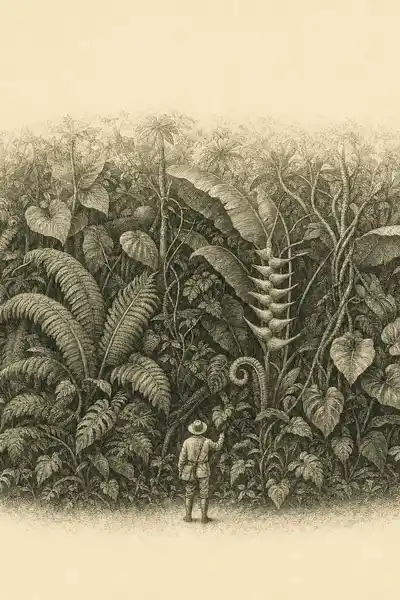
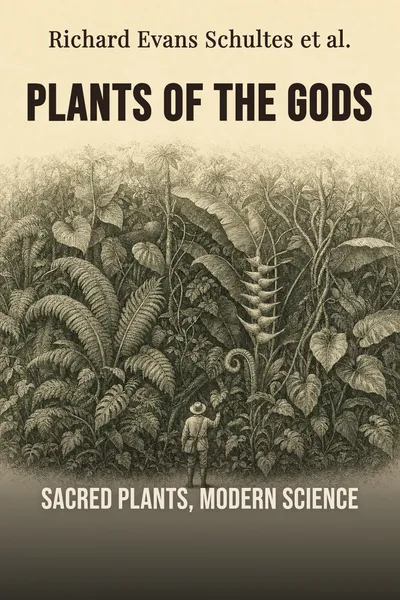
Somewhere in the Colombian Amazon in the 1940s, a young Harvard botanist named Richard Evans Schultes was living among Indigenous communities, chewing coca with them, drinking their bitter preparations, and filling notebook after notebook with the names of plants nobody in Cambridge had catalogued. He spent roughly twelve years in the northwest Amazon. He came back with thousands of specimens and a conviction that would organize the rest of his life: that the plants these cultures used to reach their gods were not superstition to be explained away, but a body of botanical and chemical knowledge worth studying with the full seriousness of a laboratory.
Decades later, that fieldwork became a book. Schultes teamed up with Albert Hofmann — the Swiss chemist who had first synthesized LSD in 1938 and famously felt its effects in 1943 — to write a survey of the world's psychoactive plants. Their collaboration paired the man who had walked the rainforest with the man who could name the molecule inside the leaf. The result, later expanded and updated by the German ethnopharmacologist Christian Rätsch, sits at an unusual intersection: part botanical atlas, part chemistry primer, part account of how human cultures have used these plants for thousands of years.
What makes the book more than a catalogue is its refusal to separate the plant from the people who use it. A morning glory seed in a suburban garden and a morning glory seed on an Aztec altar contain the same alkaloid — and the book insists that the difference between the two is exactly what deserves attention. It reads these plants the way a scientist reads them and the way a culture lives them, at the same time.
The question we’re asking : How do a botanist, a chemist and an anthropologist read the plants that cultures have used to reach the sacred?What we’ll see : A survey that moves from Amazon fieldwork to the world's sacred flora, into the molecules that produce the visions, and toward what the book argues we lose when we study any of these in isolation.
Table of contents
01 Chapter 1 — The Amazon botanist who took the plants seriously
Richard Evans Schultes did not set out to become the most influential figure in the field. He arrived in the Colombian Amazon in 1941 on a fellowship, initially to study how Indigenous peoples prepared curare, the arrow poison, and the source of rubber during the war years. He stayed for over a decade. What kept him there was the sheer scale of what the communities knew about their own plants — a working pharmacology, refined across generations, that no herbarium in the world had recorded.
His method was unusual for its time. Where earlier travelers had treated Indigenous plant use as exotic curiosity, Schultes treated the shaman as a colleague and the forest as a database. He learned which plants were used, how they were prepared, in what combinations and at what doses. He noted that many preparations were not single plants but careful mixtures, and that the knowledge of which parts to use and how to process them was as precise as any recipe. He collected some twenty-four thousand plant specimens over his career, several hundred of them previously unknown to science.

02 Chapter 2 — A field guide to the sacred pharmacy
The core of the book is a survey, and it is deliberately global. It moves across continents to show that reaching altered states through plants is not a regional quirk but something cultures have arrived at nearly everywhere they found the right flora. The peyote cactus of the Mexican deserts, still central to the Native American Church. The psilocybin mushrooms of the Mexican highlands, which the Aztecs called teonanácatl, roughly the flesh of the gods. The ayahuasca brews of the Amazon. The iboga root of Central Africa. The fly agaric mushroom of Siberia. Each gets its botany, its geography, and its place in ritual life.
What emerges is a pattern rather than a list. In culture after culture, these plants sit at the center of the most serious business a community has — healing, divininig the cause of misfortune, marking initiation, contacting ancestors or gods. They are rarely recreational in the modern sense. They are handled by specialists, taken in prescribed settings, surrounded by preparation and restriction. The book is careful to render this seriousness rather than sensationalize it.
03 Chapter 3 — The molecules behind the visions
Albert Hofmann's contribution turns the atlas into chemistry. Most of the plants in the book, it turns out, work through a surprisingly small family of compounds. Many of the major visionary molecules are structurally related to substances the human body already produces. Psilocybin, the active compound in the Mexican mushrooms, resembles serotonin, one of the brain's own signaling chemicals. So does DMT, the compound at the heart of ayahuasca. The book lays out these structures plainly, showing how molecules found in a fungus or a vine slot into the same receptors the brain uses for its ordinary chemistry.
Hofmann's own history runs through this section. He had synthesized LSD from ergot, a fungus that grows on rye, and the book connects that laboratory compound to a longer natural lineage — the same ergot alkaloids that Hofmann later identified in the morning glory seeds the Aztecs had used under the name ololiuqui. The discovery closed a loop: a Swiss chemist and an ancient Mexican ritual reaching for versions of the same molecule, centuries and continents apart. The compound the priest ground on the altar and the one Hofmann isolated in Basel were chemical cousins.
04 Chapter 4 — When the laboratory meets the ritual
The book's deeper claim, running under the botany and the chemistry, is that neither one alone explains these plants. A molecule can tell us which receptor it fits; it cannot tell us why one culture treats the experience as a meeting with ancestors and another treats the same compound as a public danger. The plant, the dose, the setting, the intention and the meaning are not separable ingredients. They are a single system, and studying only one part gives a distorted picture. This is the through-line Rätsch's updates keep sharpening as later science accumulates.
Rätsch, the ethnopharmacologist who revised and expanded the work, brings the story forward. His additions fold in decades of research that confirmed much of what Schultes had documented in the field and identified new compounds and new plants along the way. But his framing stays loyal to the original insight: the science is most useful when it sits beside the anthropology, not on top of it. Knowing the alkaloid does not retire the shaman's knowledge; it corroborates a great deal of it.
05 Conclusion
Schultes died in 2001, Hofmann in 2008 at the age of a hundred and two. The book they began together outlived both of them, carried forward by Rätsch and by the field of ethnobotany that Schultes had done more than anyone to establish. What began as a young man's notebooks in the Colombian rainforest became a reference work that still sits on the shelves of botanists, chemists and anyone curious about how humans have used the flora around them to step outside ordinary consciousness.
Related books