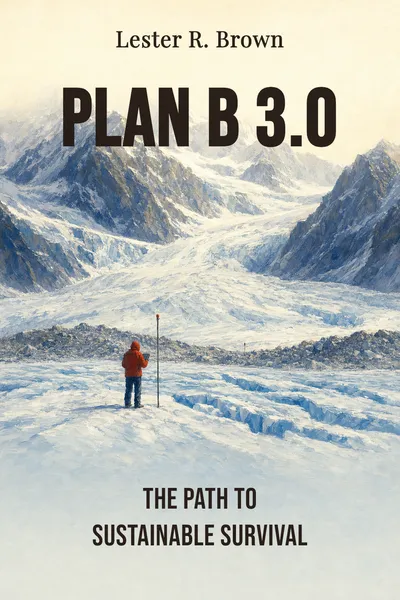
Plan B 3.0
The path to sustainable survival
Description
In 2008, an environmental analyst named Lester R. Brown published the third rewrite of a book he had first put out five years earlier. Brown had spent decades tracking the planet's ledgers — grain harvests, aquifer levels, glacier mass, carbon in the atmosphere — with the patience of an accountant who suspects the books are being cooked. He had founded the Worldwatch Institute in 1974 and later the Earth Policy Institute, and he had a habit of publishing numbers that governments preferred to ignore. Plan B 3.0 was his running attempt to add those numbers up and say what they meant, out loud, before the total came due.
The title carries the whole argument. Plan A is the path we are already on: an economy that treats the natural world as a limitless warehouse and a bottomless sink, burning fossil fuels, draining rivers, thinning soils, and assuming next year will look like last year. Brown's case is that Plan A is not immoral so much as arithmetically doomed — it depends on resources that are visibly running down and a climate that is visibly shifting. Plan B is the alternative: cut carbon fast, stabilize population, restore the natural systems that feed and water us, and eradicate the poverty that keeps the whole thing unstable.
What makes the book more than a warning is its insistence on scale and speed. Brown does not ask for gentle adjustment. He reaches for the metaphor of wartime mobilization — the way the United States retooled its entire industrial base in a matter of months after Pearl Harbor — and asks whether a civilization can do the same thing on purpose, before the crisis rather than after it. The book is less a lament than a budget: here is what it costs, here is where the money comes from, here is the deadline.
The question we’re asking : Can a civilization redesign its economy fast enough to outrun the environmental limits it is already hitting?What we’ll see : How Brown reads the planet's warning signs, and the mobilization he says could still turn them around.
Table of contents
01 Chapter 1 — Plan A has run out of runway
Brown builds his case the way a doctor reads a chart, one worrying trend at a time, and the trends refuse to stay separate. Atmospheric carbon dioxide keeps climbing past levels the planet has not seen in hundreds of thousands of years. Glaciers in the Himalayas and the Andes, the frozen reservoirs that feed the rivers of Asia and Latin America in the dry season, are shrinking. Water tables are falling under the grain belts of China, India, and the American Great Plains as farmers pump aquifers faster than rain refills them. Topsoil that took centuries to build is blowing and washing away in a single generation. None of these on its own ends a civilization. Together, Brown argues, they describe an economy operating on borrowed capital it cannot repay.
The heart of the argument is a distinction between income and principal. A sustainable economy lives on nature's interest — the fish a fishery can regenerate each year, the water a watershed can renew, the trees a forest can regrow. Plan A, by contrast, is drawing down the principal: catching fish faster than they breed, pumping water that took millennia to accumulate, cutting forests that will not come back in any human timescale. For a while the accounts look healthy, because spending your savings feels exactly like earning money right up until the balance hits zero. Brown's whole vocabulary of "overshoot" and "collapse" turns on that lag.

02 Chapter 2 — Cutting carbon like a wartime mobilization
The centerpiece of Plan B is an energy transition on a scale that most planners at the time treated as fantasy. Brown sets a target — cutting global carbon emissions sharply and quickly, on the order of 80 percent by 2020 in his framing — and then works backward to show what it would physically take. Wind farms across the Great Plains and offshore. Solar arrays and rooftop panels. Geothermal wherever the crust runs hot. Efficiency everywhere: compact fluorescent bulbs replacing incandescents, buildings redesigned to leak less heat, cars electrified and fed from a cleaner grid. The point is not any single technology but the combination, deployed all at once.
What separates Brown from a hopeful futurist is his refusal to leave the money vague. He puts a price tag on Plan B — restoring forests, stabilizing soils, protecting fisheries, providing basic education and health, cutting emissions — and totals it at a few hundred billion dollars a year, a sum he then sets beside global military spending to show it is not, in fact, unaffordable. The obstacle is not resources; it is priorities. He argues for a carbon tax offset by cuts to income tax, so that prices finally tell the ecological truth about what fossil fuels cost.
03 Chapter 3 — Feeding a full planet without wrecking it
Energy is only half the ledger. The other half is whether the planet can keep feeding a growing population without destroying the systems that make food possible. Brown treats food security as the hinge on which political stability turns, and he watches the grain harvest the way a market watches interest rates. Yields that once climbed steadily are flattening. The easy gains from irrigation and fertilizer have largely been banked. Meanwhile the demands keep rising: more mouths, more meat as incomes grow, and now grain diverted into ethanol and biofuel, so that the world's cars and its poorest eaters compete for the same corn.
The pressures Brown catalogs feed directly back into the environmental accounts. Aquifers pumped dry to irrigate crops. Grasslands overgrazed into desert. Cropland paved over by expanding cities or lost to erosion. Rising temperatures that shrink harvests, since grain yields fall once the growing season runs too hot. Fisheries pushed past the point of recovery. Each of these narrows the margin between what the planet grows and what humanity needs, and Brown's worry is that the margin is thin enough that a bad year in the wrong place could tip into shortage and unrest.
04 Chapter 4 — When the old order stops being negotiable
Step back from the individual chapters and Brown's book is making a claim larger than any of its policies: that sustainability has quietly changed categories. For most of the environmental movement's history, protecting nature was framed as a value — something a wealthy society could choose to prioritize once its other needs were met, a preference balanced against jobs and growth. Plan B 3.0 argues that this framing is now obsolete. When aquifers empty and harvests fail and coastlines flood, the environment stops being a policy area and becomes the ground on which every other policy stands. Brown is effectively rewriting sustainability as a security question.
This is why the book leans so hard on the language of war and emergency rather than the language of conservation. A security threat is not something you address when convenient; it is something a state mobilizes against because failure is not survivable. Brown's insistence on speed, on totals, on comparing the cost of Plan B to military budgets, all flows from this reframing. He is not asking whether we would like a cleaner world. He is asking whether the current civilization intends to still exist, and treating that as an open question rather than a rhetorical one.
05 Conclusion
Brown ends where the accountant in him began: with the numbers and the deadline. Plan B is not offered as a utopia but as a budget that balances — a way of living on the planet's income instead of its principal, priced out line by line and set against what the world already spends on other priorities. The wager running through the whole book is that a civilization capable of retooling its factories in months during a war is capable of retooling its economy in years to avoid one. Whether it chooses to is left, deliberately, as the reader's problem rather than the author's prediction.
Related books