Phantoms in the Brain
How the mind conjures illusions
Description
A man comes into V. S. Ramachandran's office at the University of California, San Diego, and describes an itch in his left hand. He wants to scratch it. The trouble is that his left arm was amputated ten years earlier. It is gone, and yet he feels it hanging by his side, can feel the fingers clench, can feel them cramp until the pain is unbearable — pain in a hand that no longer exists. Ramachandran, a neurologist trained to take such reports seriously rather than wave them off as imagination, listens, then does something odd. He takes a cotton swab and strokes the man's cheek. The patient says he feels the swab on his cheek. And also, distinctly, on his missing thumb.
That single observation is the seed of "Phantoms in the Brain," the 1998 book Ramachandran wrote with the science journalist Sandra Blakeslee. Its argument runs against a deep intuition we all carry: that what we see, feel, and remember is a faithful readout of the world. The patients in his clinic — people who deny that their own paralyzed arm belongs to them, who insist a parent has been replaced by an impostor, who laugh uncontrollably as they die — suggest something stranger. The brain is not a passive recorder. It is a storyteller, working overtime to keep the story coherent.
Ramachandran built his reputation on a contrarian method: cheap tools, close attention, one patient at a time, in an age racing toward billion-dollar brain scanners. A mirror and a cardboard box, in his hands, could do what a laboratory could not. Behind each odd case sits a question about ourselves — the ones with unremarkable, undamaged brains, who walk around convinced we are seeing things as they are.
The question we’re asking : What do a phantom limb, a mirror box, and a patient who thinks his mother is an impostor reveal about how the mind assembles the world?What we’ll see : How Ramachandran turned strange clinical cases into a working theory of a brain that builds, rather than records, reality.
Table of contents
01Chapter 1 — The arm that isn't there
Almost everyone who loses a limb goes on to feel it. The phantom can itch, sweat, gesture, feel warm — and, cruelly, it can hurt. For a long time the standard explanation was psychological: grief, denial, the mind refusing a loss. Ramachandran suspected the answer lived in the tissue between the ears, and he had a map to prove it. The body is laid out across the surface of the brain in a strip called the somatosensory cortex, and on that strip the territory for the hand sits, awkwardly, right next to the territory for the face.
So when the swab touched the patient's cheek and he felt it on his missing thumb, Ramachandran read it as a clue, not a curiosity. The hand's patch of cortex, no longer receiving signals from a hand, had not gone silent. Its neighbors — the face territory — had crept in and colonized it. Touch the cheek, and you now activate the old hand map too. The brain had rewired itself. This was in the early 1990s, when the adult brain was widely assumed to be fixed, its wiring set in childhood. Here was a man whose cortical map had reorganized in a matter of weeks.

02Chapter 2 — A mirror, a box, and a way out
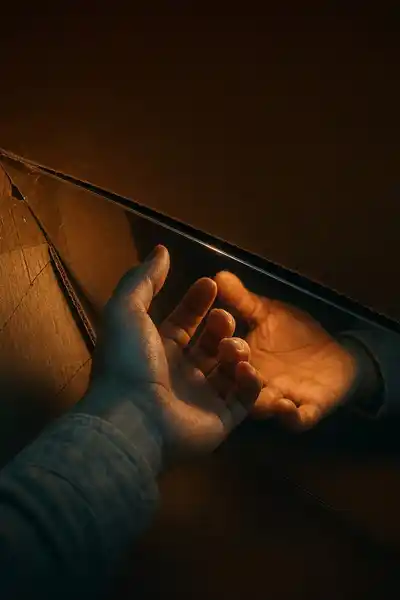
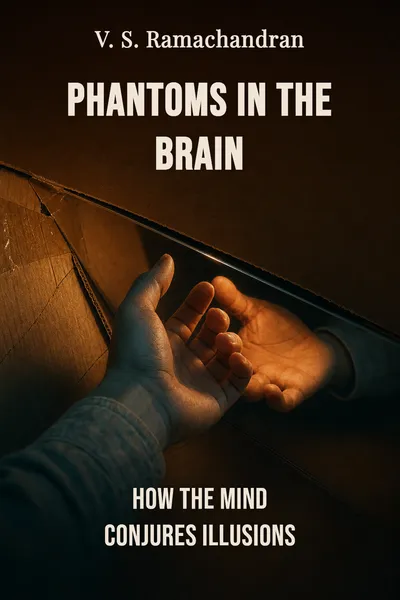
Ramachandran's solution cost a few dollars. He took a cardboard box, removed the lid, and stood a vertical mirror inside it, dividing the box in two. A patient with a phantom left arm would slide his intact right arm into one side and rest the stump of the left on the other. Looking into the mirror, he saw the reflection of his good hand exactly where the missing one should be. For the brain, briefly, the phantom was visible again — and it obeyed.
The effect could be immediate. A man whose phantom hand had been clenched painfully for years watched his reflected good hand open, and felt the phantom unclench for the first time. Others, moving the visible-and-reflected hand, felt the frozen phantom move with it, the cramp easing. What the mirror provided was the missing confirmation: the brain issued a command to move, and now it received the visual proof it had been starved of. The loop closed. The alarm, in some cases, switched off.
03Chapter 3 — The brain fills the gaps
Once you accept that the brain builds rather than records, its other malfunctions start to look like the same machinery caught misfiring. Take the patient with a large blind spot from damage to the visual pathway. Asked what he saw where the gap was, he did not report darkness or a hole. He reported wallpaper — the pattern of the surrounding wall, extended smoothly across the missing region. The brain had papered over the absence so completely that the man could not find it. We all do a version of this constantly, without noticing.
Then there is Capgras syndrome, one of the book's most haunting cases. A young man, after a head injury, was convinced his parents had been replaced by impostors who looked identical. He could recognize his mother's face perfectly; he simply felt she was a fraud. Ramachandran's explanation was elegant: the wire connecting the face-recognition area to the emotional center had been cut. The man saw his mother, but the warm jolt of familiarity never arrived. And rather than sit with that void, his brain manufactured a story that made sense of it — she must be an impostor.
04Chapter 4 — What the broken brain reveals about the whole one
Ramachandran's wager, threaded through every case in the book, is that damage is the best window we have onto the intact mind. A machine working perfectly tells you little about how it works; a machine breaking in a specific, reproducible way exposes its parts. The phantom limb reveals the body map. Capgras reveals the wiring between recognition and emotion. The papered-over blind spot reveals the fill-in habit that keeps our vision seamless. Each patient is, in his phrase, an experiment nature has already run.
What emerges is a picture of ordinary perception that most of us would resist. The seamless, stable world we seem to inhabit — a solid body, familiar faces charged with feeling, a visual field without holes — is not delivered to us. It is manufactured, moment to moment, by a brain stitching fragments into a coherent whole and hiding the seams. The confabulating patient who invents a reason for a paralyzed arm is doing, in extremity, what all of us do quietly all day: constructing a story and mistaking it for a straight report of the facts.
05Conclusion
The man with the itch in his missing hand got, at least, an explanation and sometimes relief — a stroke of the cheek, a look in a mirror, a brain persuaded to update its map. What began as a report easy to dismiss as imagination turned out to be a precise readout of tissue reorganizing itself. Ramachandran's clinic ran on that reversal: the symptom that looks like nonsense is, examined closely, a message about how the whole system is built.
Related books