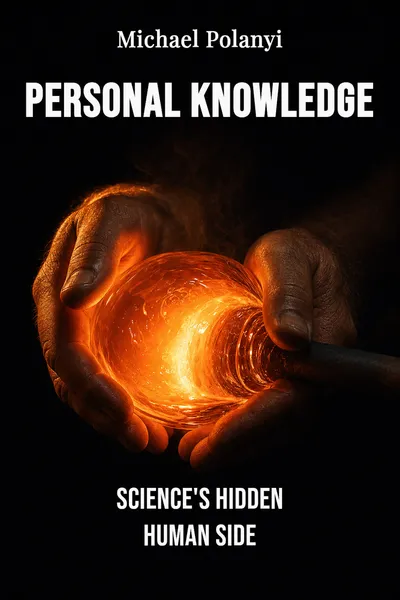
Personal Knowledge
Science's hidden human side
Description
In 1951 and 1952, a former chemist stood before an audience at the University of Aberdeen to deliver the Gifford Lectures, the prestigious Scottish series usually reserved for theologians and philosophers. Michael Polanyi was neither. He had spent decades in laboratories in Berlin and Manchester, publishing on reaction rates and the structure of matter, and had walked away from a productive scientific career to think about what science actually was. The lectures grew, over several more years of reworking, into a dense six-hundred-page book. When it appeared in 1958 under the title Personal Knowledge, it read less like a philosopher's treatise than like a working scientist's confession about how his own field really operates.
The timing made it provocative. The reigning picture of science, sharpened by the logical positivists of the Vienna Circle and popularized far beyond them, held that real knowledge was impersonal: a matter of observation, measurement, and rules of inference that any competent person could follow to the same conclusion. The scientist was supposed to be interchangeable, a neutral recorder standing outside the experiment. Polanyi, who had done the experiments, found this account not just incomplete but false to the experience of discovery. He set out to show that all knowing, including the hardest science, rests on skills, judgments, and commitments that no rulebook contains.
That claim has outlived most of the debates of its era. The phrases Polanyi coined — tacit knowledge, personal knowledge — have travelled into management theory, education, artificial intelligence, and everyday talk about expertise. What is easy to lose, in the traffic of the terms, is the argument underneath them: a careful case that the human element in knowledge is not a flaw to be scrubbed away but the very thing that makes knowledge possible.
The question we’re asking : If science works by impersonal rules, why does it take a person to do it?What we’ll see : Why a working chemist turned on the ideal of detached, rule-bound objectivity, and what he offered in its place.
Table of contents
01 Chapter 1 — From bench to blackboard, a chemist changes lanes
Polanyi came to the philosophy of science the long way round. Born in Budapest in 1891, trained as a physician, he made his name in physical chemistry, working in Germany through the 1920s at the Kaiser Wilhelm Institute alongside some of the century's finest minds. He was, by any measure, a real scientist, not a commentator looking in from outside. That biography matters, because his eventual quarrel with the standard account of science came from the inside, from someone who had felt what it was to chase a hunch that could not yet be justified and to know an experiment was going right before the numbers confirmed it.
When the Nazis took power he left for Manchester, and over the 1930s and 1940s his attention drifted from molecules to the conditions that let science flourish at all. Part of the push was political. He watched the Soviet Union try to bend science to state planning, insisting that research be directed toward social goals and that its findings serve ideology. Polanyi found this monstrous, and not only for the obvious reasons. It rested, he argued, on a misunderstanding of how discovery works — the belief that you could plan and command it from outside, as if the scientist were a technician executing instructions.

02 Chapter 2 — The knowledge we can't quite put into words
The book's most famous idea starts with a small observation: we know more than we can tell. Polanyi's favorite example is a face. We recognize a friend among a thousand others instantly, yet we could not begin to specify the features that let us do it. The recognition is real knowledge, and it is reliable, but it lives below the level of anything we could write down or hand to someone else as a set of instructions. He called this tacit knowledge, and he argued it was not a curiosity at the edges of cognition but the ground floor of all of it.
Consider learning to ride a bicycle. There is a rule that governs balance — roughly, you steer into the direction you are falling, in proportion to your speed. Almost no cyclist knows this rule, and knowing it would not help a beginner stay upright for a second. The skill is acquired by doing, absorbed into the body, and then exercised without any conscious access to what it consists of. The same holds for a doctor reading an X-ray, a wine taster naming a vintage, a pianist's hands. In every case the expert relies on a mass of knowledge they cannot fully articulate.
03 Chapter 3 — How discovery actually happens
If knowing rests on skills we cannot fully state, then discovery cannot be the mechanical procedure the textbooks describe. Polanyi turns to the moment of scientific insight and finds something closer to a passionate search than a calculation. A researcher senses a problem — feels that something is not right, that there is a hidden order waiting to be found — long before they can prove anything. That sense of an approaching solution, guiding the work without being justified by it, is not a lapse from rigor. It is the engine of discovery, and it runs on the scientist's personal judgment about what is promising and what is a dead end.
He leans on the old paradox from Plato's Meno: how can you look for something when you do not yet know what it is? If you already knew, there would be nothing to seek; if you have no idea, you would not recognize the answer if you tripped over it. Polanyi's response is that the seeker has a tacit grasp of the answer's shape — enough to be drawn toward it, not enough to state it. The scientist is held by a hunch about a reality not yet disclosed, and commitment to that hunch is what carries the work through the long stretch where nothing can be demonstrated.
04 Chapter 4 — When the knower stops disappearing from the picture
Behind the particular arguments, Polanyi is aiming at a larger target: the modern conviction that knowledge only counts when the knower vanishes from it. The ideal of pure objectivity asks us to describe the world as if no one were describing it, to trust only what could be verified by anyone and therefore by no one in particular. Polanyi thought this ideal, pursued to its end, was not merely mistaken but corrosive. A culture that believes real knowledge must be impersonal ends up unable to account for its own convictions, and a science that denies its human basis lies about how it actually proceeds.
What he offers instead is not a retreat into relativism, the charge most often thrown at him. The personal in personal knowledge is bound at every point by responsibility to a reality that exists independently and can prove us wrong. The scientist commits with universal intent — claiming not merely that this seems true to them, but that it is true, and that others ought to see it too. Commitment and objectivity, on this view, are not opposites. The commitment is how the knower reaches toward what is objectively there.
05 Conclusion
The chemist who left the laboratory to write about knowledge ended up describing something he had known all along, standing at the bench with a hunch he could not yet prove. Personal Knowledge is, in the end, the book Polanyi's own career had been quietly arguing for: that the person who knows cannot be subtracted from what is known, and that the skills, judgments, and commitments a scientist brings are the substance of inquiry, not noise around it. The tacit dimension he named is now hard to unsee once you have looked for it.
Related books