Payoff
What really drives us
Description
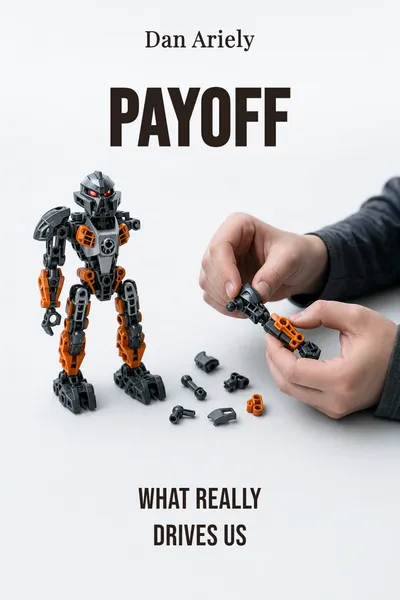
In a lab at Harvard, the behavioral economist Dan Ariely ran an experiment so simple it sounds almost cruel. Participants were paid to assemble small Lego robots called Bionicles. For each one they built, the pay dropped a little. They could stop whenever they liked. Half the group had their finished robots set neatly on a shelf. The other half watched a researcher take each robot apart, piece by piece, right in front of them — so they could rebuild the very same one again. Same task, same money, same little plastic bricks. Only the fate of the work was different.
The people who watched their creations dismantled built far fewer robots before quitting. Nothing about the reward had changed. What changed was whether the work meant anything at all, even for the twenty minutes it survived on a table. Ariely called this second group the "Sisyphic" condition, after the Greek figure condemned to roll a boulder uphill forever. The experiment became one of the small, sharp keys in his 2016 book Payoff, where he argues that we understand our own motivation far worse than we think — and that the standard story, the one built on money and incentives, misses most of what actually moves us.
Ariely is best known for showing how predictably irrational we are with money, honesty and choice. Here he turns the same lens on effort: what makes us throw ourselves into a task, and what quietly kills the desire to try. The answers he finds are stranger, and more human, than the ledgers of economics allow.
The question we’re asking : If money isn't what really drives us at work, then what does — and why do we keep getting the answer wrong?What we’ll see : How a few deceptively simple experiments dismantle the idea that we work for pay, and rebuild motivation around meaning, effort and the stories we tell about our lives.
Table of contents
01 Chapter 1 — The Lego experiment and the meaning of futility
The Bionicle study is Ariely's opening argument, and it lands hard because it strips motivation down to almost nothing. In the meaningful condition, workers built an average of roughly eleven robots. In the Sisyphic condition, where each creation was torn apart before their eyes, they averaged about seven. Same declining pay in both. The only variable was whether the work vanished the moment it was done, and that alone cost a third of their effort.
What interests Ariely is how little it takes to drain meaning. Nobody needed the robots. They were toys, headed for a bin either way. The shelf group knew this perfectly well. But watching your own hands' work undone in real time is a different experience from imagining it discarded later — it turns effort into something visibly pointless, and people respond by caring less.

02 Chapter 2 — Why a bonus can make us worse at our jobs
If meaning is fuel, money is a far trickier substance than most companies assume. Ariely spent years studying incentives, and one of his most uncomfortable findings is that large bonuses can actually degrade performance on the tasks that matter most. He describes a set of experiments run in rural India, where participants were offered rewards for games of memory, concentration and creativity. Some could earn a small bonus, some a medium one, and some an amount equal to several months of ordinary spending.
The expectation, from any standard economic view, is that bigger stakes should sharpen effort. Instead, the people playing for the largest rewards performed the worst. The pressure of the enormous payoff made them tense, distracted, prone to choke. High stakes worked fine for purely mechanical tasks, but for anything requiring thought or flair, the size of the carrot became a weight. Ariely's point is not that money doesn't matter — it obviously does — but that it operates on our psychology in ways that don't map cleanly onto more is better.
03 Chapter 3 — The labor of love, and why we overvalue what we build
There is a flip side to the futility of the Sisyphic condition: the strange pride we take in things we have made ourselves, even badly. Ariely calls it the IKEA effect, a phenomenon documented with his colleagues Michael Norton and Daniel Mochon. When people assemble their own furniture — a plain IKEA storage box in the studies — they value it more highly than an identical piece put together by an expert. Their own wobbly, hard-won creation feels worth more, purely because their sweat is in it.
The effect isn't limited to flat-pack shelving. It shows up with origami, with Lego, with almost anything that costs effort. People will pay more for their own clumsy paper frog than for a stranger's neat one, and they assume onlookers will admire it just as much — which onlookers, of course, do not. The work we invest ourselves in becomes precious to us in a way that has little to do with its objective quality. Effort itself creates attachment.
04 Chapter 4 — Death, legacy, and the stories we work for
The reason Ariely wrote Payoff is more personal than most of his books admit. As a teenager he was severely burned across much of his body and spent years in painful treatment, an experience that left him thinking hard about suffering, meaning and what makes a life feel worthwhile. Motivation, for him, is not finally a workplace question. It is a question about how we bear our own existence, and the experiments are windows onto something much larger than productivity.
What he arrives at is that the deepest driver of human effort is the need for meaning that outlasts us — the desire to matter beyond the immediate task, beyond even our own lifetimes. He points to how people behave around death: the elaborate care we take with funerals, the money spent on gravestones we will never see, the wish to be remembered well. None of this makes sense to a purely self-interested calculator. It makes complete sense to a creature that works, quietly, for a story it hopes will survive it.
05 Conclusion
The robots on the shelf were never going anywhere. Someone would clear them away by the end of the week, exactly as they cleared away the ones dismantled on the spot. And yet the workers who got to see their creations sit there, briefly, gave more of themselves than the ones who watched their work undone. That gap — between the same pay, the same plastic, the same futility deferred by a matter of hours — is the whole of Ariely's argument in miniature. We work for the meaning, however small, and we notice instantly when it is taken.
Related books